(401) 479-1472

Lisbon, CT · Route 12 at I-395

Underground utilities in Lisbon: the commercial pad playbook.

Lisbon is a well-and-septic town almost everywhere — except the Route 12 corridor, where Lisbon Landing anchors the region’s largest open-air retail center and the only stretch of town where public water exists and a sewer connection is even a conversation. If you’re building a pad on that corridor, the services under the slab follow a sequence. This is ours.

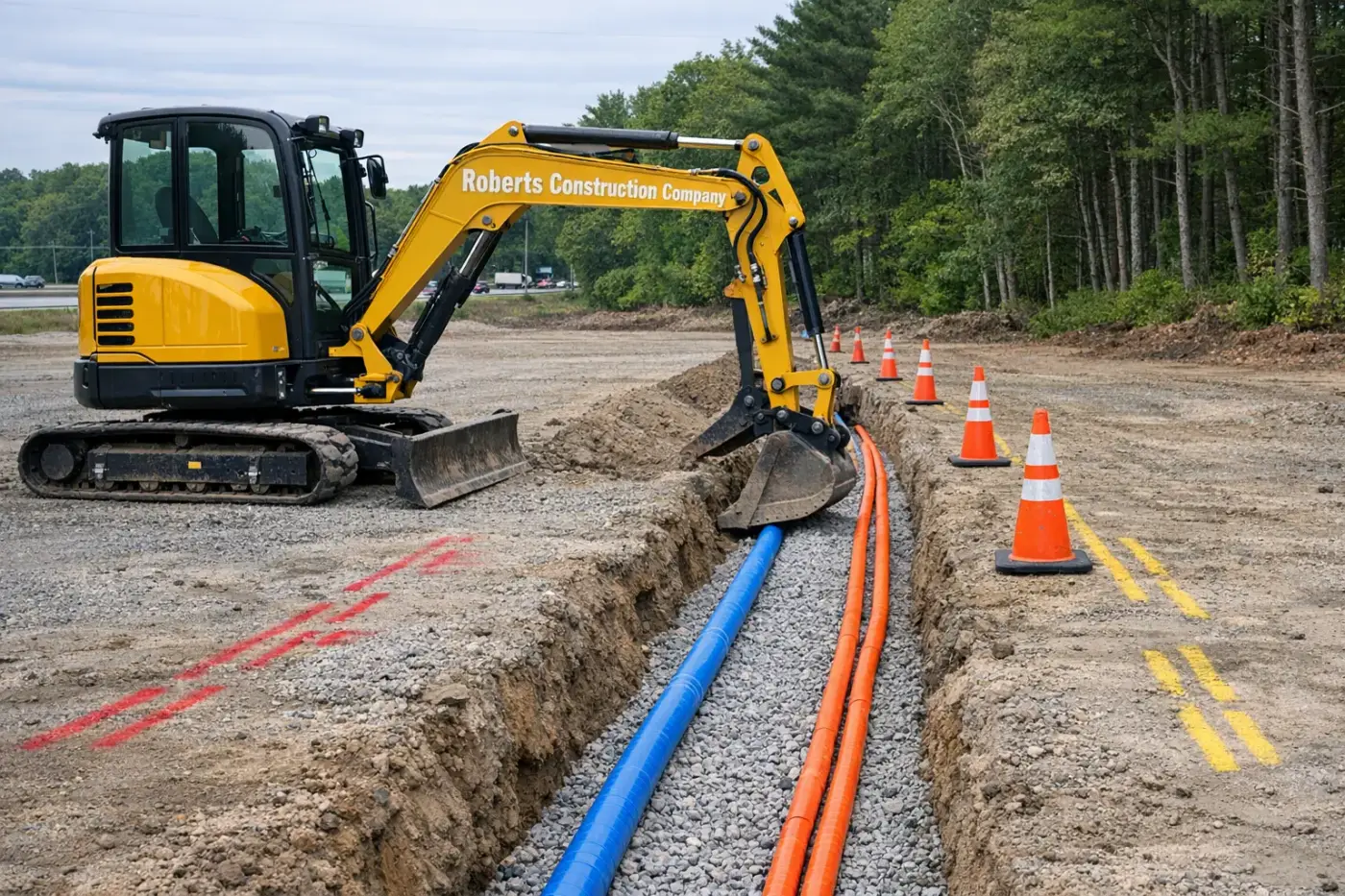
Underground utilities in Lisbon, CT — Roberts Construction Company excavator over an open water line and conduit trench
Underground utility trenching in Lisbon, CT — every dig starts with 811 marks.

Phase 01 · Locate & layout

Mark what’s already down there.

Every dig starts with CBYD — 811 — so the public utilities mark their lines. On a corridor pad that’s the floor, not the ceiling: retail sites built in phases since the early 2000s carry unrecorded laterals, dead conduit, and irrigation runs no as-built ever captured. We add private locates, stake the trench routes against the site plan, and dig test pits along each run — because Lisbon’s glacial till hides ledge that can move a trench line two days before it moves your budget.

Phase 02 · Site power

Primary conduit and the transformer pad.

Power goes in early so the rest of the site can build around an energized service. We trench and bed the primary electrical conduit run to the serving utility’s construction spec — depth, sand bedding, warning tape, sweeps sized so cable actually pulls — form and set the transformer pad, and rough the secondary runs to the building line. The utility inspects before we backfill. Nothing gets buried that hasn’t been photographed and measured.

Phase 03 · Water & fire service

Tapping the Jewett City Water corridor main.

The corridor’s public water comes from the Jewett City Water Company — a private utility that’s been at it since 1894. Commercial pads usually split into a domestic service and a fire service, and both are water line installs we coordinate with the company’s tap requirements: main location confirmed in the field, cover held below frost depth, thrust restraint at fittings, pressure test and disinfection before the meter is set. Off the corridor there is no main — it’s a drilled well and a service line, and we build those too.

Phase 04 · Sanitary — the Lisbon fork

Sewer if you can reach it. Engineered septic if you can’t.

Fork A · Public sewer

Only a small section of Lisbon is sewered, but a 2019 inter-municipal framework reserves treatment capacity in the Norwich Public Utilities system for Lisbon, and an NPU main runs along Route 12. If your parcel can reach it, we build the sewer lateral to spec — bedding, grade, cleanouts, tie-in under permit.

Fork B · Engineered septic

No reach, no connection — the pad runs on an engineered on-site system permitted through NDDH, the Northeast District Department of Health. Commercial flows change the design math, and large enough flows move review up to the state level. We flag that in week one, not at permit time.

Settling this fork is the first phone call we make on any corridor pad — it drives the site plan, the budget, and sometimes the deal itself.

Phase 05 · Comms duct bank

Fiber, telecom, and the spare conduit you’ll thank us for.

Retail and commercial tenants live on connectivity, so the comms trench gets a multi-way duct bank — conduits on spacers, handholes at the bends, sweeps a fiber crew can actually pull through, and required separation from the power runs. We always argue for at least one spare way in the bank. On a corridor where tenants turn over and providers change, an empty conduit is the cheapest trench you’ll never have to dig twice.

Phase 06 · Backfill, drainage & as-builts

Close the trenches like the pavement is coming tomorrow.

Every trench gets processed bedding, warning tape at the right elevation, and compacted lifts — because on a commercial pad, every trench eventually lives under pavement, and a lazy backfill shows up as a dip in the drive lane two winters later. We tie the utility work into the pad’s stormwater and drainage plan, then hand over measured as-builts — swing ties, depths, photos — so the next contractor on this site isn’t guessing the way we had to in Phase 01.

Who’s who on a Lisbon utility job.

CBYD (811) before any dig. Jewett City Water Company for corridor water taps. Norwich Public Utilities for any sewer conversation. NDDH for on-site septic. Lisbon P&Z and the Inland Wetlands & Watercourses Commission for anything within 100 feet of a regulated wetland — which, near the Quinebaug side of the corridor, is worth checking before you assume. CT DOT for work in the state road right-of-way.

General guidance — confirm current requirements with CBYD, the Jewett City Water Company, NPU, NDDH, and the Town of Lisbon for your specific parcel and scope.

The residential coda

Not building a pad? Most of Lisbon isn’t.

Off Route 12, the utility work is residential and it’s steady: well-to-house water lines re-trenched below frost, replacement septic laterals, buried electric out to a detached garage or a standby generator, and the drainage that keeps a Newent or Bundy Hill basement dry. Same locate discipline, same compaction standard, one-day trenches instead of one-month packages.

If the utility trench is part of a bigger dig — a foundation, an addition, a new driveway — start from our Lisbon excavation page. And if there’s an old slab or structure in the way first, that’s our Lisbon demolition side of the shop.

Frequently asked — Lisbon utilities

Five questions that come up before a Lisbon utility trench opens.

Is there public water along Route 12 in Lisbon?
Yes — the Jewett City Water Company, a private water utility operating since 1894, is the water utility of record for Lisbon, and its service is concentrated on the Route 12 / I-395 corridor around Lisbon Landing. Off the corridor, Lisbon is private wells. We confirm main location and tap requirements with the company before we price a water service.
Can a commercial pad in Lisbon connect to public sewer?
Sometimes. Only a small section of Lisbon is sewered, but a 2019 inter-municipal framework reserves treatment capacity in the Norwich Public Utilities system for Lisbon and four neighboring towns, and an NPU main runs along the Route 12 corridor. Whether your parcel can reach it is a parcel-by-parcel question we settle before design money gets spent. If the answer is no, the pad runs on an engineered septic system permitted through NDDH.
Who marks existing utilities before you trench?
CBYD — Call Before You Dig, 811 — marks the public utilities' lines, and that call happens on every job, no exceptions. On corridor pads we also run private locates, because retail sites built out in phases carry unrecorded laterals, abandoned conduit, and irrigation runs that never made it onto any as-built. We sweep before we cut.
How deep do utilities get buried in Lisbon soil?
Water services go below frost depth; power and comms conduit go to the serving utility's spec, with bedding, warning tape, and separation between systems. The complication in Lisbon is glacial till with intermittent ledge — a trench that runs clean for two hundred feet can hit rock in the last twenty. We test-pit the route first so depth surprises show up in the estimate, not the invoice.
Do you handle residential utility work in Lisbon too?
Yes. Off the corridor, the steady work is well-to-house water lines, replacement septic laterals, buried electric to detached garages and generators, and drainage that keeps all of it dry. Same crew, same locate discipline, smaller trench.
Phase 00 · The phone call

Corridor pad or a well line to the house — the playbook starts the same way. Tell us what’s going in the ground.

More on how we run this work statewide: underground utilities · utility trenching · water lines