Underground Utilities Contractor for Eastern CT & Western RI
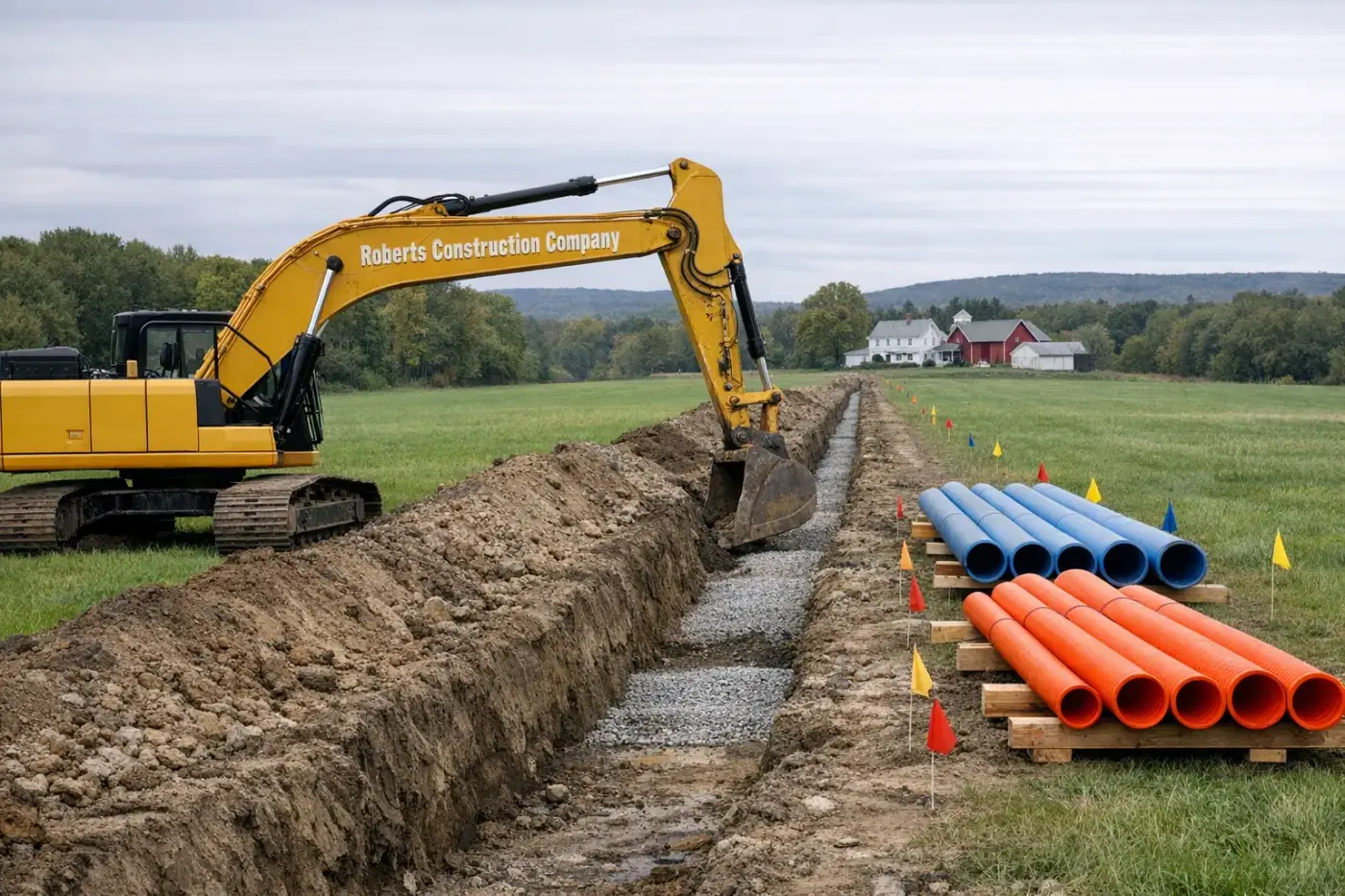
Water, sewer, electric, communications, storm — every service a property needs, installed below grade to the owning utility’s spec. CBYD in Connecticut, Dig Safe in Rhode Island, on every single job.
Every buried service, one contractor
Underground utility work is where excavation meets code. Each service has its own depth, bedding, separation, and inspection requirements — and its own utility looking over your shoulder. We install all of them, and we coordinate the people who own them.
- Water service linesNew services and replacements, meter pit to foundation, 48-inch bury, pressure-tested and inspected before backfill.
- Sewer lateralsGravity laterals on continuous pitch, cleanouts at the line, town or WPCA inspection coordinated at tie-in.
- Electric & generator conduitPrimary and secondary conduit runs, sweeps and pull boxes to utility spec, tracer wire, inspection-ready.
- Comms, fiber & joint trenchDuct bank and joint-trench design when multiple services run one alignment — one dig, every service placed to code.
- Storm drainageRoof leaders, catch basins, culverts, and underground detention on commercial pads — water managed below grade.
- Septic systemsWhere no sewer main exists — and across our rural towns it usually doesn't — the OWTS is the underground utility.
Two states. Two rulebooks. One crew.
Connecticut side
CBYD — Call Before You Dig
Ticket placed through 811 at least two full business days before excavation. Municipal utilities vary town to town — Norwich Public Utilities owns all four services in Norwich, Jewett City runs its own water and electric, Danielson and Putnam have their own water and sewer service areas, and the rural towns have none at all.
Wells and septic run through the regional health districts, and street openings need the town’s permit and patch spec. We work these systems every week.
Rhode Island side
Dig Safe
Rhode Island excavation runs through the Dig Safe one-call system, also via 811. Most of our RI towns — Foster, Glocester, West Greenwich, Scituate — have no public water or sewer, so underground utilities means private well lines, OWTS laterals permitted through RIDEM, and long power and comms runs to houses set deep off the road.
Where public water exists — Kent County Water Authority territory in eastern Coventry — we install services to KCWA spec and coordinate their tie-in and inspection.
General guidance — confirm current requirements with CBYD or Dig Safe (811), the owning utility, and your local building official for your specific parcel.
Underground utilities, answered
- What counts as underground utilities?
- Everything that serves a building from below grade: water service lines, sewer or septic laterals, storm drainage, electrical primary and secondary conduit, natural gas coordination, and communications duct (phone, cable, fiber). We install the trench, bedding, conduit or pipe, tracer wire, warning tape, and backfill to the owning utility's specification, then coordinate their inspection and tie-in.
- Do you handle the 811 marking process?
- Yes, on every job. In Connecticut that's Call Before You Dig (CBYD); in Rhode Island it's Dig Safe. Both run through 811. We place the ticket, wait out the legal marking window, and verify the marks against the plan before a bucket touches the ground. On congested streets we add private utility locating when the public marks don't tell the whole story.
- How deep do underground utilities get buried?
- Depth is set by code and by the owning utility. As a working rule in our region: water services at 48 inches to clear frost, sewer laterals at 48 inches with continuous pitch, electric primary at 24-30 inches in conduit, gas at 18-24 inches with marker tape, and communications at 18-24 inches. Separations matter as much as depths — water and sewer need 10 feet horizontal where achievable, 18 inches vertical at crossings.
- Can water, electric, and comms share one trench?
- Sometimes. Electric and communications can usually share a trench with 12 inches of vertical separation. Water and sewer must stay separate. Gas usually gets its own trench. A shared joint trench saves real money on long rural runs — we design it with each utility's blessing so their inspectors sign off without rework.
- Do you work in both Connecticut and Rhode Island?
- Yes. Our shop sits in Sterling, CT, minutes from the state line, and roughly a third of our utility work is in Rhode Island. The rules differ — CBYD vs. Dig Safe, CT DPH vs. RIDEM oversight, different health districts for wells and septic — and we run both permit systems weekly.
- Who do you coordinate with on a typical connection?
- The owning utility (municipal water and sewer departments, Norwich Public Utilities, Jewett City utilities, Kent County Water Authority, Eversource, and the comms carriers), the local building official for the permit, and the health district when wells or septic are in play. We schedule the utility's inspection so the trench closes once, not twice.
Underground utilities, town by town
Local underground utilities pages for all 15 eastern Connecticut and western Rhode Island towns we serve.
- Sterling, CTHome town · granite ledge, wells & septic
- Plainfield, CTFour villages · river-valley site work
- Norwich, CTNPU water & sewer · six neighborhoods
- Willimantic, CTThread City mill-era foundations
- Killingly, CTDanielson borough · eight villages
- Putnam, CTQuinebaug-side downtown · antiques district
- Brooklyn, CTRural agricultural lots · farm work
- Canterbury, CTRoute 14 + 169 · wetland-heavy
- Griswold, CTJewett City borough · Pachaug
- Lisbon, CTThree highways · three job profiles
- Coventry, RISuburban east · rural west of 102
- Foster, RIRural acreage · RIDEM-permitted
- Glocester, RIChepachet · Harmony · West Glocester
- Scituate, RIProvidence Water watershed
- West Greenwich, RII-95 corridor · large-acreage
Ready to Start Your Project?
Contact us today for a free consultation and estimate. Our team is ready to help with your construction needs.