(401) 479-1472

Document

Demo spec — Lisbon

Prepared by

Roberts Construction

Coverage

Lisbon, CT 06351

Contact

(401) 479-1472

Demolition in Lisbon, CT — slabs, foundations, and small structures, written up like a spec sheet.

Most Lisbon demolition isn’t a wrecking ball — it’s an old barn ahead of a new garage, a cracked slab ahead of an addition, a cellar hole ahead of a rebuild. Removal ahead of reuse. So we write the work the way we run it: scope, equipment, haul-off, backfill spec. Three sheets below cover almost every job in town.

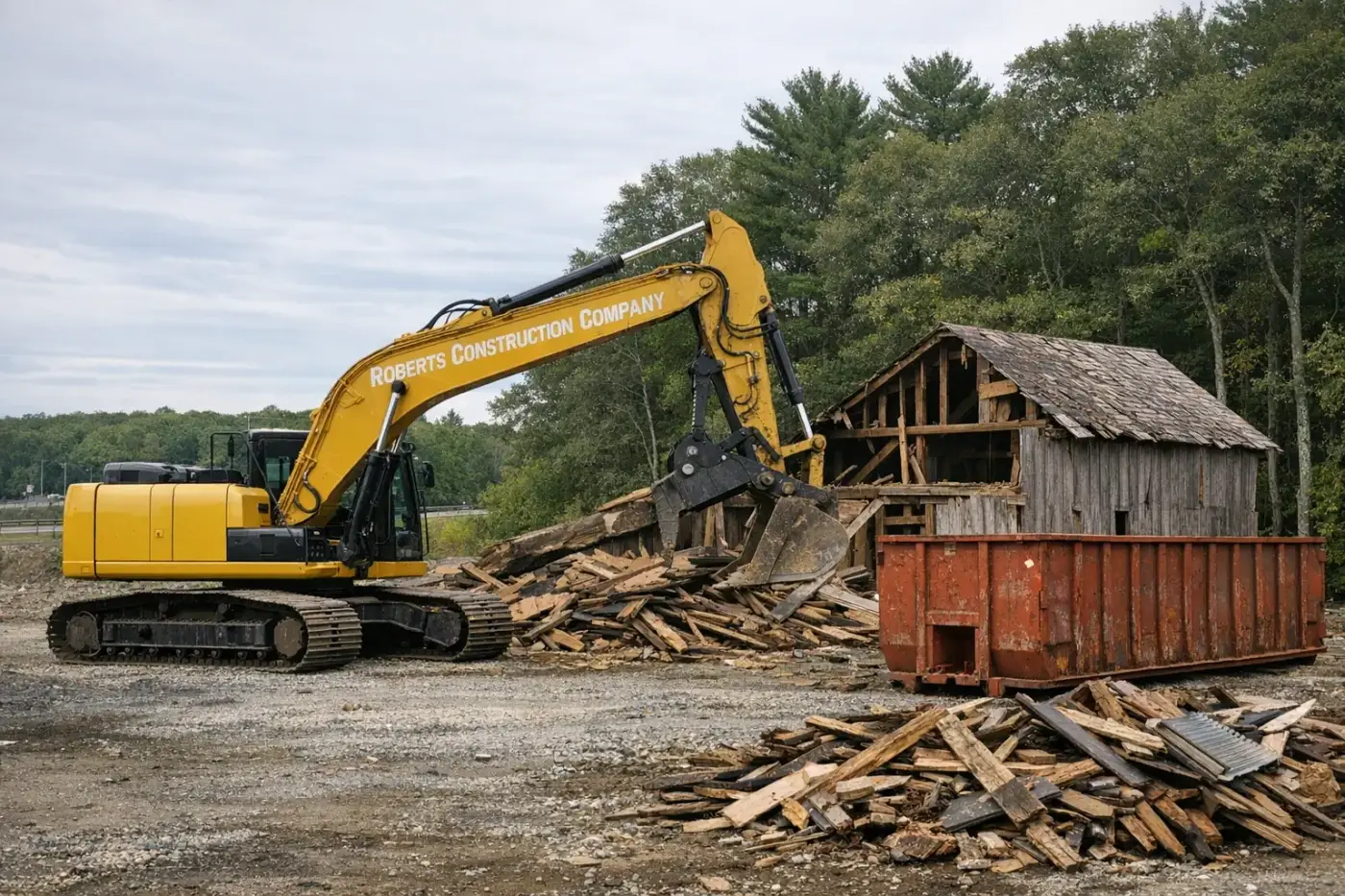
Demolition contractor in Lisbon, CT — Roberts Construction Company excavator taking down a barn
Structure demolition in Lisbon, CT — tested, disconnected, then taken down.
SPEC-01

Slab & pad removal

Garage slabs, barn floors, old pool decks, and commercial pads that outlived their building. Common on Route 138 lots where a new garage or addition is going in the footprint.

Scope
Saw-cut the perimeter where anything adjacent stays; break, load, and haul the slab; pull the base gravel if it's contaminated with debris; grub any turned-down footings at the edge.
Equipment
Excavator with hydraulic breaker and thumb, skid steer for loading, tri-axle for haul-off. Tight-access lots get the mini machine and more trips.
Haul-off
Clean concrete separated for crushing and recycling; rebar and mesh clipped out for scrap; weight tickets furnished.
Backfill spec
Lawn-grade or build-ready, priced as options. Build-ready means processed gravel in compacted lifts to subgrade, ready for a new slab.
SPEC-02

Foundation removal

Full foundation take-outs after a fire, a teardown-rebuild, or a long-collapsed structure. Lisbon's older stock includes fieldstone and rubble walls that come out differently than poured concrete.

Scope
Remove walls and footings to full depth — not chased two feet down and buried, which is the shortcut that haunts future owners. Strip out any floor slab, bulkhead, and chimney base. Cellar hole backfilled to spec.
Equipment
Excavator with breaker for poured walls; fieldstone comes out with the thumb and gets sorted — good wall stone has value in this town and we say so.
Haul-off
Concrete crushed or hauled to recycling; stone reused on site or stockpiled at the owner's call; no foundation rubble left in the hole.
Backfill spec
Compacted structural lifts if a new foundation is coming; clean fill graded to drain if the hole is being retired. Either way, no future sinkhole where the cellar was.
SPEC-03

Small structures

Barns, detached garages, sheds, mobile homes, and single-family teardowns — the working end of demolition in a town of farmsteads along Routes 138 and 169.

Scope
Pre-demo survey and abatement closed out first; utilities cut and documented; structure brought down in a controlled sequence, worked away from anything that stays — the house, the well casing, the stone walls at the byway frontage.
Equipment
Excavator with thumb and grapple, water on hand for dust, ground protection when the route to the structure crosses lawn or paving that survives the job.
Haul-off
Sorted streams: metals to scrap, clean wood and mixed C&D to licensed volume-reduction facilities, concrete to crushing. Tickets in the closeout packet.
Backfill spec
Footprint graded to match the reuse plan — pasture, lawn, driveway, or the pad for what's coming next.

Before any sheet gets executed

The paperwork comes down before the building does.

  1. 1.

    Asbestos and lead survey. Connecticut DPH rules govern asbestos identification and abatement, and DEEP governs where the material can legally go. Transite barn panels, pipe wrap, and old floor tile are routine finds in Lisbon’s building stock — abatement by licensed contractors closes out before demolition starts.

  2. 2.

    Utility disconnects, in order. CBYD (811) marks what’s live. Electric is cut at the source and documented. On the Route 12 corridor, water means coordinating the kill with the Jewett City Water Company; everywhere else it means protecting the well casing. The septic tank gets pumped and decommissioned under NDDH — never buried full and forgotten.

  3. 3.

    Permit through the town. The Lisbon building official issues the demolition permit with the disconnect sign-offs attached. Anything within 100 feet of a regulated wetland adds an Inland Wetlands review; byway-frontage parcels on Route 169 get their stone walls flagged and protected in the work plan.

General guidance — confirm current requirements with CT DPH, CT DEEP, NDDH, and the Town of Lisbon building official for your specific structure and site.

After the last load leaves

A demo site is just a build site in the right order.

Because removal-ahead-of-reuse is the whole point, the handoff matters. If trees and brush are part of the footprint, the demo rolls into land clearing and stump removal in the same mobilization. If the cellar hole hit the same glacial till and ledge the rest of Lisbon sits on, rock removal happens while the machine is already there. And when the plan calls for a new structure, we carry straight into site preparation and grading — one contractor, one compaction standard, no finger-pointing between the crew that closed the hole and the crew that builds on it.

New services going into the cleared footprint? That’s our Lisbon underground utilities playbook. Foundations, septic, and the rest of the dig live on our Lisbon excavation page.

Frequently asked — Lisbon demolition

Five questions Lisbon owners ask before a structure comes down.

Do I need an asbestos inspection before demolishing in Lisbon?
Assume yes for any structure with real age on it. Connecticut DPH rules require asbestos to be identified and abated by licensed contractors before demolition, and older Lisbon farmhouses, barns with transite panels, and mid-century slabs with 9-inch floor tile are exactly where it hides. We don't put a machine on a building until the survey and any abatement are closed out.
Who issues the demolition permit in Lisbon?
The Lisbon building official issues the demolition permit, and Connecticut separately licenses demolition contractors at the state level. Utility disconnect sign-offs come first — power and any gas cut at the source, water and septic handled — and the permit paperwork documents each one before the structure comes down.
What happens to the septic system when the building goes?
It gets decommissioned, not ignored. Since nearly all of Lisbon runs on NDDH-permitted septic, most demolitions include pumping the tank, then crushing and backfilling it or pulling it out entirely. If the site is being rebuilt, we coordinate with NDDH on whether the existing system can serve the new structure or whether the demo is the start of a new system design.
Where does the demolition debris actually go?
Sorted and hauled, not landfilled as one pile. Clean concrete gets crushed for reuse — sometimes right on site as compactable fill product. Steel and metals go to scrap. Mixed C&D leaves in our trucks to licensed volume-reduction and recycling facilities with weight tickets to prove it. The town transfer station is for resident loads, not structural demo debris.
What does the site look like when you leave?
That depends on which backfill spec you pick, and we price both. A lawn-grade close means clean fill, topsoil, and seed. A build-ready close means engineered structural fill placed in compacted lifts and documented, so the next foundation or slab goes down without re-excavating our work. Deciding before demo day is cheaper than deciding after.

Revision 0 · Issued for pricing

Send us the structure and the reuse plan. We’ll send back the sheet — scoped, sequenced, and priced.

How we run demolition everywhere we work: demolition services