
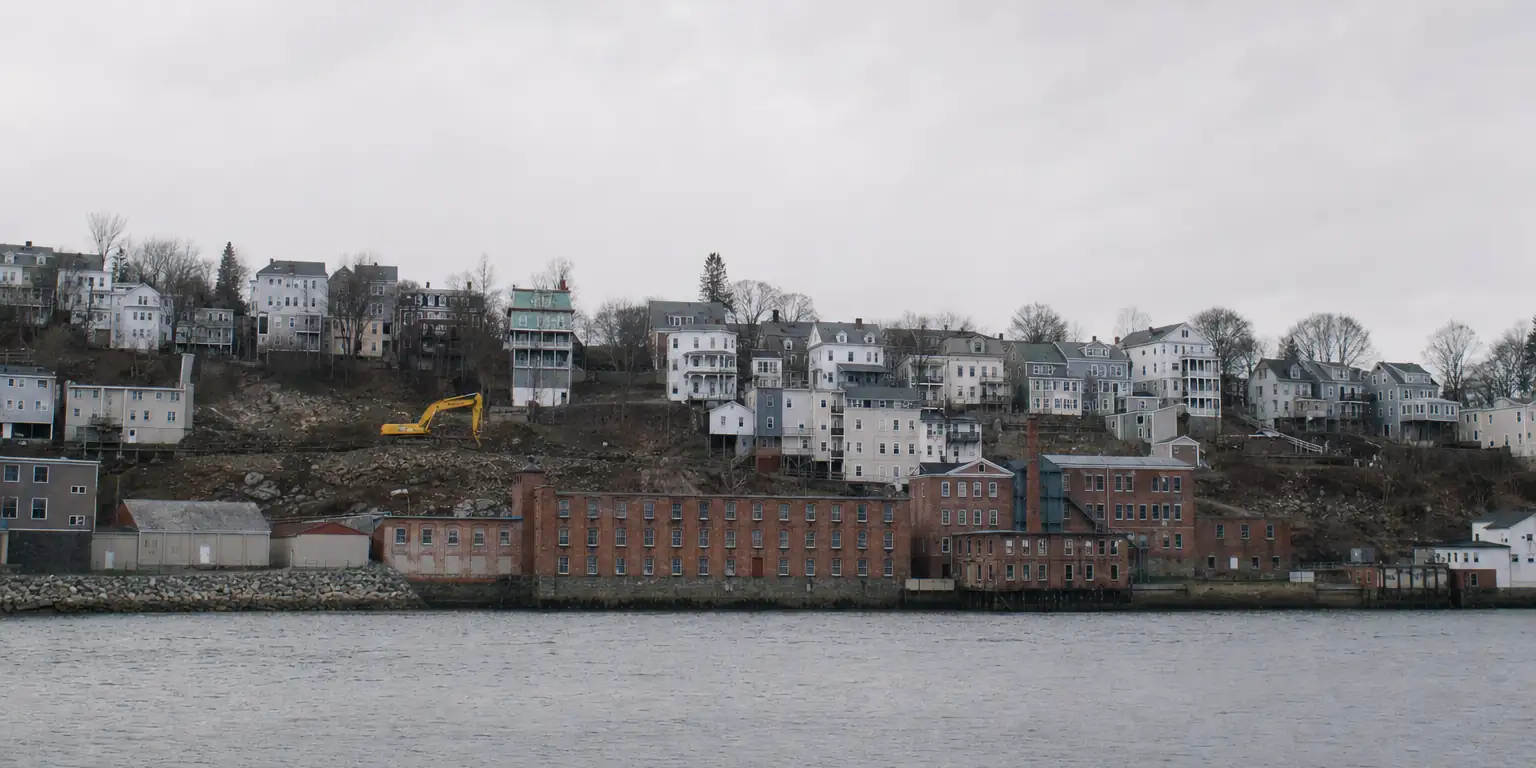
Register of works · demolition · Norwich, Connecticut
The Norwich demolition register.
A mill city on three rivers generates its own particular demolition work: worker housing that has reached the end, flood-zone structures below the hills, buildings under historic review, and stone foundations that outlived what stood on them. Five recurring entries, recorded the way we actually run them.
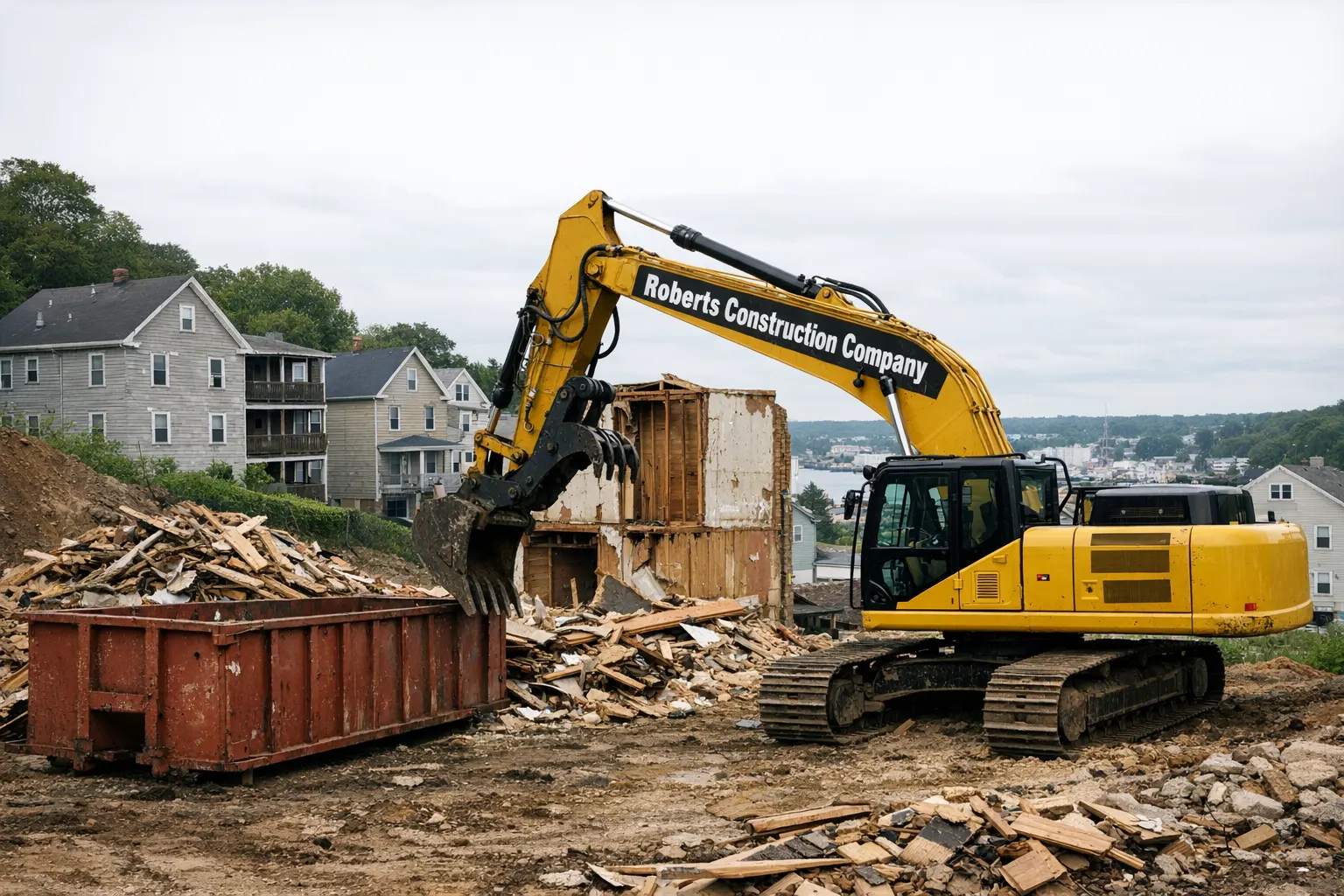
Entries on file.
No. / scenario / where filed
01
Mill-era house replacement
Filed from: Taftville · Greeneville · YanticTrigger — A 19th-century worker house past the point where renovation math works — sills gone, frame racked, foundation failing.
Norwich built thousands of houses fast in the mill decades, and some of them are simply done. This is the register's most common entry: take the structure down tight to the lot lines on a narrow village street, protect the neighboring house that may stand ten feet away, and leave a hole that's ready for the next foundation. The demo is the easy half; the value is in what the lot looks like after — which is why these jobs roll straight into site preparation and grading for the rebuild.
02
Flood-zone teardown
Filed from: Chelsea · the harbor edgeTrigger — A structure in the FEMA-mapped floodplain where the Yantic and Shetucket meet — flood-damaged, or being replaced with a compliant building.
Below the hills, Norwich is a river town, and the FEMA maps around the harbor decide what can be rebuilt and at what elevation. Substantial-damage and substantial-improvement rules can make a teardown the rational move: demolish, then rebuild to base flood elevation plus freeboard under the city's flood ordinance. We pull the FIRM before quoting, sequence the demo so the site drains rather than ponds, and hand the rebuild team a pad that the elevation certificate can live with.
03
Historic-district demolition
Filed from: Norwichtown · Little PlainTrigger — A structure — or part of one — inside one of Norwich's two local historic districts, where the Historic District Commission reviews demolition before a permit issues.
Norwich designated the Norwichtown Historic District in 1967 and Little Plain in 1969, and inside those boundaries demolition of all or part of a structure goes through the Historic District Commission first. These entries run slower by design: the review exists to weigh alternatives before a building is gone for good. Our part is honest scoping — often these end up as partial demolitions, a failed ell or a collapsing barn taken down while the primary structure stays — and clean execution around buildings that are older than the republic.
04
Rubble-stone foundation removal
Filed from: All six neighborhoodsTrigger — An abandoned or failed dry-laid stone foundation — under a house being replaced, or orphaned on a lot whose building is long gone.
The signature Norwich entry. Mill-era housing sits on rubble-stone foundations, and when one fails, the stone has to come out before anything modern goes in. That means excavating around the perimeter, pulling stone that was hand-set a century and a half ago, separating soil from rock, and dealing with whatever the dig finds — old cisterns, buried debris, and more than occasionally ledge, which shifts the job into rock removal. Backfill goes in compacted lifts, because the point isn't a filled hole, it's a buildable one.
05
Garages, barns & partial demos
Filed from: CitywideTrigger — A detached garage, a leaning barn, a fire-damaged wing, or an overgrown lot with structures swallowed by brush.
The register's small-format entries: a collapsing garage behind a Greeneville two-family, a barn on a Norwichtown back lot, a fire-damaged section removed so the rest of the building can be saved. Small doesn't mean casual — the same disconnects, permit, and disposal rules apply, just at a scale where a compact machine and one clean day of work does it. When the structure is buried in growth, clearing and stump removal ride the same mobilization so the lot comes back usable, not just building-free.
Before any entry is executed
Six clearances, in order, before the machine works.
Demolition in Norwich is mostly sequencing. The excavator is the short part; the clearances below are what keep a teardown legal, safe, and off the neighbors’ list of grievances.
- 1
Asbestos survey & abatement
Connecticut requires a licensed asbestos consultant's inspection before demolition of residential buildings with five or more units and of commercial, industrial, institutional, and public buildings. Abatement beyond the small-quantity thresholds takes a licensed abatement contractor, with notification to CT DPH above the notification thresholds. Mill-era buildings hit often enough that we treat the survey as step one, not paperwork.
- 2
Lead-paint reality
Nearly all of Norwich's teardown-age housing predates 1978, so lead-safe handling and disposal assumptions apply to the debris stream. It changes how material is wetted, loaded, and manifested more than whether the building can come down.
- 3
NPU disconnects — all four at once
Water, sewer, gas, and electric all belong to Norwich Public Utilities, so disconnection is one coordinated effort: services killed, meters removed, lines capped or plugged at the appropriate point. Customer service at (860) 887-2555 routes it to a project coordinator; we run this on the job's schedule.
- 4
Demolition permit & 72-hour notice
The permit comes from the Norwich building department, with documentation of insurance required, and the department expects utility disconnects verified before work. City practice also calls for notice ahead of starting — on city work Norwich has specified 72 hours — and a historic-district property adds Historic District Commission review before the permit can issue.
- 5
CBYD, even for a teardown
The marks matter as much on a demolition as on a trench — grubbing a foundation or ripping a slab finds buried services the hard way otherwise. CBYD (811) before the machine tracks onto the lot, every time.
- 6
Debris plan
Sorted streams beat mixed loads. Clean concrete, brick, and stone get separated for crushing or reuse; metals go to scrap; the C&D balance goes out in roll-offs to a permitted facility. The city's Rogers Road Transfer Station (73 Rogers Road) accepts small renovation-scale C&D loads — useful for punch-list debris, not for a whole house.
General guidance — confirm current requirements with the City of Norwich building department, the Historic District Commission where applicable, CT DPH and CT DEEP on asbestos and disposal, and NPU on disconnects for your specific structure.
Frequently asked — Norwich demolition
Five questions before a Norwich building comes down.
- Do I need Historic District Commission approval to demolish in Norwich?
- Only if the property sits in one of the two local historic districts — Norwichtown (designated 1967) or Little Plain (1969) — where demolition of all or part of a structure goes through the Historic District Commission before the permit can issue. National Register districts like Taftville/Ponemah and Greeneville are honorary for private work and don't add a local demo review by themselves. We check the district maps before we quote, not after.
- Who disconnects the utilities before a Norwich demolition?
- Norwich Public Utilities — and because NPU owns water, sewer, gas, and electric citywide, it's one coordination instead of four. Services get disconnected, meters pulled, and lines capped or plugged before demolition starts, and the city building department requires that to be squared away before the machine works. We schedule the NPU disconnects as part of the job, not as your homework.
- Is an asbestos inspection required before tearing down a house?
- Connecticut requires a pre-demolition asbestos inspection by a licensed consultant for residential buildings of five or more units and for commercial, industrial, institutional, and public buildings. Single-family houses aren't automatically in that rule — but disposal facilities want to know what's in the load, abatement over the small-quantity thresholds needs a licensed contractor, and mill-era Norwich housing has a real hit rate on pipe wrap, siding, and floor tile. We advise a survey on essentially every pre-1980 teardown.
- Where does the demolition debris go?
- Small renovation-scale loads — sheetrock, shingles, lumber, brick, concrete — are accepted at the city's Rogers Road Transfer Station at 73 Rogers Road. A full house teardown is a different order of volume: we load roll-offs on site and haul to a permitted C&D facility, with clean concrete and stone separated out for recycling or reuse as fill where the spec allows. Sorting on site is what keeps disposal from becoming the biggest line on the invoice.
- Can you remove just an old rubble-stone foundation?
- Yes — foundation-only removal is a regular entry in the Norwich register. Mill-village lots sometimes carry an abandoned stone foundation from a house or outbuilding that's long gone. We dig out the stone, pull any slab and footing debris, crush or haul the material, and backfill in compacted lifts so the ground is buildable instead of just filled. If there's ledge tangled in the stone, we handle that in the same mobilization.
End of register
Most Norwich teardowns are the first line of a bigger job. The next lines are usually excavation and new underground utilities — and we price them together. The full demolition scope lives on our demolition services page.
Also in NorwichExcavation Underground utilities