- Is my Plainfield street on public water or a private well?
- Depends which street. Connecticut Water's Plainfield system runs mains through the village centers, but coverage thins out fast once you leave them — plenty of roads a half mile from a village core are on drilled wells. We confirm what's actually in front of the house with CT Water and a CBYD markout before we design anything, because a water service tap and a 300-foot well line are two different jobs.
- Who handles sewer connections in Plainfield?
- The Plainfield Water Pollution Control Authority (860-564-3335) owns the collection system — roughly 100 miles of gravity pipe, 5 miles of force main, and 13 pump stations feeding two treatment plants. The WPCA signs off on the connection; we dig the lateral, set the pipe at grade, and handle the street restoration. If your street isn't sewered, the answer is a septic system under NDDH rules instead.
- What is the water main project on Route 12 in Wauregan?
- Connecticut Water began installing roughly 9,300 feet of 12-inch main along Wauregan Road (Route 12) in fall 2025 to connect its Crystal system with its Plainfield system. For property owners along that stretch it's worth knowing two things: the utility corridor under Route 12 is getting busier, and new main can change what a connection costs versus a well. Ask us — we track it because we trench next to it.
- How deep do you bury water and sewer lines here?
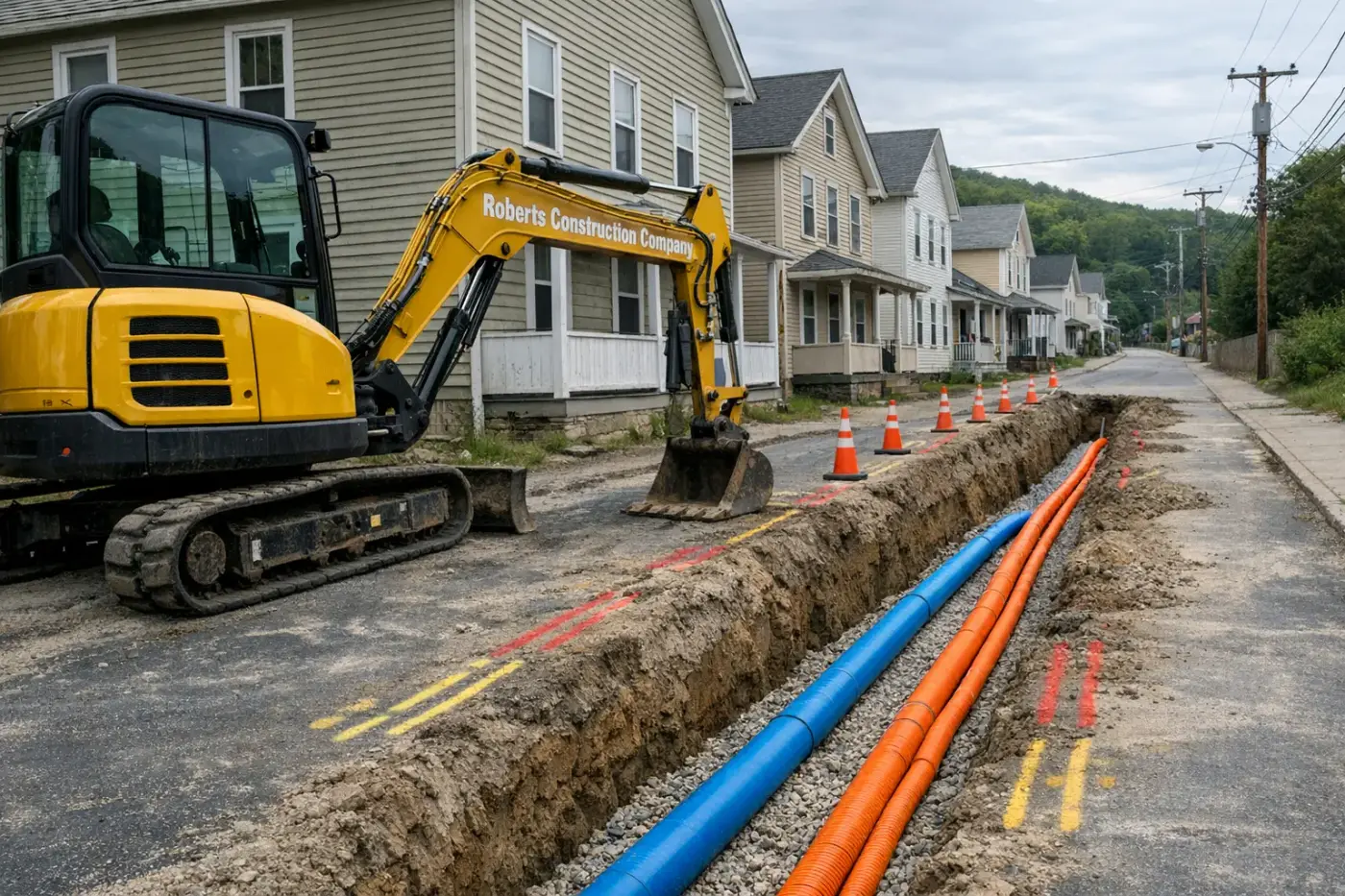
- Water services go below frost — in northeastern Connecticut we hold roughly four feet of cover, more under driveways that get plowed hard. Sewer laterals run at whatever grade carries flow to the main, which on Plainfield's flat village blocks sometimes means shallower pipe with insulation board rather than deeper digging. River-bottom lots near the Quinebaug get a groundwater check first; a wet trench changes the bedding spec.
- Can you trench power to a garage or barn?
- Yes — trenching and conduit are ours, the wire and terminations belong to your licensed electrician. We open the trench, set electrical conduit with warning tape at code depth, and backfill in lifts. On mill-village lots in Moosup and Wauregan the constraint is usually what else is already buried in a 60-foot-wide lot, which is exactly why the CBYD call comes first.
- Do I really need Call Before You Dig for work on my own property?
- Yes. Connecticut law requires a CBYD (811) markout before mechanized digging, on private property included, and it's free. In sewered, watered village blocks the ground is more crowded than it looks — gas, water, sewer, telecom, and old abandoned services nobody mapped. We file the ticket on every job and hand-dig near the marks.