- Do I still call 811 if everything on my lot is private well and septic?
- Yes — Call Before You Dig (CBYD) is required by Connecticut law before any mechanized digging, and there is almost always something public in the ground even on a rural Sterling lot: the Eversource service drop, a phone or cable line, sometimes an old trunk route along the road frontage. What CBYD does not mark is your private side — well line, septic pipes, old feeds to outbuildings. Locating those is on the excavator, which is why we keep as-builts of every run we install in town.
- How deep does a water line have to go in Sterling?
- Below the frost line, which in practice means a trench most contractors would call deep. The complication in Sterling is granite ledge sitting above target depth on a lot of lots. Where that happens we hammer a keyway into the rock, bed the pipe in sand, and insulate where the cover is thin. Our quotes carry a rock line item by default because in this town it is not a surprise — it is a Tuesday.
- Can power and comms share a trench to my barn or shop?
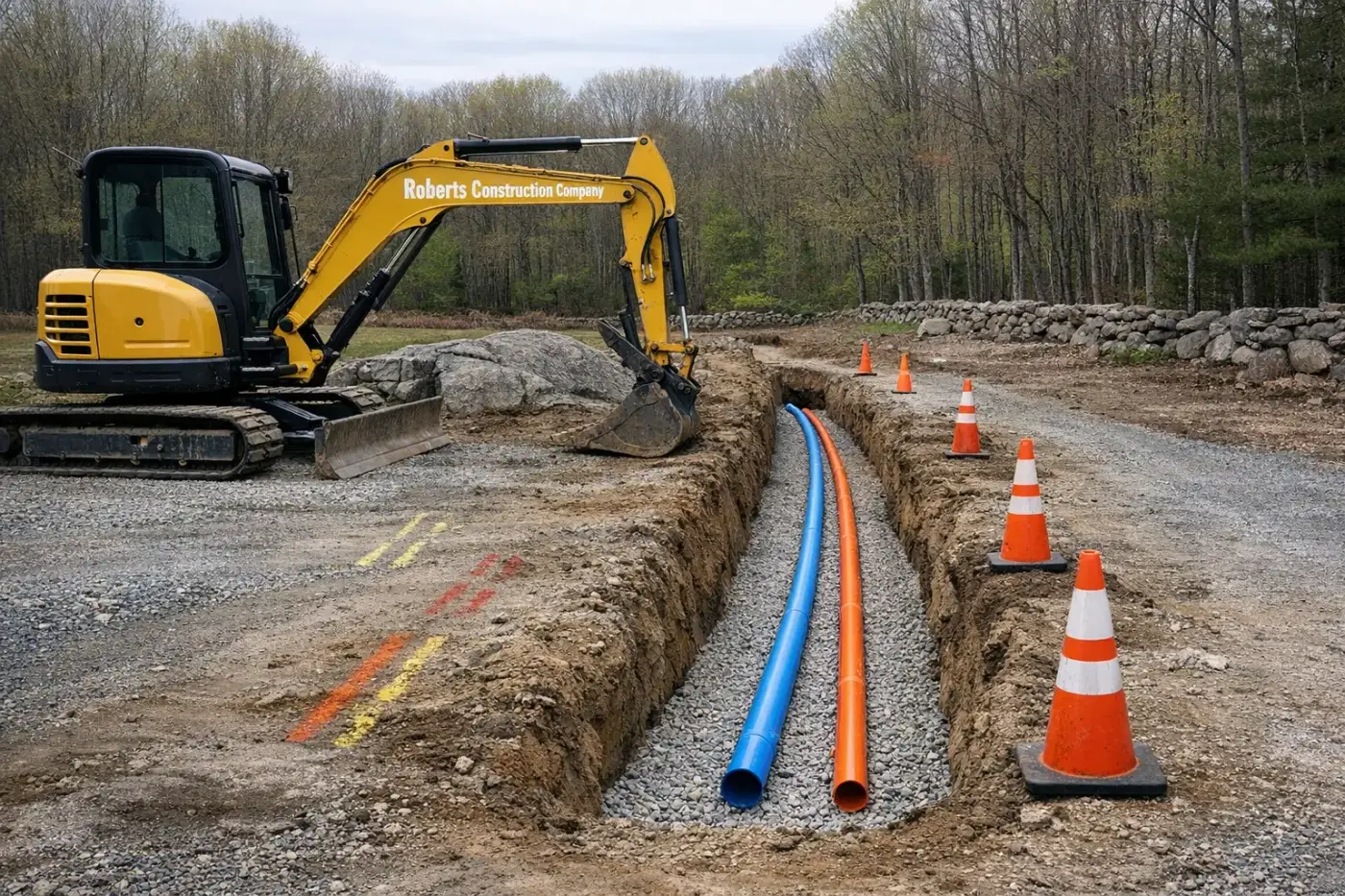
- Usually, with the required separation between them — one trench, two levels, is the standard way we run power and fiber to an outbuilding. We lay out the trench so the separations work, and the conduit stays open for inspection before anything gets backfilled. Water and sewer runs are kept clear of the electrical trench per code separations.
- Who inspects conduit work in Sterling before backfill?
- Electrical work is permitted and inspected through the Town of Sterling building official, and a licensed electrician handles the wire and terminations. Our part is the trench: excavation, bedding, conduit placement with pull string, and leaving it open and safe until the inspection is signed off. Then we backfill and compact.
- Does NDDH get involved in a utility trench?
- Whenever the trench comes near septic components. The Northeast District Department of Health permits every well and septic system in Sterling, and its separation requirements — like keeping a well roughly 75 feet from a leaching system — also constrain where new utility runs can go. Before we cut a trench across a lot with a septic system, we confirm where the tank, D-box, and laterals actually sit, not where the old sketch says they sit.