
(401) 479-1472

Job logbook · Sterling, CT · farm-structure demolition

Demolition in Sterling reads like a farm ledger: barns, silos, burned sheds, old trailers.

Our shop is in this town, so the structures we take down are our neighbors’ — agricultural buildings past saving, fire losses, mobile homes making way for houses. Below are four entries from the log, written the way the work actually goes, day by day.

LOG 01 TIMBER-FRAME BANK BARNLOG 02 CONCRETE STAVE SILO & FOUNDATION RINGLOG 03 FIRE-DAMAGED OUTBUILDINGLOG 04 MOBILE HOME REMOVAL
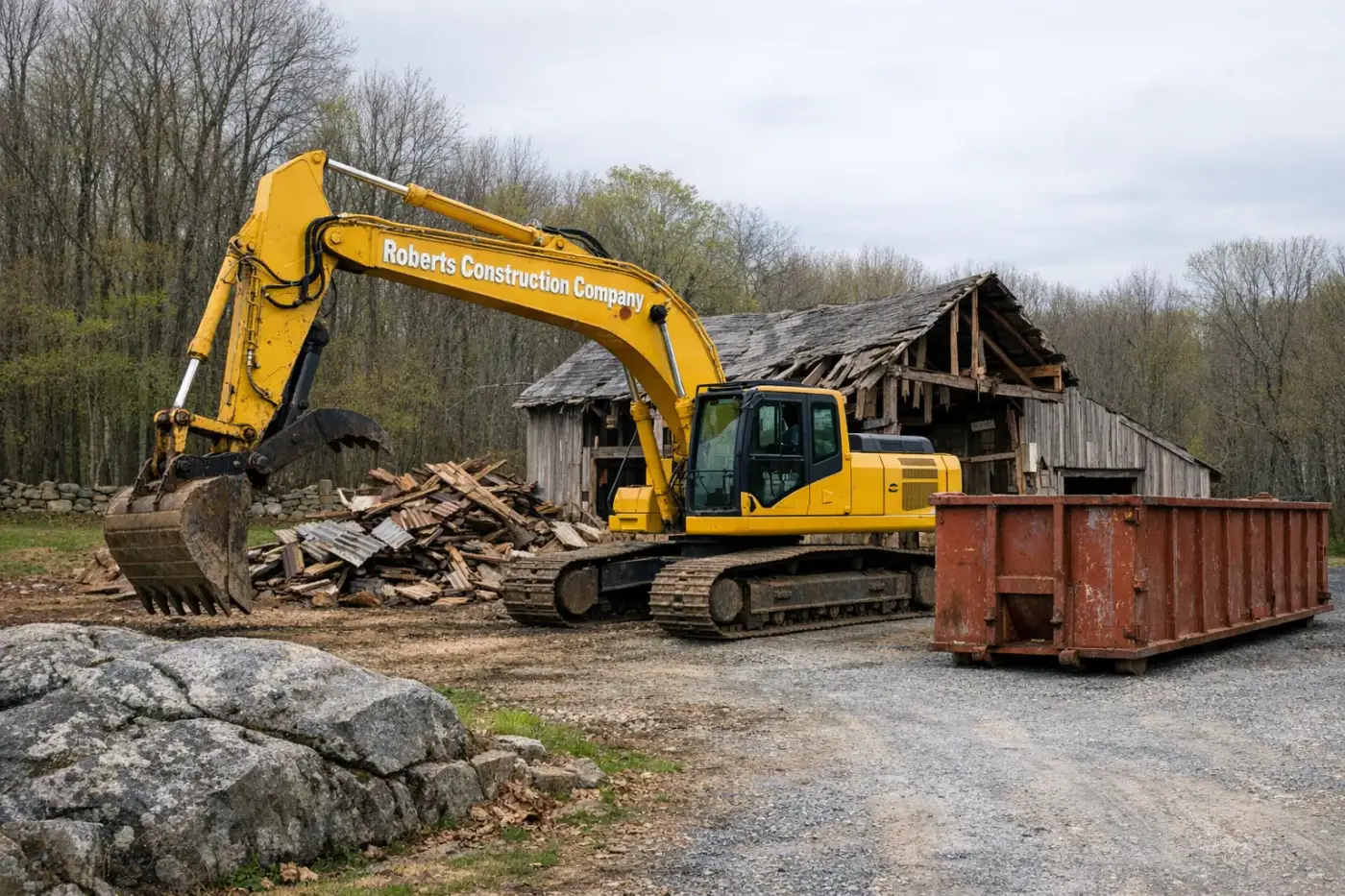
Demolition contractor in Sterling, CT — Roberts Construction Company excavator taking down a barn
Structure demolition in Sterling, CT — tested, disconnected, then taken down.

LOG 01

Timber-frame bank barn

EKONK · 3-DAY ENTRY · FRAME SALVAGED

DAY 1

Survey and strip. Asbestos survey already cleared the roofing; power to the barn confirmed dead at the pole by Eversource. We clear the brush line around the structure — the same first move as any land clearing job — then strip roofing and board siding into separate piles. Hand-hewn frames have buyers; we do not chew up a two-hundred-year-old chestnut beam with a grapple if a salvager wants it whole.

DAY 2

The frame comes down away from the bank wall, in sections, lowest stress first. Steel roofing and hardware go to the scrap pile, salvage timber gets loaded, and everything else is sorted into the C&D containers. A bank barn is half building, half retaining wall — the demolition plan has to respect the half that is holding back the hill.

DAY 3

The foundation. Dry-laid fieldstone over granite ledge, which in Sterling means the stone comes out clean and stays on the property — wall stone, cellar-hole fill, rip-rap. We grade the ramp and bank smooth, spread topsoil, and the hillside reads as a field again instead of a hazard.

LOG 02

Concrete stave silo & foundation ring

STERLING HILL · 2-DAY ENTRY · CONCRETE CRUSHED ON SITE

DAY 1

Drop and separate. A stave silo is a masonry tube under hoop tension — it comes down into a planned fall zone, never “wherever.” Once it is on the ground the steel hoops are cut out for scrap and the concrete staves get piled for processing.

DAY 2

The ring. Silo foundations here are poured directly over granite, so there is no chasing footings six feet down — the ledge is the bottom. We hammer the ring, crush the concrete with the staves, and use the product as sub-base for whatever comes next. On one job that is a pole-barn pad we grade the same week; on another it is simply a clean field corner. Either way the material never rides a truck twice.

LOG 03

Fire-damaged outbuilding

ONECO · 2-DAY ENTRY · INSURANCE DOCUMENTED

DAY 1

Document, then touch. Fire jobs start with photographs and the adjuster’s sign-off, because once the machine moves, the evidence is gone. The DPH notification still applies to a burned structure, the power disconnect still gets confirmed — fire does not waive paperwork. We fence the well head before any iron gets close to it.

DAY 2

Burned debris is mixed C&D and it all leaves — nothing gets buried in the cellar hole, nothing gets re-burned, both of which were the old Yankee habits and neither of which is legal now. We excavate the ash layer, backfill with clean material, and compact so the site is ready for site preparation instead of remediation later.

LOG 04

Mobile home removal

NORTH STERLING · 2-DAY ENTRY · PAD REGRADED

DAY 1

Disconnect and gut. Power confirmed cut, propane tank picked up by the supplier, well line valved off at the house side, septic tank pumped. Interior strip-out separates the regulated and recyclable material before the shell is touched — a mobile home is mostly steel chassis, aluminum skin, and light framing once you sort it honestly.

DAY 2

The shell comes apart, the chassis goes to scrap in one piece, and the pad gets pulled. Then the Sterling question: what is under it. Usually processed stone over till or ledge, which we regrade in place — with stumps and any surprise boulders handled the same visit, since we already brought the machine that eats rock.

Before any entry gets written

The paperwork, in the order it actually happens.

  1. 1.Demolition permit through the Town of Sterling building official. Small town, direct process — the office knows our trucks, which does not skip any steps but does keep them moving.
  2. 2.Asbestos survey and CT DPH notification. A licensed inspector surveys the structure; any regulated material is removed by a licensed abatement contractor before we mobilize; the Demolition Notification is filed with the state Department of Public Health.
  3. 3.Utility disconnects. Eversource confirms the electric service is dead, the propane supplier collects the tank, the well is isolated and the head protected, and the septic tank is pumped and then protected or abandoned in line with NDDH requirements — because in Sterling the “utilities” are almost all on your own lot.
  4. 4.CBYD (811) before foundations get grubbed or stumps pulled. Even on a back lot with nothing public in sight, the ticket gets filed — it is the law, and old service routes surprise people.

General guidance — confirm current requirements with the Town of Sterling building official, CT DPH, CT DEEP, and NDDH for your specific structure and parcel.

Where Sterling demolition debris actually goes.

A demolition quote in this town is really a materials-handling quote, and granite changes the math. Fieldstone and granite foundation stone are assets, not waste — they become wall stone, fill, and rip-rap on the same property. Clean concrete gets crushed and reused as sub-base. Steel rides to scrap and offsets cost. What is left — wood, roofing, mixed debris — is the only part that pays tipping fees at a permitted facility.

The transfer station Sterling shares with Voluntown handles household bulky loads, not contractor-scale demolition volume, so hauling is on us and priced up front. And because the cellar hole usually bottoms on ledge, backfill needs are modest — most jobs close their own hole with their own crushed material instead of buying fill by the truckload.

Frequently asked — Sterling demolition

What owners ask before a Sterling structure comes down.

Does an old barn really need an asbestos survey before it comes down?
Usually, yes. Connecticut’s pre-demolition rules put a licensed asbestos inspector through the building before demolition, and mid-century farm structures are exactly where the material hides — cement roofing panels, siding shingles, pipe wrap in a milk house. If the survey finds it, a licensed abatement contractor removes it before we mobilize. A Demolition Notification also gets filed with CT DPH before the machine starts.
What happens to a fieldstone or granite foundation?
In Sterling, it stays useful. Dry-laid fieldstone comes out clean and goes back into the property — wall stone, fill for the cellar hole, rip-rap for a wet corner. Poured concrete gets broken, separated from rebar, and crushed for reuse as sub-base. In a granite town, hauling stone away just to buy processed stone back is a bill we help you avoid.
Can my septic system stay if I rebuild on the same footprint?
That is NDDH’s call, not ours or the town’s. Sometimes an existing, functioning system can serve a rebuild; sometimes the new bedroom count or the system’s condition forces a new permit and a new design. Either way, during demolition the tank gets pumped and the components get protected or properly abandoned — we never track a machine over a leaching field.
Can demolition debris be buried or burned on site in Sterling?
No. Burying demolition debris on the lot or open-burning a structure is not a legal disposal path in Connecticut. Metal goes to scrap, clean concrete and stone get crushed and reused on site, and mixed debris gets hauled to a permitted facility. The Sterling transfer station Sterling shares with Voluntown serves resident drop-off loads — a contractor-scale demolition load is our hauling problem, not yours.
Who pulls the demolition permit and files the paperwork?
We do, as part of the job: the demolition permit through the Sterling building official, the CT DPH Demolition Notification, the CBYD (811) ticket before we grub foundations, and the utility disconnect confirmations — Eversource on the power side, the well and septic handled with NDDH’s rules in mind. You sign; we chase the signatures.

Next entry: yours

Got a structure in Sterling that has outlived its arguments?

Demolition is one page of the home-town file. The full dig story is on our Sterling excavation page, the buried-services ledger on Sterling underground utilities, and the service-wide overview at demolition services.