
The depth chart · Willimantic, CT
Underground utilities in Willimantic, read from the street down.
Under a Thread City street there are five systems stacked in a predictable order — comms shallowest, sewer deepest, and a century of mill-era surprises in between. This page walks the whole column, band by band, the way we plan a trench.
Locate colors · CBYD 811
- Communications12–24 in
- Natural gas2–3 ft
- Electric2–4 ft
- Water4.5 ft +
- Sanitary sewer5–10 ft
Typical depths, not guarantees — mill-era streets keep their own records. We locate, probe, and hand-dig before we trust any of them.
12–24 in
Communications
The shallowest band under a Willimantic street: telephone, cable, and fiber. Downtown these runs are old, dense, and not always where the record says — Thread City's streets were laid out for a mill economy, and a century of overbuilds sits in the first two feet.
This is the band most often nicked by careless digging, which is why every job of ours starts with a CBYD ticket and orange paint on the pavement before a bucket touches ground. Conduit for new comms drops rides in the same trench as electric when we can combine them — one cut, one restoration.
2–3 ft
Natural gas
Willimantic is one of the gas-served pockets of eastern Connecticut — the distribution system here is run by Eversource, and mains and services generally ride two to three feet down. Yellow marks are the ones we treat with the most respect on any street cut.
We don't install gas pipe — the utility and its contractors own that work — but we routinely trench alongside it, cross it, and expose it by hand for verification. On tight mill-district streets, knowing exactly where the yellow line runs decides where the rest of the trench can go.
2–4 ft
Electric
Most of Willimantic is still fed from overhead Eversource lines, so the red band is thinner here than in newer towns — but it's growing. New builds, ECSU-area projects, and owners tired of storm outages ask for buried service, and that means trench, conduit, and sand bedding at roughly two to four feet, deeper for primary.
We dig the trench, set the conduit and pull boxes to spec, and bed and backfill so the inspection passes the first time; the utility and your electrician make it live. Details are on our electrical conduit installation page.
4.5 ft +
Water
Below frost sits the Windham Water Works system — a municipal utility drawing from the Willimantic Reservoir through roughly 84 miles of main and three storage tanks. In this climate we hold water services at four and a half feet or better; frost doesn't negotiate.
A lot of our blue-band work is generational replacement: mill-era houses still running the service that was laid when the street was. New taps and renewals are coordinated through the Water Works, with permits and bonding depending on scope. Our water line installation crew runs this band week in, week out.
5–10 ft
Sanitary sewer
The deepest band, because gravity sets the grade. Willimantic's sanitary network falls toward the Water Pollution Control Authority's treatment plant at 2 Main Street beside Recreation Park — built in 1959, upgraded to secondary treatment in 1974, designed for 5.5 million gallons a day and running well under that today.
Old clay laterals under narrow streets are the defining sewer job in this town: root-bound, back-pitched, sometimes sharing a trench with utilities nobody mapped. We shore anything past five feet, replace to the main under an Engineering Department street-cut permit, and cap or connect to WPCA standards. Full scope on our sewer line installation page.
One cut, whole column
How we run the whole chart in one Willimantic trench.
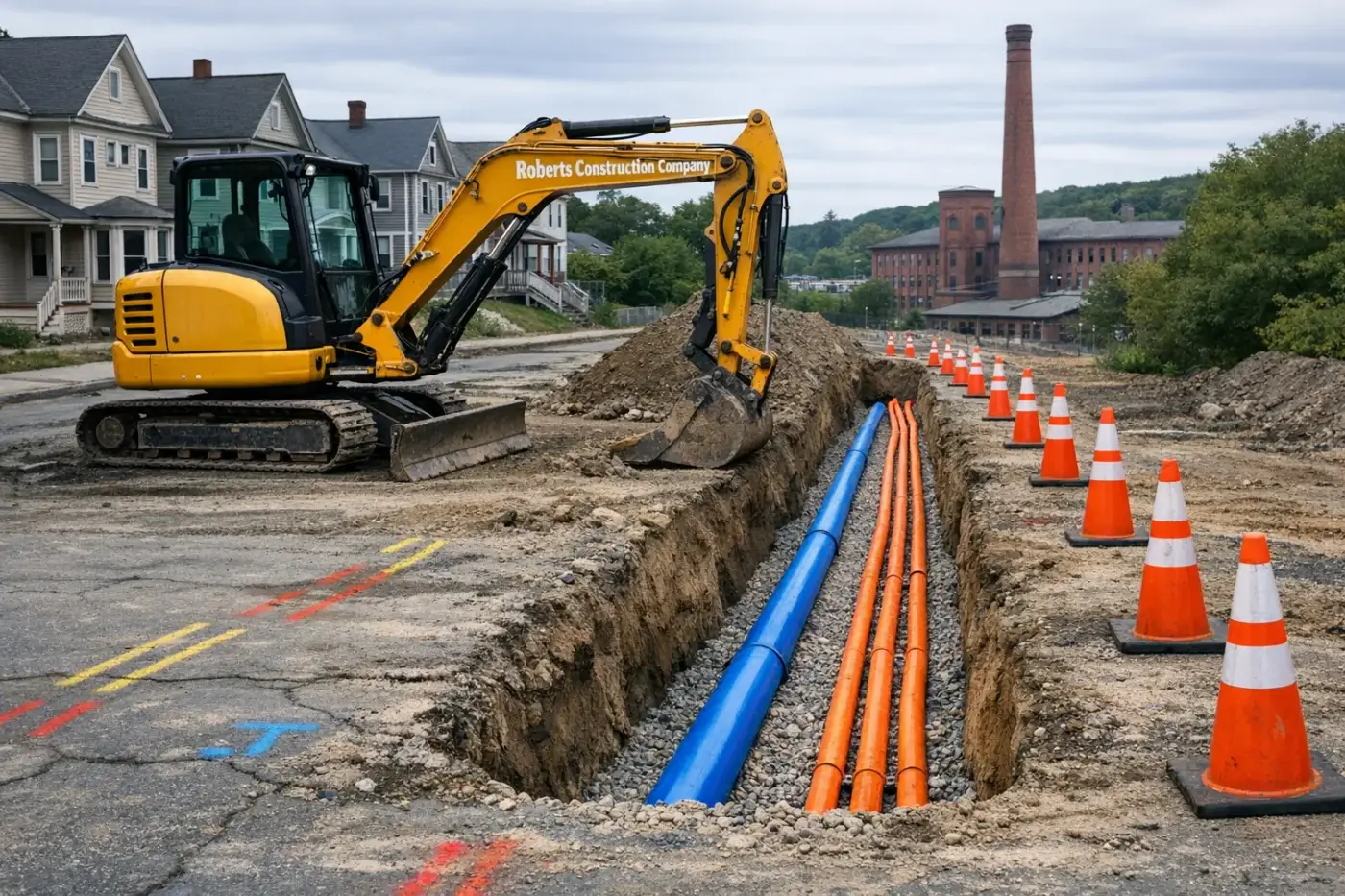
On a new service run — a house on the streets climbing north toward ECSU, an infill lot near the mills — we’d rather open one trench than four. Water at the bottom shelf, sewer on its own grade, electric and comms conduit benched above with the separations each system requires. That’s standard utility trenching practice, but Willimantic adds its own conditions: high groundwater near the Willimantic and Natchaug Rivers, buried mill-canal alignments downtown that we map before digging within 200 feet, and streets narrow enough that spoil management is part of the plan, not an afterthought.
Wet ground also means the sixth system nobody paints: storm drainage. On riverside and low-lying lots we routinely add footing drains or a storm lateral to the same mobilization — cheapest foot of pipe you’ll ever buy is the one that goes in while the trench is already open.
Utility work is one slice of what we do in town — foundations, drainage, and site work live on our Willimantic excavation page, the service itself is detailed on the underground utilities hub, and when a structure has to come out before the new services go in, that’s our Willimantic demolition crew.
General guidance — confirm current requirements with the Windham Water Works, the Windham Water Pollution Control Authority, the Windham Engineering and Building Departments, and CBYD (811) for your specific parcel and scope.
Frequently asked — utilities in Willimantic
Five questions about the pipes and wires under Thread City.
- Who supplies water in Willimantic, and who do you coordinate with?
- The Windham Water Works — the town's own municipal utility. It draws from the Willimantic Reservoir and runs roughly 84 miles of main through the system. New taps, service replacements, and main extensions all run through their office, and depending on scope there are bonding requirements. We handle that coordination as part of the job.
- Who handles sewer — is that the Water Works too?
- No, sewer is separate. The Windham Water Pollution Control Authority runs the sanitary system, which flows mostly by gravity to the treatment plant at 2 Main Street next to Recreation Park — a facility first built in 1959 and upgraded to secondary treatment in 1974. Laterals, connections, and caps are WPCA business; street-cut permits are the Engineering Department. We deal with both.
- Do I need to call CBYD before you dig on my Willimantic property?
- We place the CBYD (Call Before You Dig / 811) ticket ourselves before any trench opens — it's Connecticut law and it's free. One caveat: CBYD marks only public utilities. Private lines — a garage feed, a landscape circuit, an old drain — don't get marked, and mill-era Willimantic lots hide plenty of those. We probe and hand-dig where the record is thin.
- How deep does a water line need to be in Willimantic?
- Below frost, which in eastern Connecticut means we treat roughly four and a half feet as the working floor for a water service, deeper where the run crosses ledge or fill that sheds cover. A shallow line here freezes in a normal January. Sewer depth is different — it's set by the grade needed to reach the main, not by frost, so laterals commonly run five to ten feet down.
- My house is mill-era with the original lateral. Can you replace it without wrecking the street?
- Usually, yes. Most of the job runs in your yard; the street cut at the main is permitted through the Windham Engineering Department, which processes over 100 right-of-way permits a year, so the process is well-worn. On narrow downtown blocks we plan traffic control and plate the cut overnight. What we won't do is guess at depth — old clay and Orangeburg laterals wander, so we locate before we saw pavement.
Know what’s under your street before you commit to a plan. We’ll read the chart with you.
Also in WillimanticExcavation Demolition