
An interview about buried lines · Brooklyn, CT
Underground utilities in Brooklyn, explained by the people who dig them.
Most of what we bury in Brooklyn never shows up on a utility bill. We sat our own estimator down and made him answer the questions Brooklyn property owners actually ask — about wells, conduit, the one corner of town with public sewer, and what the glacial till does to all of it.
Q01
Brooklyn reads as a farm town. Is there anything public to connect to?
Mostly no — and settling that is the first ten minutes of every estimate. The bulk of Brooklyn runs on private wells and septic systems permitted through the Northeast District Department of Health. The exception sits along the Danielson line: East Brooklyn has public water, served by Connecticut Water’s system in that corridor, and the Brooklyn WPCA has operated a small public sewer there for more than forty years, with maintenance long contracted through the operator across the Killingly line. Everywhere else in town, every buried pipe and wire on the parcel is private infrastructure — yours to install, yours to maintain, ours to put in correctly.
Q02
So what does “underground utilities” mean on a rural Brooklyn parcel?
Four trenches, basically. The water service from the wellhead to the basement. The power and communications feed from the pole to the house — and usually onward to a barn or shop. The septic piping, which is its own permitted world. And drainage, which nobody calls a utility until the trench for one of the other three turns into a creek. It’s the same utility trenching discipline we run everywhere, applied by the same crew that handles our Brooklyn excavation work — the difference here is distance. A farmhouse set five hundred feet off the road triples the trench footage of a suburban lot.
Q03
Walk me through a water line. How deep, what pipe, what goes wrong?
Four feet of cover, minimum, in this climate — deeper under plowed driveways where frost drives harder. On a well-supplied property that line is the whole water system: freeze it once and the house is dry until March. We see two failure modes in Brooklyn. Old polyethylene from the sixties and seventies that’s gone brittle at the fittings, and lines laid shallow over ledge because the original installer hit rock and gave up. When we do a water line installation or replacement, we bed the pipe in screened material, keep it off the rock, and sleeve it where it crosses anything a future machine might dig.
Q04
And the long-driveway conduit runs?
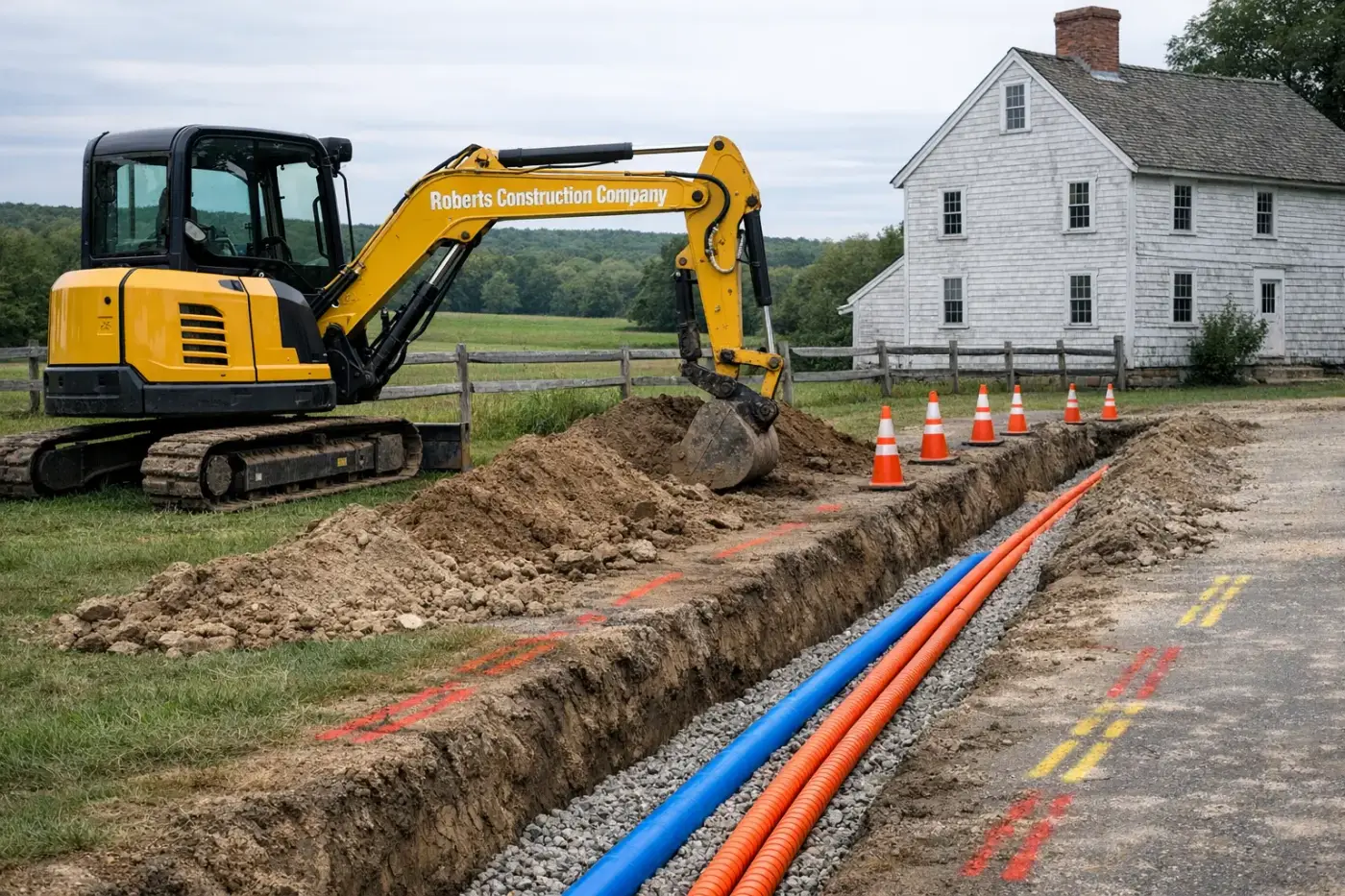
That’s signature Brooklyn work. Farm parcels here put the house well back from the road, and outbuildings further still — so an electrical conduit installation might run from a roadside pole to the house, then onward to a barn, a shop, and a frost-free hydrant. We trench once and lay everything the property will need: schedule-40 or 80 conduit with long-radius sweeps, a spare duct for future fiber, warning tape a foot above the bank, pull strings in everything. Where separation rules allow, power and water share the trench. Nobody has ever regretted the spare conduit. Plenty of people have regretted not having one.
Q05
What if the property is inside the East Brooklyn sewer area?
Then the job changes character — it’s a lateral to a public main instead of a private system. We do the sewer line installation to WPCA requirements: correct pitch all the way to the connection, proper bedding, cleanouts where they belong. A lot of East Brooklyn housing dates to the mill era across the river in Danielson, and the original clay laterals are decades past their design life — root intrusion and bellied runs are the usual reasons we get the call. Everything is verified before you connect and before we backfill.
Q06
What’s actually down there when you open a trench in Brooklyn?
Glacial till, mostly — dense, bouldery, good bearing, slow to drain. Ledge shows up less than in Sterling but often enough that we test-pit long runs before quoting them. And then the artifacts of two centuries of farming: buried stone walls that kept going when the field was regraded, old clay field tile, filled cisterns near the older houses, and the odd forgotten fuel line to a barn that lost its furnace in 1970. On old farmsteads we assume the ground has history and dig the first pass like we expect to find some.
Q07
Does calling 811 cover all of that?
No — and this is the most misunderstood thing in rural utility work. Call Before You Dig marks member utilities: the public gas, electric, telecom, and water infrastructure, mostly in and along the road. Your well line, your septic piping, the feed to the barn — private lines are in nobody’s database. We make the CBYD call on every job because it’s the law and because the road crossings matter, and then we do our own private-side locating with as-builts, probe bars, and hand-dug test pits before a bucket goes near anything pressurized or energized.
General guidance — confirm current requirements with CBYD (811), the Brooklyn building official, NDDH, and the Brooklyn WPCA for your specific parcel and scope.
Q08
Anything different near the Green, or out by the fairgrounds?
Around Brooklyn Green, care. The historic district covers the town center, the houses run to the late 1700s, and the stone walls and street trees are the streetscape — so trench routes get planned around them, and restoration is part of the job, not an afterthought. Out by the fairgrounds it’s mostly a calendar question: Brooklyn Fair week in late August fills that end of town, and we schedule trench work on nearby properties around it rather than fight the traffic with an open excavation.
Q09
Is drainage really an underground utility?
On till, absolutely. Brooklyn’s upland soils hold water in the top layers long after a storm, and a utility trench cut across a wet slope becomes a french drain whether you meant it or not — so we design for it instead of discovering it. Curtain drains uphill of foundations, stone-bedded drainage runs to daylight, and trench backfill compacted so the utility run doesn’t become the low path for every spring thaw. It’s the quiet half of the trade and it’s where rural jobs get won or lost.
Q10
Last one. A lot of these lines end at a building that’s on its way out.
True — utility work and demolition are neighbors on a farmstead. When a line serves a barn or an ell that’s coming down, the disconnect sequencing has to happen in the right order before anything else does, and we handle both sides of that. If that’s the project you’re actually planning, our Brooklyn demolition page walks through it structure by structure. And for the trade-wide picture beyond this town, start at our underground utilities overview.
“In Brooklyn the utility company owns the pole and one corner of town owns a sewer. Everything else underground belongs to the property — which means it deserves to be installed like it has to last fifty years. Because it does.”
— from the interview
Quick answers — Brooklyn utilities
The short version, for people who skipped the interview.
- Does Brooklyn CT have public water and sewer?
- Only in one corner. Public water reaches the East Brooklyn area near the Danielson line — Connecticut Water's system serves that corridor — and the Brooklyn WPCA has run a small public sewer there for more than forty years. The rest of town is private wells and NDDH-permitted septic, which means most 'utility' work in Brooklyn is private-side trenching.
- How deep do you bury a water line in Brooklyn?
- Below frost — we trench water services at roughly four feet of cover in northeastern Connecticut, deeper where the line crosses a driveway that gets plowed down to pavement. Shallower lines freeze in a bad February, and on a well-supplied Brooklyn property a frozen service means no water at all until it thaws.
- Will CBYD mark my well line or septic pipe?
- No. Call Before You Dig (811) marks member-utility infrastructure — the public side. Private lines on your property — the well service, septic laterals, the power feed to a barn — are not in anyone's database. We locate those ourselves with as-builts, probing, and careful test pits before the machine digs near them.
- Can you run power and water in the same trench?
- Often, yes — with the separations the codes require, electrical conduit and a water service can share a trench on the long rural runs common in Brooklyn. One trench instead of two matters here, because a farmhouse set 500 feet off the road doubles or triples the trench footage of a typical suburban lot.
- Is trenching near Brooklyn Green restricted?
- The Brooklyn Green Historic District covers the town center, and exterior work on contributing properties gets reviewed. Below-grade utility work on private lots is usually straightforward, but we plan trench routes to protect stone walls, mature trees, and the streetscape — and we put lawns and driveway aprons back the way we found them.
Brooklyn, CT
Tell us what the trench needs to carry. We’ll tell you what the ground will say about it.
Also in BrooklynExcavation Demolition