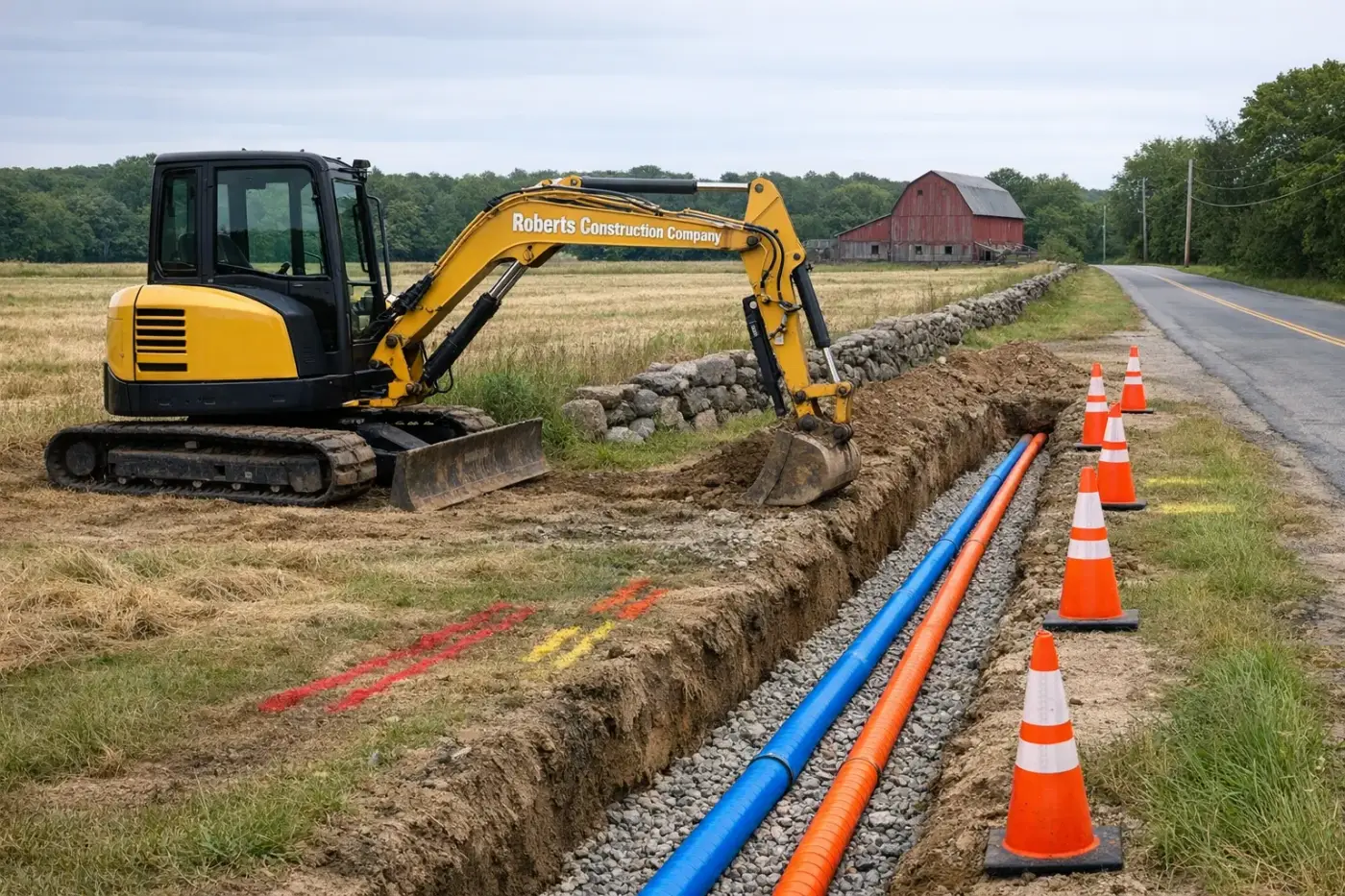
- How deep do you bury water lines in Canterbury?
- Below frost, always — we run well supply lines at roughly four feet of cover, which keeps them safely under Connecticut's frost depth. On long runs from a distant wellhead we also bed the line in screened material so a stray piece of till or a stone edge never sits against the pipe. A frozen or stone-pinched line 300 feet from the house is a miserable February repair; depth and bedding are cheap by comparison.
- Can you trench power to a house set 600 feet off Route 169?
- Yes — long private services are normal Canterbury work. The utility typically ends its overhead service at a pole near the road; from there the run to the house is the owner's trench. We cut a single trench, set conduit for power and a second conduit for communications at the same time, bed and tape it, and coordinate the inspection sequence so the trench is only open once.
- Does calling 811 mark the lines on my Canterbury property?
- Only partly. CBYD (Call Before You Dig) locates utility-owned lines — generally up to the meter or the service point. Everything past that is private: the well line, the septic laterals, the run from the pole to the house, the feed out to the barn. None of it is in the 811 database. We still make the call on every job, and then we locate the private side ourselves with as-builts, probing, and careful test-holes.
- Do I need NDDH involvement to replace a septic line?
- Usually, yes. Canterbury septic work runs through the Northeast District Department of Health, and repairs to tanks, distribution lines, and leaching systems generally need a repair permit and an inspection before backfill. Swapping a crushed section of pipe is a smaller process than a new system, but it is still a process. We handle the NDDH paperwork as part of the job.
- Can you run water and power out to a barn?
- That is one of the most Canterbury requests there is. We trench subpanel feeds to barns and outbuildings, water lines with frost-proof hydrants for stock, and conduit for lighting or a camera run — often all in one trench with proper separation. On working farm parcels we plan the route around field access and the existing stone wall gaps so the trench never cuts off equipment movement.
- What about trenching near the stone walls?
- We route around them. Canterbury's walls run along most property lines and many field edges, and they are older than anything else on the lot. Where a line genuinely has to pass a wall we use an existing gap or bore beneath the wall rather than pulling stone. It costs a little planning and saves something that cannot be rebuilt as it was.