
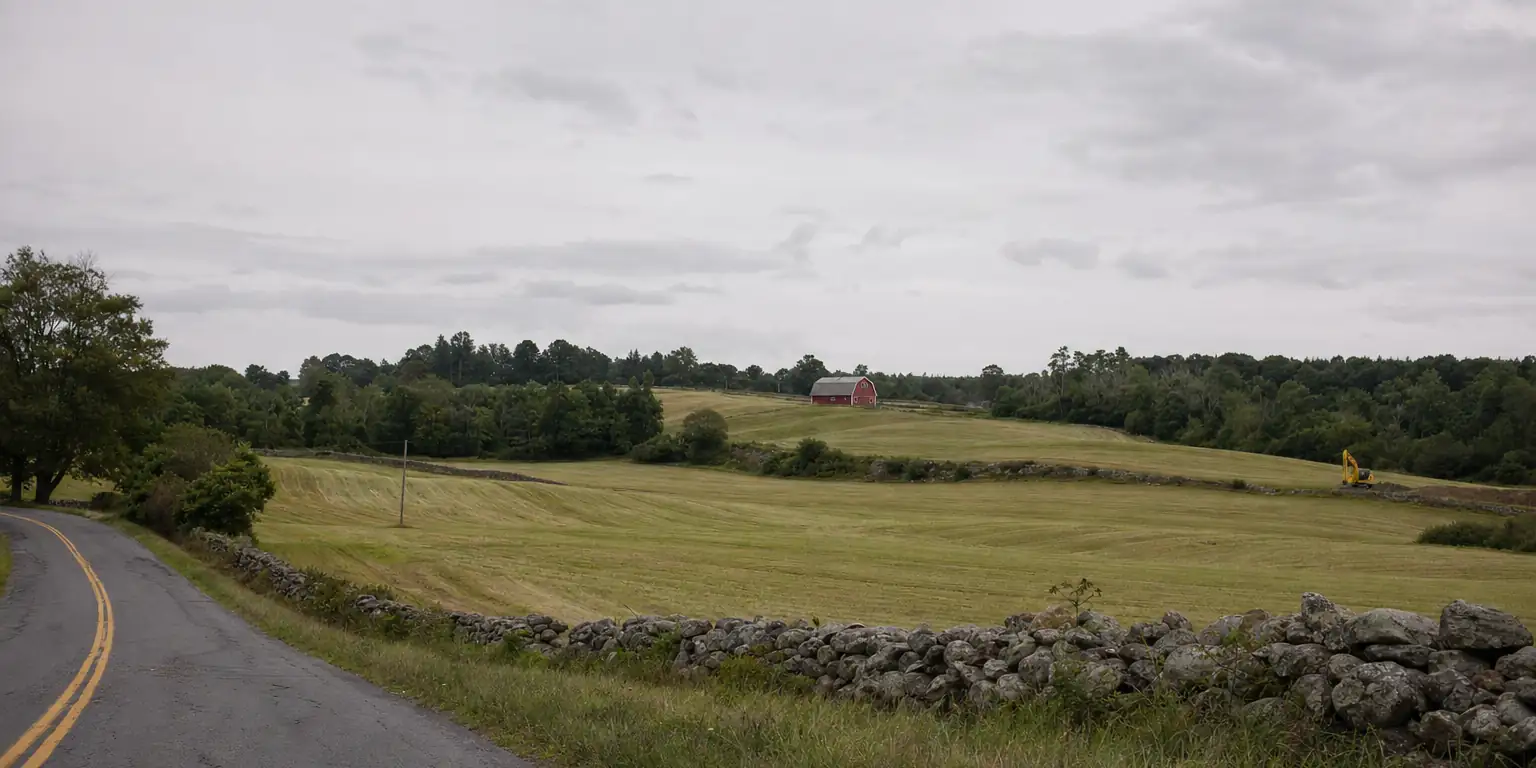
Process timeline · Canterbury, CT
Demolition in Canterbury: condemned or fire-damaged to clean lot.
When a Canterbury house burns or gets condemned, the owner inherits a process nobody volunteers for. This is that process, in order — every step from the loss to a lot you could build on tomorrow.
Eight steps
- 01Assessment & insurance coordination
- 02Asbestos & hazardous material testing
- 03Utility disconnects, Canterbury edition
- 04Permits & notifications
- 05Demolition
- 06Foundation removal & septic decommissioning
- 07Debris out
- 08Backfill, grading, clean lot
- 01
Assessment & insurance coordination
Owner · adjuster · us·Week one
A condemned or fire-damaged structure starts as a paperwork problem, not an equipment problem. We walk the property with the owner — and, on fire losses, alongside the insurance adjuster's process — to document the structure, scope what's coming down versus what's salvageable, and put a real number on the demolition so the claim reflects the actual cost of getting to a clean lot. Nothing gets touched until the documentation everyone needs exists.
- 02
Asbestos & hazardous material testing
Licensed inspector·Days, plus lab turnaround
Before any Connecticut structure comes down, the asbestos question has to be answered in writing. A licensed inspector samples the likely suspects — pipe insulation, floor tile and mastic, siding, plaster, roofing — and the lab results dictate the path. Clean results mean straight to permitting. Positive results mean licensed abatement first, with its own CT DPH notification when quantities exceed 10 linear or 25 square feet. Fire damage doesn't waive any of this; burned asbestos is still asbestos.
- 03
Utility disconnects, Canterbury edition
Electric utility · septic hauler · us·Scheduled in parallel with permits
In a town with no water or gas mains, the disconnect list is short but unforgiving. The electric utility de-energizes and pulls the service at the pole. We cap the wellhead so debris never enters the casing, pump the septic tank dry, remove or secure propane tanks, and check for the buried oil lines and old fuel tanks that rural properties like to hide. Then we call CBYD — 811 — so every marked line on the parcel is painted before a machine arrives.
- 04
Permits & notifications
Canterbury building official · CT DPH·DPH notice: 10+ days before demo
The demolition permit runs through the Canterbury building official at the town office on Municipal Drive. Separately, Connecticut requires a demolition notification filed with the state Department of Public Health at least ten days before the structure comes down. If the building sits near the historic town center — the green, the Route 169/14 crossroads by the Prudence Crandall Museum — we flag it with the land use office early rather than discover a review requirement late.
- 05
Demolition
Our crew·One to three days, typical house
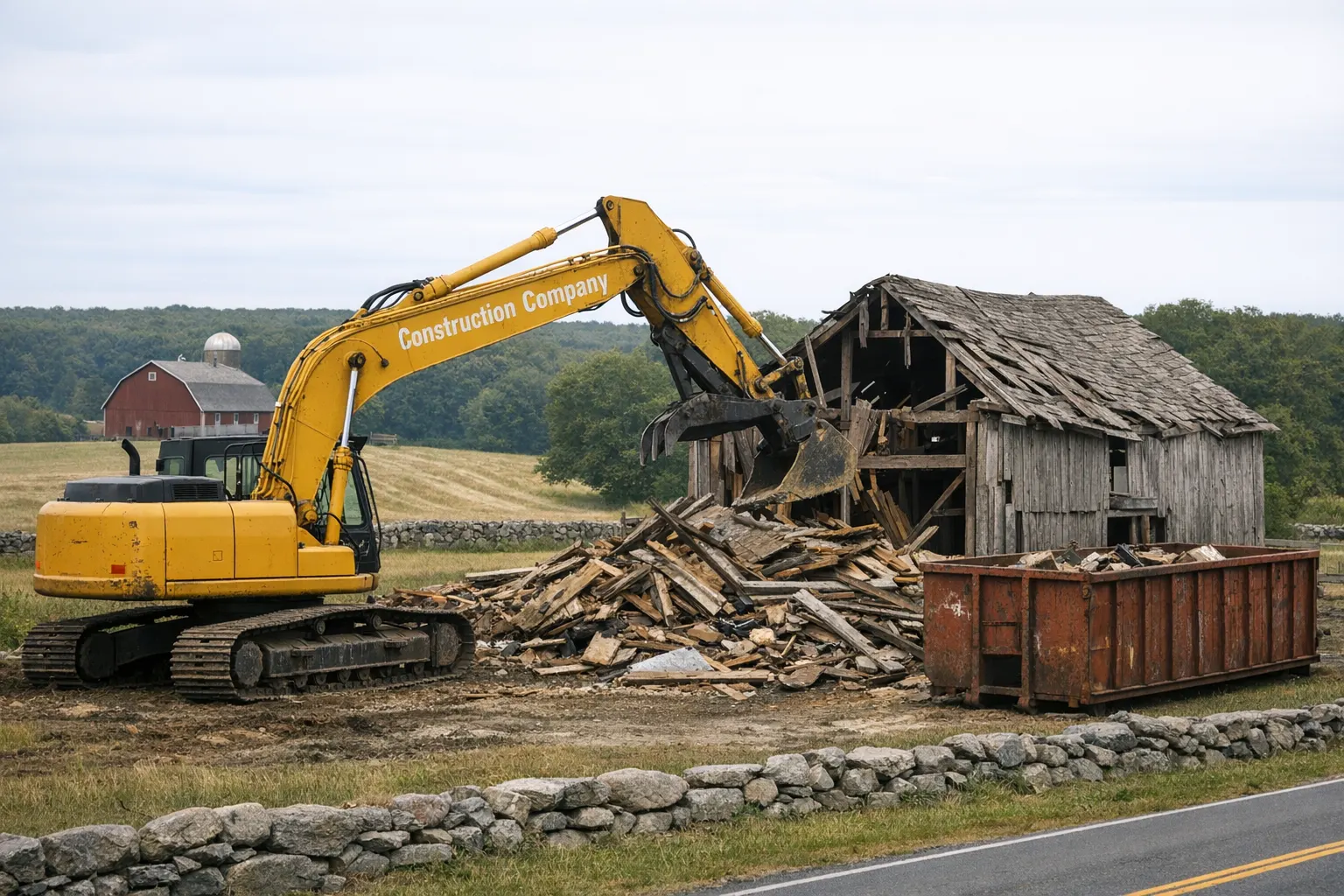
The visible part is the short part. We wet the work to control dust, take the structure down section by section rather than in one dramatic push, and sort as we go — clean wood, metals, and mixed debris separated at the machine. On tight Canterbury lots we sequence the takedown so the excavator always has clear ground and the neighbors' stone walls, wells, and trees are never inside the swing radius.
- 06
Foundation removal & septic decommissioning
Our crew · NDDH where required·Concurrent with load-out
A clean lot has nothing hiding under the grass. We break out and remove the foundation and slab, pull the chimney base, and deal with the septic system per the plan — kept and protected if the rebuild will reuse it, or pumped, crushed, and filled if it's being abandoned. Old cisterns and hand-dug wells turn up on Canterbury farm parcels more often than you'd think; we close them properly instead of burying the problem.
- 07
Debris out
Our trucks · permitted C&D facility·Rolling through the job
Structure debris leaves in containers to a permitted construction-and-demolition facility — the town transfer station on Kinne Road is for resident household loads, not house demolitions. Metals go to recycling. On fire losses we keep the load tickets organized because the insurance file usually wants proof of what left and where it went.
- 08
Backfill, grading, clean lot
Our crew·Final days
The hole gets backfilled in compacted lifts with clean material — not demo debris — and the lot gets graded to drain away from wherever the next foundation will sit. If the plan is to rebuild, we're already the site contractor: the same machines roll straight into site preparation. If the plan is to sell or pause, the lot gets left seeded, stable, and looking like nothing bad ever happened there.
General guidance — confirm current requirements with the Canterbury building official, CT DPH, CT DEEP, and NDDH for your specific structure and parcel.
After step eight
A clean lot is usually the start of something.
Most Canterbury demolitions end with a rebuild, a sale, or a field returning to being a field. Because we’re an excavation contractor first, the handoff is seamless: the same crew moves from demo into site preparation for the new structure, grading to reshape the ground, or land clearing where the overgrowth took the property back faster than the family expected. Old foundations here often mean rock removal — glacial erratics under century-old footings — and cleared farmyards nearly always need stump removal before they mow clean.
The wider picture of how we work this town — foundations, NDDH septic, drainage on the Quinebaug-edge parcels — is on our Canterbury excavation page, the trench-work side is on the Canterbury underground utilities page, and the service overview lives at demolition services.
Frequently asked — Canterbury demolition
What owners ask after the fire marshal or the building official has been out.
- Do I need asbestos testing before demolishing an old Canterbury farmhouse?
- Assume yes. Canterbury's housing stock skews old, and pipe wrap, floor tile, siding, and plaster systems from the mid-1900s routinely contain asbestos. Connecticut requires a DPH demolition notification before a structure comes down, and abatement of more than 10 linear feet or 25 square feet of asbestos-containing material triggers its own DPH notification and a licensed abatement contractor. Testing first is how the rest of the timeline stays predictable.
- Who disconnects the utilities before a demo in a town with no mains?
- It's a shorter list than in a city, but it still has to be sequenced. The electric utility kills and removes the service from the pole. There's no gas main or water main to cut in Canterbury — instead we cap the well so nothing enters the casing, pump the septic tank, and deal with propane tanks and any buried oil lines or underground tanks before machines move. We run the disconnect checklist as part of the job, not as the owner's homework.
- Can house demolition debris go to the Canterbury transfer station?
- No — the town transfer station on Kinne Road is a residential-scale, sticker-based facility, not an outlet for structure demolition debris. A house demo produces tens of tons of mixed material. We load it into containers on site and haul to a permitted construction-and-demolition facility, with metals separated out for recycling where practical.
- How long does it take to get from fire loss to a clean lot?
- The digging is the fast part — a typical house comes down and gets loaded out in days. The calendar is driven by everything before it: the insurance adjuster's documentation, asbestos testing and any abatement, utility disconnects, the town demolition permit, and the state DPH notification that must be in at least ten days before demolition. Realistically, plan in weeks. We keep it moving by running the paperwork tracks in parallel instead of one at a time.
- What happens to the old septic tank and the well?
- If the lot is being rebuilt, the septic system's fate depends on the new design — NDDH reviews whether the existing system can serve the new structure. If the system is being abandoned, the tank gets pumped by a licensed hauler and then crushed and filled or removed so it can never collapse under someone's feet. The well is usually worth keeping: a capped, protected wellhead is an asset on a rural rebuild.
- Do you take down barns and outbuildings too?
- Regularly. Canterbury has more aging agricultural structures than almost any kind of building — leaning barns, collapsed sheds, silo bases. The process is the same shape as a house demo, usually lighter on the abatement side, and we salvage sound timber or roofing when the owner wants it. The lot gets finished the same way: stumps and foundations out, holes filled, grade restored.
Dealing with a condemned or fire-damaged structure in Canterbury?
Call before the insurance file settles — a demolition estimate early in the claim makes the whole timeline shorter. Our Sterling shop is fifteen minutes from Canterbury Green, and we’ve run this sequence enough times to keep it boring.
Also in CanterburyExcavation Underground utilities