
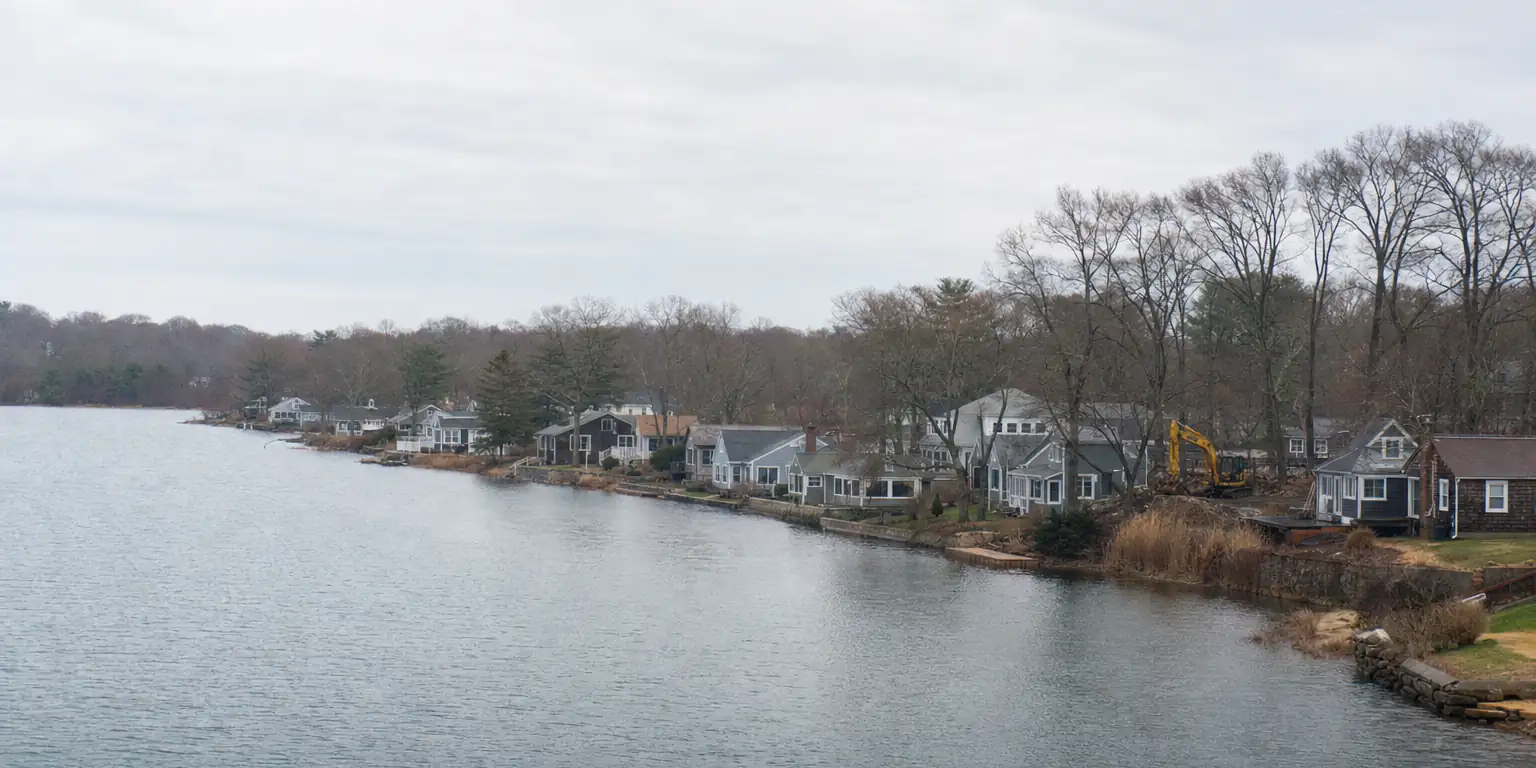
Coventry, RI · the lake-cottage question
Take it down,
or take it apart?
Around Johnson’s Pond and Tiogue Lake, hundreds of seasonal cottages are aging into the same decision: full demolition and rebuild, or a strip-to-the-frame renovation. We’re the demolition contractor for either answer in Coventry — and because we do the excavation too, we’ll tell you honestly which one your lot is asking for.
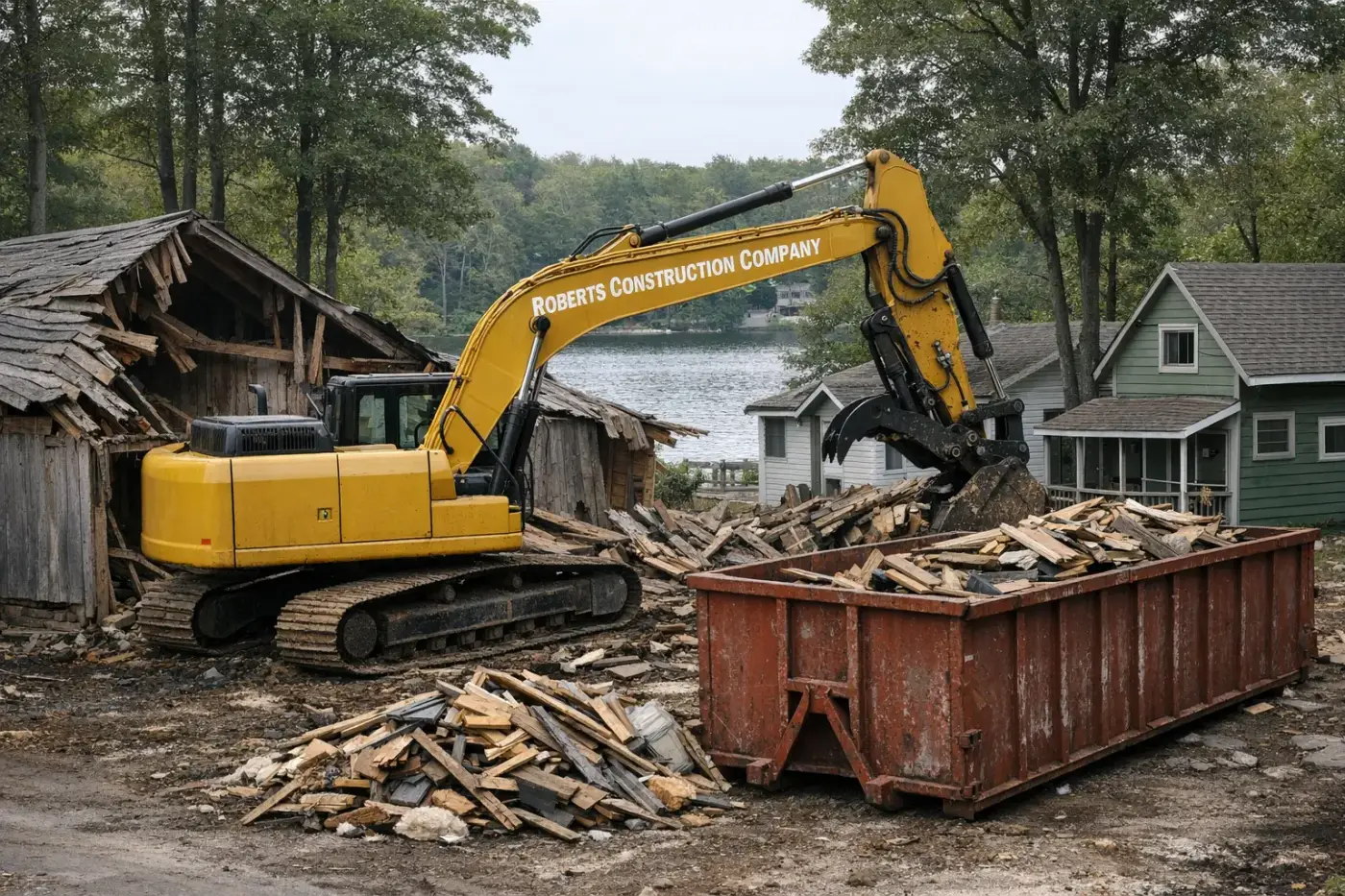
Path A · Knockdown-rebuild
What a full teardown involves on a small lake lot.
A cottage demolition in open country is a day of machine work. On a 5,000-square-foot Johnson’s Pond lot with the water behind you, a neighbor eight feet off each side, and a leach field under the only staging area, it’s a sequence — and the sequence is the job.
- 01
Hazmat first, permit second
Licensed inspectors survey for asbestos — common in cottage-era siding, flooring, and pipe wrap — and RIDOH approves the abatement plan before Coventry issues the demolition permit. Lead-safe practices cover the rest of the envelope.
- 02
Disconnects, documented
Electric killed at the pole through the utility, water and sewer capped where the villages have them, propane tanks pulled, and the septic tank pumped before anything moves. Dig Safe (811) marks the lot before a bucket touches soil.
- 03
Protection zones set
The tank and leach field get fenced as no-track zones, silt sock goes in along the shoreline side, and we plan the swing so demolition debris loads out over the driveway — never over the field, never toward the water.
- 04
The knockdown
Sized to the lot: a compact excavator with a thumb for most cottages, working top-down, wetting for dust, sorting metal from wood from mixed debris as the pile comes apart. Tight-access demolition is picking, not smashing.
- 05
Foundation out, hole ready
Fieldstone or block comes out whole, slabs get broken and lifted, and any surprise boulders are handled the same way we approach rock removal on any Coventry dig. What's left is a clean, inspected cellar hole ready for new footings.
From there the project rolls straight into site preparation and grading for the new foundation — one contractor, no handoff gap between the last load of debris and the first footing form.
Path B · Strip and renovate
When the smarter demolition is a partial one.
Some lake cottages shouldn’t come down — because their footprint is worth more than their frame. A cottage that predates today’s shoreline setbacks often sits where nothing new could be permitted. Keep the structure legally standing and you keep that position; level it the wrong way and you may be negotiating with the zoning board for a smaller house further from the water.
Our part of a renovation is the selective demolition: interior gut to the studs, porch and addition removal, chimney take-downs, and the excavation that renovations on old cottages almost always need — undermined corners re-supported, crawlspaces opened up, failed perimeter drainage replaced. The same hazmat rules apply at renovation scale: asbestos gets surveyed and abated before disturbance, whatever the project is called on the permit.
Outbuildings complicate lake lots too. We fold shed and garage removal, stump removal, and land clearing into the same mobilization, so the lot gets cleaned up once instead of three times.
What actually decides it.
Four factors settle most Coventry teardown-versus-renovate calls. We walk every one of them with you on site before you spend a dollar on design.
TeardownFieldstone or block foundation heaving, rotted sills, cottage racked out of square — the frame has nothing left to give.
Keep itFoundation sound or economically repairable; the frame holds a level line and can carry a second story.
TeardownOld cesspool or failed system — Rhode Island phases cesspools out, and a rebuild is the moment a new OWTS gets designed into the lot properly.
Keep itA conforming OWTS already permitted and sized for the bedroom count you want to keep.
TeardownNew footprint can meet — or get relief from — today's shoreline setbacks; the lot geometry supports a compliant rebuild.
Keep itThe existing nonconforming footprint sits closer to the water than anything you could permit new. Keeping walls keeps the envelope.
TeardownAsbestos siding, pipe wrap, or lead paint throughout — abatement plus renovation costs converge on replacement cost anyway.
Keep itLimited, accessible hazmat that a targeted abatement handles without touching the whole shell.
Rhode Island demolition runs on a fixed order: asbestos survey and RIDOH-approved abatement plan, then the demolition permit from the Coventry building official, then utility disconnects, then Dig Safe (811), then the machine. Debris is sorted and hauled to licensed facilities — much of the state’s C&D stream ends up with processors or at Rhode Island Resource Recovery’s Central Landfill in Johnston. Work near Johnson’s Pond or Tiogue Lake adds RIDEM freshwater-wetlands jurisdiction and Coventry Conservation Commission review to the stack.
General guidance — confirm current requirements with RIDOH, RIDEM, and the Town of Coventry building official for your specific structure and lot.
Demolition — frequently asked
Five questions Coventry owners ask before the machine shows up.
- What has to happen before a demolition permit in Coventry?
- Rhode Island requires an asbestos survey by licensed professionals and, where asbestos-containing material is found, a RIDOH-approved Asbestos Abatement Plan before the town issues the demolition permit. Abatement happens first, demolition second — federal NESHAP rules apply on top. We build that sequence into the schedule from day one so the permit isn't the surprise at the end.
- Which utilities get disconnected before a Coventry teardown?
- Depends on the zone. An east-village house means a Kent County Water Authority service kill and, if sewered, a lateral cap coordinated with the Coventry Sewer Authority. A lake cottage usually means electric disconnect through Rhode Island Energy, pumping and handling the septic tank or cesspool, and pulling any propane tank. Every disconnect is documented before the machine arrives.
- Can you demolish a cottage on a tight Johnson's Pond lot without wrecking the septic?
- Yes — that's most of the planning. We locate the tank and leach field first, fence them off as no-track zones, and pick the machine (often a mini-excavator or a compact high-reach approach) so demolition and load-out happen from the driveway side, never over the field. A crushed leach field turns a demo budget into a septic-replacement budget.
- If I tear down, can I rebuild in the same footprint near the water?
- Often, but it's a zoning and wetlands question before it's a construction question. Many lake lots are legally nonconforming — the existing cottage sits closer to the shoreline than today's setbacks allow — and RIDEM freshwater-wetlands jurisdiction plus Coventry zoning determine what the new footprint can be. We recommend settling that answer before demolition, because the old footprint can be your most valuable asset.
- Where does Coventry demolition debris actually go?
- Sorted and hauled to licensed facilities — much of Rhode Island's C&D debris routes to processors or to Rhode Island Resource Recovery's Central Landfill in Johnston, the state's only landfill. Metals get separated for recycling, and any asbestos-containing material travels separately under manifest per RIDOH rules. Disposal is a real line item on a lake-cottage teardown, and we price it up front.
Not sure which path your cottage is on? Walk it with us before you decide.
We’ll look at the foundation, the septic, and the setbacks and give you a straight answer — teardown, renovation, or walk away. Related reading: our Coventry excavation page, our Coventry underground utilities page, and the full demolition services overview.
Also in CoventryExcavation Underground utilities