
(401) 479-1472

Foster, RI · Private service runs

Off-grid service runs across Foster.

Foster has no public water and no public sewer — anywhere in town. Every drop, every watt, and every gallon of wastewater moves through underground utilities that are privately owned, privately maintained, and usually much longer than anything a suburban lot would need. We build those runs: trench, bed, conduit, backfill, as-built. Our Sterling, CT shop is fifteen minutes from the town line.

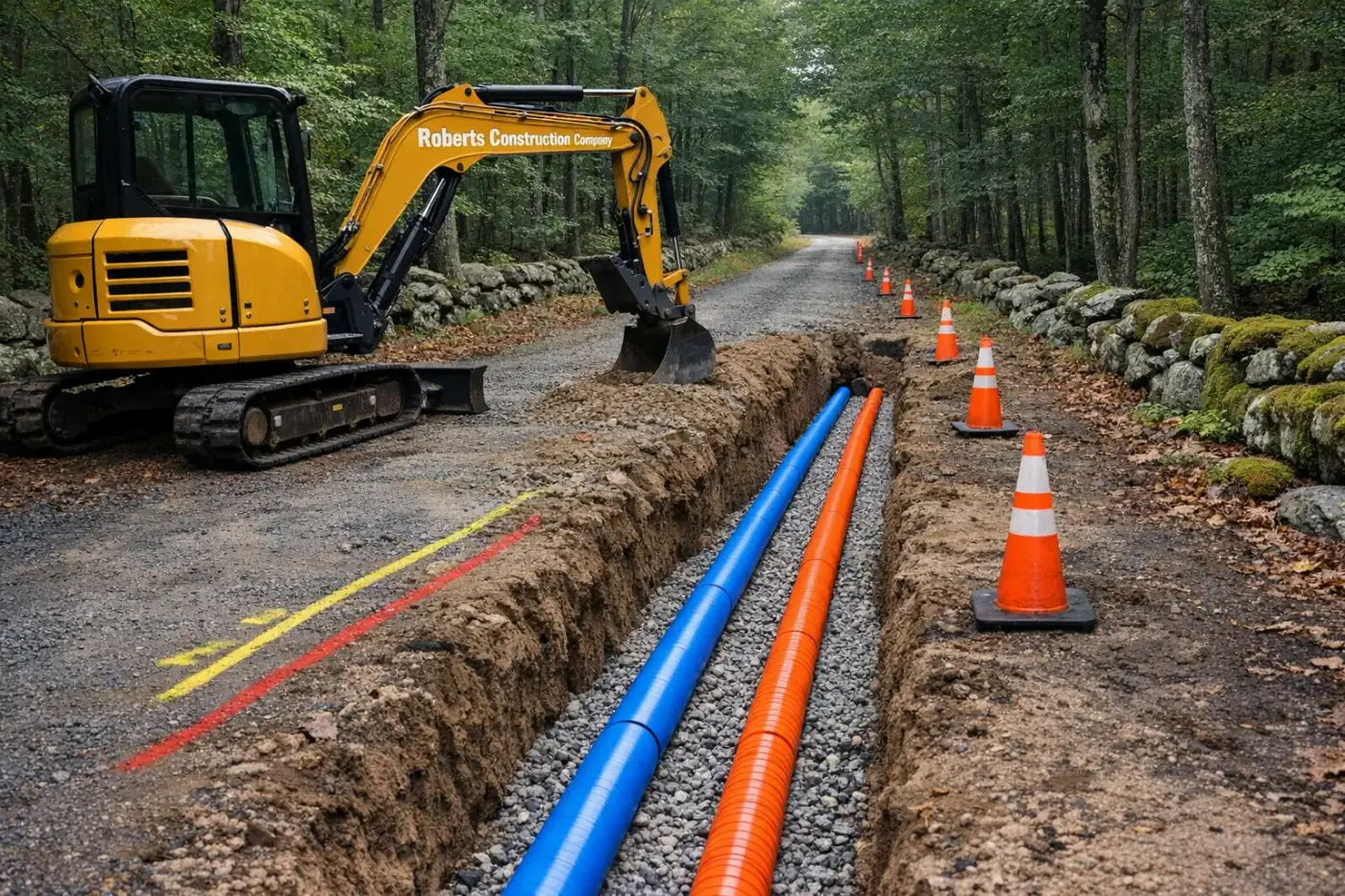
Underground utilities in Foster, RI — Roberts Construction Company excavator over an open water line and conduit trench
Underground utility trenching in Foster, RI — every dig starts with 811 marks.

RI Dig Safe · 811. Required before any excavation in Rhode Island. The marks stop at the meter — on a Foster lot, most of what’s buried is yours, and nobody paints it but us.

RUN 01

Well line + pump wiring

DEPTH ·
±4 ft frost cover
CARRIES ·
Supply pipe + pump circuit

Every Foster house drinks from a drilled well, and every well needs a trench: from the pitless adapter at the casing, below frost, to the pressure tank in the cellar. On wooded Foster acreage the casing often sits well away from the house — partly for RIDEM’s 100-foot minimum separation from the OWTS leach field, partly because the driller went where the water was. That makes the water line installation a real run, not a stub.

We put the pump’s electrical circuit in the same trench with the required separation, so the yard opens once instead of twice. Where ledge pushes the pipe shallow, we sand-bed and insulate before backfill. New siting jobs get coordinated with the well driller so the trench, the casing, and the future leach field don’t box each other in.

RUN 02

OWTS laterals & force mains

PERMIT ·
RIDEM OWTS rules
CARRIES ·
Gravity pipe or pressure main

With no sewer anywhere in town, Foster’s wastewater piping is all private: building sewer to tank, tank to distribution box, laterals out into the leach field. Rhode Island regulates all of it as an Onsite Wastewater Treatment System — designed by a RIDEM-licensed designer and approved by the state before we trench. Where the approved field sits uphill of the tank, the run becomes a pressurized force main with a pump chamber, and grade control gets replaced by air-tight joints and a checked pump curve.

We install laterals to designed grade, build the stone-and-pipe field, and handle repairs on the piping side — the failed line between tank and D-box is one of the most common calls we get from older Foster Center and Moosup Valley properties. Full system replacement lives on our sewer and septic line installation page; the trenching rules are the same either way.

RUN 03

Power + comms conduit, 400–600 ft

UTILITY ·
Rhode Island Energy specs
CARRIES ·
Feeder conduit + comms duct

Foster houses sit back. Long gravel drives off Route 6 and the town roads mean the last pole is often hundreds of feet from the meter — and most owners would rather not string new overhead line through the trees they moved here for. The alternative is a buried service: we trench from the pole or transformer, lay feeder conduit to Rhode Island Energy’s burial and sweep specifications, add a separate communications duct in the same trench, and set pull boxes where a 400-to-600-foot run needs them so the cable pull doesn’t fight the whole distance at once.

Division of labor is clean: we build and backfill the raceway as part of our electrical conduit installation scope, your licensed electrician pulls and terminates, and the utility connects at the pole. Empty spare conduit goes in while the trench is open — pulling fiber through a duct years later costs nothing compared to digging twice.

RUN 04

Generator & solar feeds

WHY ·
Rural feeders, long outages
CARRIES ·
Standby + array feeder conduit

When a storm drops trees on a rural feeder, the ends of the line wait longest — and Foster is the end of the line. That’s why standby generators are close to standard equipment here, and why ground-mount solar makes sense on lots with open field and no roof worth re-shingling around. Both need trenched feeds: a pad and buried circuit from the generator to the transfer switch, or a feeder run from the array — which can sit several hundred feet from the house — back to the panel.

We dig and prep the pad, trench the circuit with utility trenching done to burial spec, and grade the surface back so the run disappears. Fuel piping for a generator is the licensed gas fitter’s work; we open and close the ground it lives in.

Sequence

How a long private run gets built.

Same six steps whether the trench carries water, wastewater, or wire. On Foster’s glacial till the honest variable is rock — we test the route before we quote it.

  1. 01

    Walk and stake the run

    We flag the route around ledge outcrops, mature trees worth keeping, and anything the Ponaganset’s wetland buffers touch. The shortest line is rarely the right one.

  2. 02

    File Dig Safe (811)

    Mandatory in Rhode Island before any dig. Utility marks cover the public side; we locate the private side ourselves before the bucket goes in.

  3. 03

    Open the trench

    One pass through till where we can, hammer work where ledge says otherwise. Depth is set by what the trench carries — frost cover for water, burial spec for conduit.

  4. 04

    Bed, lay, and separate

    Sand bedding under pipe and conduit, required separation between services sharing the trench, pull boxes set on long conduit runs.

  5. 05

    Tape, backfill, compact

    Warning tape above every service, lifts compacted so the lawn or drive over the run doesn’t settle into a stripe next spring.

  6. 06

    Hand over the as-built

    A dimensioned sketch of what’s buried where. On an off-grid lot, that sketch is the only utility map your property will ever have.

General guidance — confirm current requirements with RIDEM, Rhode Island Energy, Dig Safe (811), and the Town of Foster building official for your specific parcel and scope.

Where this fits in the rest of a Foster project.

Service runs rarely travel alone. A new house needs the whole ground package — see our Foster excavation page for foundations, OWTS, and rural driveways. A long trench downhill of the house is also the cheapest moment to solve water: adding drainage pipe while the ground is open beats a second mobilization every time. And if the project starts with an old camp or barn coming down before the new service goes in, that’s our Foster demolition side of the shop.

For the service itself beyond Foster — methods, materials, and what we run town by town — the underground utilities hub covers the full scope.

Frequently asked — Foster utilities

Five questions before trenching a Foster service run.

Does Dig Safe mark the private lines on my Foster property?
No — and on a Foster lot that matters more than almost anywhere in Rhode Island. Dig Safe (811) marks utility-owned facilities, which typically end at the meter or the pole. Everything past that point — your well line, pump wiring, OWTS laterals, a 500-foot service conduit to the house — is private and unmarked. We still file the Dig Safe ticket on every job, then locate the private side ourselves from as-builts, pump-house clues, and careful test pits.
How deep does a well water line need to run in Foster?
Below frost — we trench supply lines at roughly four feet of cover, from the pitless adapter at the casing to the basement wall. Where ledge forces the line shallower, we bed it in sand and add rigid foam insulation over the pipe before backfill. The pump circuit usually rides in the same trench with the required separation, so the well only gets dug once.
Can you run power and communications 400 to 600 feet to a setback house?
Yes — that’s a standard Foster scope for us. We trench from the pole or meter point, lay conduit for the electric feeder to Rhode Island Energy’s specifications, add a separate comms conduit in the same trench, set pull boxes where the run length calls for them, and backfill with warning tape above. Your electrician pulls and terminates the conductors; we hand them a clean, inspected raceway.
What drives the cost of a long private run in Foster?
Three things, in order: length, rock, and what shares the trench. A 500-foot run through clean glacial till is straightforward machine work. The same run through outcrop ledge needs hammering or rock removal, and that’s the line item that moves a quote. Combining services in one trench — water and pump wiring, or power and comms — spreads the digging cost across everything in it, which is why we plan runs together instead of one at a time.
Do OWTS force mains and laterals need RIDEM involvement?
Yes. Any new OWTS piping or a repair to tank-to-field lines falls under RIDEM’s Onsite Wastewater Treatment Systems rules — a licensed designer specifies the system and RIDEM approves it before we install. We build the trenches, set the pipe to the designed grade or install the pressurized force main, and coordinate the RIDEM inspection alongside the Foster building official’s permits.

RUN 05 · YOURS

Tell us what needs to get from there to here, and how many feet are in between.

We’ll walk the route, flag the ledge, and quote the whole run — fifteen minutes from the Sterling shop to anywhere in Foster.