
(401) 479-1472
Foster, RIStructures: 4 typesStatus: taking work

The Foster teardown dossier.

Rural demolition in Foster isn’t about wrecking balls — it’s hunting camps a half mile up a wood road, barns that quit standing on their own, tired mobile homes, and the occasional fire loss. Getting equipment there and debris out is half of every job. We run it all from our Sterling, CT shop, fifteen minutes from the town line.

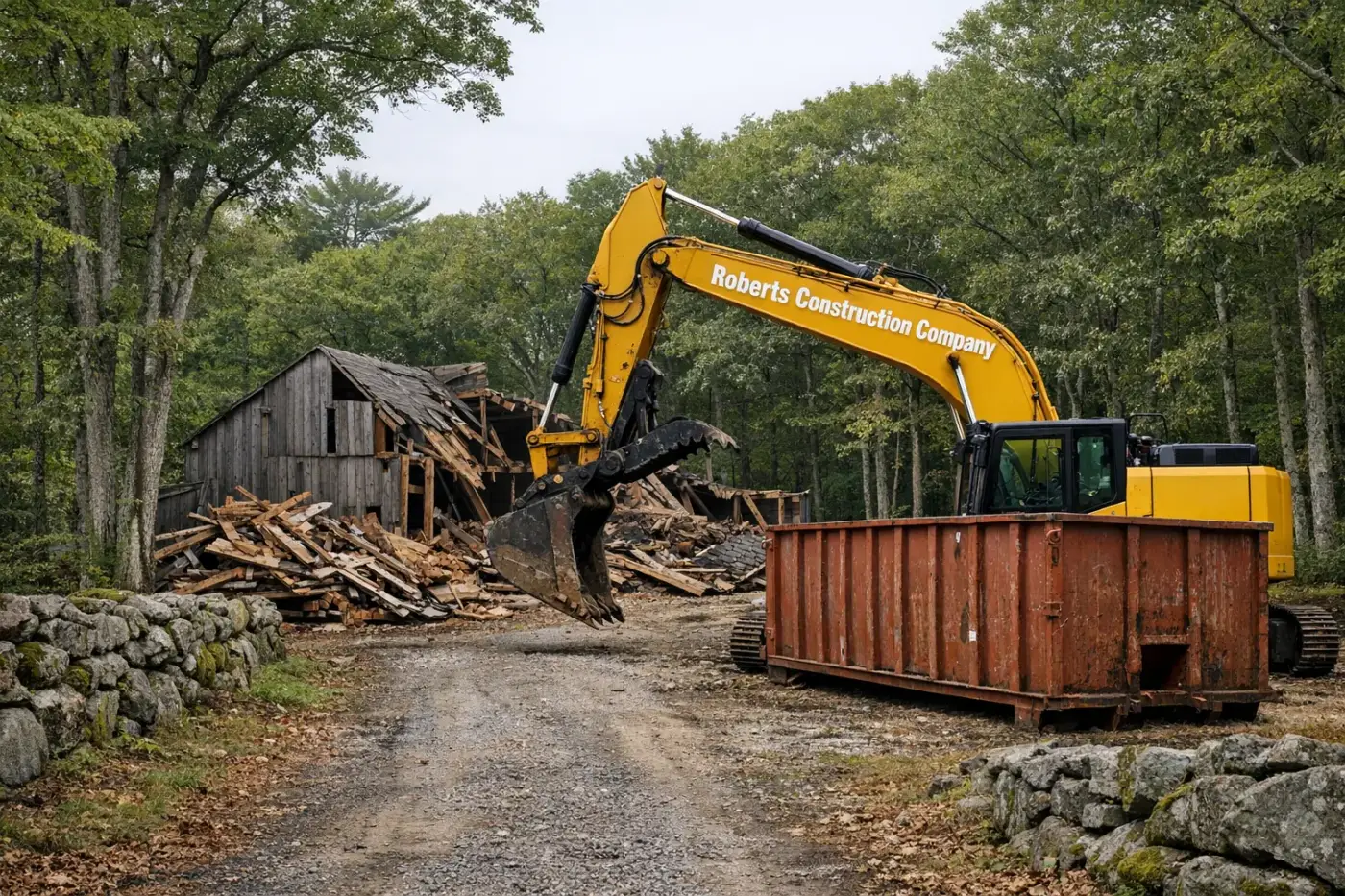
Demolition contractor in Foster, RI — Roberts Construction Company excavator taking down a barn
Structure demolition in Foster, RI — tested, disconnected, then taken down.
FILE 01

The hunting camp

Seasonal, small, and a long way from the road

Typical structure
One-room to 600 sq ft frame camp, pier or block foundation
Access
Wood road off pavement, often unmaintained for years
Utilities to kill
Frequently none — maybe a propane bottle and an outhouse

Foster’s woods are full of mid-century deer camps whose owners aged out of them. Most sit on piers or dry-stacked block, which makes the teardown itself quick — the job is really about getting there. We walk the old wood road, brush the corridor back to working width, and firm up wet spots before the first machine rolls.

Camps this size often never had electric service, which removes the disconnect step entirely. The survey-and-permit sequence still applies, and everything — frame, roofing, the rusted stove — leaves the woods on our trucks. What stays behind is a graded clearing you could park a new camp on.

FILE 02

The collapsed barn

Down on its own schedule, dangerous to finish by hand

Typical structure
Hay or dairy barn, timber frame, dry-laid stone foundation
Access
Farmyard or field edge — usually the easy part
Watch for
Buried fuel cans, hardware in every stick, standing gable ends

Foster was farm country before it was forest, and the barns are still letting go one snow load at a time. A half-collapsed timber frame is unpredictable — standing gable ends and racked bents can move when you pull the wrong member. We work them with the machine, top down, and never send anyone under a hung frame.

The good news in an old barn is salvage: hand-hewn timber and weathered board have buyers, and the dry-laid stone foundation is often worth keeping as landscape material or wall stone. We sort as we go — timber one pile, stone another, scrap steel a third — so what has value doesn’t ride to Johnston with the debris. Afterward the stump line and overgrowth usually want attention too; that’s our land clearing and stump removal work on the same mobilization.

FILE 03

The mobile home

Fastest teardown on this page — if the paperwork is ready

Typical structure
Single-wide on piers or slab, steel chassis underneath
Access
It got in on wheels — the route usually still exists
Utilities to kill
Electric at the pole, well line, OWTS connection, oil or propane

Older single-wides scattered on Foster’s back lots reach the end of repairable life, and hauling one out whole is rarely worth it. We strip the interior, break the box, and separate the steel chassis and axles for scrap — the frame often pays a meaningful piece of the disposal bill.

The utility closeout is the part owners underestimate: the electric disconnect has to be confirmed with Rhode Island Energy before we touch the structure, the fuel tank gets pumped and removed, and the well and OWTS get protected or closed depending on what’s next for the lot. If a new home is coming, we roll straight into site preparation on the same footprint.

FILE 04

The burned-out house

Emotional job, procedural teardown

Typical structure
Fire-damaged full-size dwelling, standing chimney, open cellar
Access
Established driveway — but fire trucks may have rutted it
Watch for
Asbestos survives fire; documentation drives the insurance claim

A fire loss is the one teardown nobody planned for. The sequence is strict: asbestos survey (fire doesn’t exempt it), RIDOH paperwork, town permit, confirmed disconnects, then the chimney comes down first — it’s the least stable thing standing. We photograph everything and keep every disposal receipt, because the insurance file is as much a deliverable as the cleared lot.

The cellar hole gets filled with compacted, documented lifts — never with debris — and graded to drain. Done right, the lot comes out of the worst month of your life ready for a rebuild, with the well and OWTS preserved for the next foundation.

The through-line

In Foster, the road to the structure is part of the demolition.

The most rural town in Rhode Island keeps its teardowns at the ends of gravel drives and grown-in wood roads. Before we quote the structure, we quote the route: can a tri-axle make the turn, will the wet crossing near a Ponaganset tributary need matting, is there ledge in the one spot the road has to widen? Wetland edges get flagged and respected — RIDEM and the Foster Conservation Commission review work near regulated streams, and a debris truck rut in a buffer is a problem no one needs.

Mud season is real here. Frozen ground in January carries loads that March swallows whole, so remote jobs get scheduled around the ground first and the calendar second. Where the access itself needs work, our grading and rock removal crews open the route — and the improved road stays behind as a bonus deliverable.

Paperwork & closeout

Five steps every Foster teardown clears, in order.

  1. 1

    Asbestos survey & RIDOH plan

    Licensed inspection before anything else; RIDOH-approved abatement plan when material is found. The town permit waits on this.

  2. 2

    Demolition permit

    Through the Town of Foster building official, with lead-safe practices on pre-1978 structures.

  3. 3

    Utility disconnects

    Electric confirmed dead at the pole with Rhode Island Energy; fuel tanks pumped and pulled; well and OWTS protected or closed per RIDEM practice.

  4. 4

    Dig Safe (811)

    Filed before grubbing foundations or filling the cellar hole — even in Foster, where most of what’s buried is private and unmarked.

  5. 5

    Sorted disposal

    Steel to scrap, clean masonry reused where approved, mixed C&D to licensed processors and the Central Landfill in Johnston. Receipts kept.

General guidance — confirm current requirements with RIDOH, RIDEM, and the Town of Foster building official for your specific structure and parcel.

A cleared Foster lot is usually the start of something.

Most of our demolition files end with a second scope on the same mobilization: land clearing and stump removal where the woods have closed in around the structure, then site preparation if a new build is coming to the footprint. The full ground package for the town — foundations, OWTS, wells, driveways — lives on our Foster excavation page, and new service trenches to a rebuilt structure are covered under Foster underground utilities.

For how we run demolition everywhere we work — methods, machines, and safety practice — see the demolition services hub.

Frequently asked — Foster demolition

Five questions before a rural Foster teardown.

Does a small hunting camp in Foster really need an asbestos inspection?
Usually, yes. Rhode Island requires an asbestos survey by licensed professionals before demolition, and RIDOH approval of an abatement plan when asbestos-containing material is found — the town won’t issue the demolition permit without that step resolved. Mid-century camps are exactly the vintage where cement siding, pipe wrap, and old flooring turn up positive. We build the survey into the schedule so it never stalls the machine.
What happens to the well and septic system when a structure comes down?
They get closed out properly, not buried and forgotten. The OWTS tank is pumped by a licensed hauler, then crushed and filled or removed per RIDEM practice. A well that won’t serve a future structure is capped or formally abandoned by a licensed well driller. If you’re rebuilding on the lot, we protect both — a working well and an approved OWTS are worth real money on a Foster rebuild.
Can you reach a camp that’s a half mile off the pavement?
That’s the Foster specialty. We assess the wood road first — width, wet crossings, ledge pinch points — then improve what needs improving: brush back the corridor, regrade the running surface, mat the soft spots. Timing matters more than distance; a road that carries a loaded truck fine in August is impassable in March mud season, so we schedule remote teardowns around the ground, not the calendar.
Where does Foster demolition debris actually go?
Off the property, sorted. Steel — mobile home frames, roofing, appliances — goes to scrap. Clean concrete and stone can often stay on site as approved fill or get crushed for reuse. Mixed construction and demolition debris trucks to licensed C&D processors and the Rhode Island Resource Recovery Central Landfill in Johnston, about a half hour east. Burying debris in the cellar hole is illegal and shows up on every future title and perc question — we don’t do it.
Do you take down burned-out houses, and does insurance get involved?
Yes. Fire jobs still require the asbestos survey — a burn doesn’t exempt the structure — plus careful documentation. We photograph before and during, keep disposal receipts, and coordinate scope with the adjuster so the teardown, the cellar hole fill, and the site grading are all in the claim paperwork. The chimney usually outlasts the fire; dropping it safely is step one.

New file · your structure

Send us a photo and a pin. We’ll walk the road, price the teardown, and tell you what the paperwork needs.