
Underground utilities · Glocester, RI
Underground utilities in Glocester run two ways: village lot or backroad.
There’s no public water and no public sewer anywhere in town — the village included — so every utility line in Glocester is private-side work. What changes is the ground it crosses. We’ve dug both kinds for two decades from our Sterling, CT shop, twenty minutes down the road.
Context A
The village center
Chepachet’s National Register core along Route 44 — small 19th-century lots, fieldstone foundations, stone walls, wells and septic squeezed onto the same quarter acre.
Context B
The backroads
Harmony ridges and West Glocester acreage to the Connecticut line — long driveways, wooded frontage, glacial till, ledge that surfaces without warning.
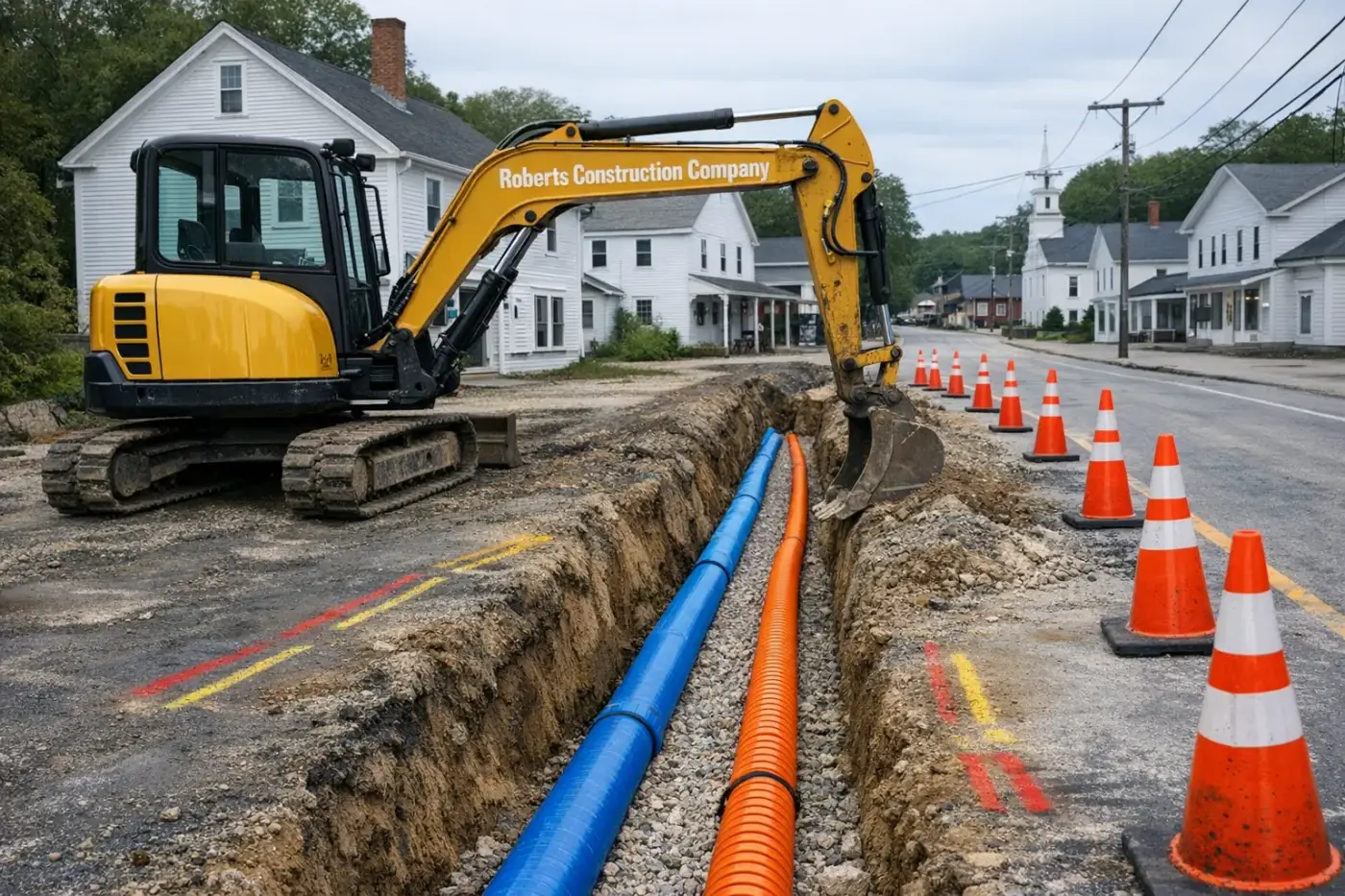
Water lines
In Chepachet village
Replacing supply lines where the lot has no room to spare
The village core along Route 44 was platted in the 1800s, long before anyone worried about separation distances. Wells, OWTS, stone foundations, and property lines all crowd each other, so a failed supply line rarely gets re-trenched on its original route — we plot a new path that keeps legal separation from the leach field, often threading between the house and a neighbor’s wall. Water line installation in the village is a surgical job, not a straight-line job.
On the backroads
Long runs from roadside wells across big frontage
Out in Harmony and West Glocester the problem inverts: plenty of room, serious distance. A well set near the road with the house 400 feet back means a long trench at four-foot bury, pipe sized for pressure loss, and tracer wire so the line can be found in thirty years. We cut through till, root mat, and the occasional ledge shelf, and backfill in lifts so the driveway crossing never settles.
Wastewater laterals
On the backroads
Full-length OWTS runs with room done right
Rural Glocester acreage lets us do what the regulations intend: generous well-to-leach-field separation, gravity runs at consistent pitch, and tanks set where the pump truck can actually reach them. The same crew that installs sewer laterals in towns that have mains runs these lines — same pitch discipline, same bedding spec, different destination.
In Chepachet village
Building-to-tank pipe on postage-stamp lots
Glocester has no municipal sewer, so the wastewater trench here is the building lateral: house to septic tank, tank to distribution. On tight village lots the state’s current OWTS separation rules are genuinely hard to satisfy — which is exactly why the town has studied public water for the village. Until infrastructure changes, we make small-lot systems work: shallow-cover pipe with insulation where grades force it, and careful hand-digging around the fieldstone foundations that anchor these houses.
Power & communications
In Chepachet village
Conduit that respects a National Register streetscape
Rhode Island Energy’s lines run overhead through the village, and owners of the old houses increasingly want the last leg underground — no service drop across a 19th-century facade. That means electrical conduit trenched in tight quarters: shallow lots, granite steps, stone walls that must go back stone-for-stone. In the historic district we route to protect what’s visible from the street, because that’s what the commission — and the neighbors — care about.
On the backroads
One trench, three utilities, six hundred feet
Long wooded driveways are the classic West Glocester conduit job. We cut a single utility trench from the pole to the house and lay power and communications conduit together at code separation, with warning tape and clean sand bedding. Generators and barn subpanels ride the same mobilization. Trenching the driveway once beats trenching it three times — and beats losing power every time a pine limb comes down on an overhead run.
Drainage
On the backroads
Culverts, ditch lines, and driveways that survive March
Rural drainage is about the driveway: culverts sized for spring melt, ditch lines that carry water past the house instead of into it, and check-dam protection on grades. Glocester’s small streams feed RIDEM-regulated wetlands, so we confirm where the buffers sit before we redirect anything — a drainage fix that triggers a wetlands violation isn’t a fix.
In Chepachet village
Getting roof and cellar water off crowded lots
Village houses sit close together on ground that slopes toward the Chepachet River, and their fieldstone cellars have been damp for two centuries. We trench tight-lot drainage — curtain drains, buried downspout lines, daylight outlets — with an eye on where the water lands, because on these lots your discharge point is ten feet from someone else’s foundation.
Before either kind of trench opens.
Dig Safe (811) on every job. Rhode Island requires the call before any excavation, village or backroad. Public utilities get marked; private lines — old farm water lines, well supply runs, buried generator feeds — don’t, so we probe and hand-expose where history suggests something’s down there.
RIDEM where water moves. Freshwater wetlands buffers along the Chepachet River and the town’s many small streams reach up to 200 feet. Trench routes and drainage discharge points get checked against the mapped buffers before we quote.
The commission in the village. Work visible from the street inside the Chepachet Village Historic District can need Glocester Historic District Commission review. We flag it early so a two-day trench doesn’t wait a month for an approval nobody requested.
General guidance — confirm current requirements with Dig Safe, RIDEM, and the Town of Glocester for your specific parcel and scope.
Frequently asked — Glocester utilities
Five questions about running utility lines in Glocester.
- Does Chepachet village have public water or sewer?
- No. Chepachet village runs on private wells and RIDEM-permitted OWTS, same as the rest of Glocester. The town has studied bringing public water into the village — the most recent feasibility work pointed to a connection with Burrillville's Clear River district as the leading option — but nothing is in the ground yet. The only piped-water exception in town is a small lakeside district near Echo Lake. Plan every utility job in Glocester as private-side work.
- How deep do you bury water lines in Glocester?
- Four feet is our standard bury — safely below northwest Rhode Island frost depth. On ledge-heavy sections where four feet isn't achievable without blasting, we insulate the shallow run and document it. Long backroad runs also get sized for pressure loss: a 600-foot run from a roadside well to a house is a different pipe spec than a 60-foot village hop.
- Can you put power underground down a long rural driveway?
- Yes — that's one of our most common Glocester requests. We trench and set conduit from the pole at the road to the house, coordinate the specs with Rhode Island Energy and your electrician, and usually share the trench with communications conduit at code-required separation. One mobilization, one trench, two or three utilities.
- Do I really need Dig Safe on a wooded backroad lot?
- Yes. Dig Safe (811) is mandatory in Rhode Island before any excavation, and rural lots are where surprises live — unmarked well lines, old farm water lines, and private power runs that no utility ever mapped. The 811 ticket covers the public utilities; we probe and hand-expose around anything private the locators can't flag.
- Does the historic district complicate trench work in Chepachet?
- Below-grade work on private property is usually straightforward, but street-front excavation, stone walls, and anything touching a contributing structure's setting can draw Glocester Historic District Commission review. We've worked around the village's stone foundations and tight setbacks before — we plan trench routes so the streetscape goes back exactly as it was.
Village lot or backroad run — tell us which, and we’ll price the trench.
Underground utilities are one slice of what we do in town — see our full Glocester excavation scope, our Glocester demolition page, or the underground utilities service overview for how we run this work everywhere.
Also in GlocesterExcavation Demolition