
(401) 479-1472

Obsolete-structure register · Glocester, RI

The buildings Glocester is done with — and how demolition handles each one.

A rural town three centuries old sheds structures in predictable classes: lake camps that were never houses, barns that outlived their farms, village ells that failed before the house they lean on. We keep a working register of what comes down in Glocester and run a proven takedown for each class — with extra care where the historic village is watching.

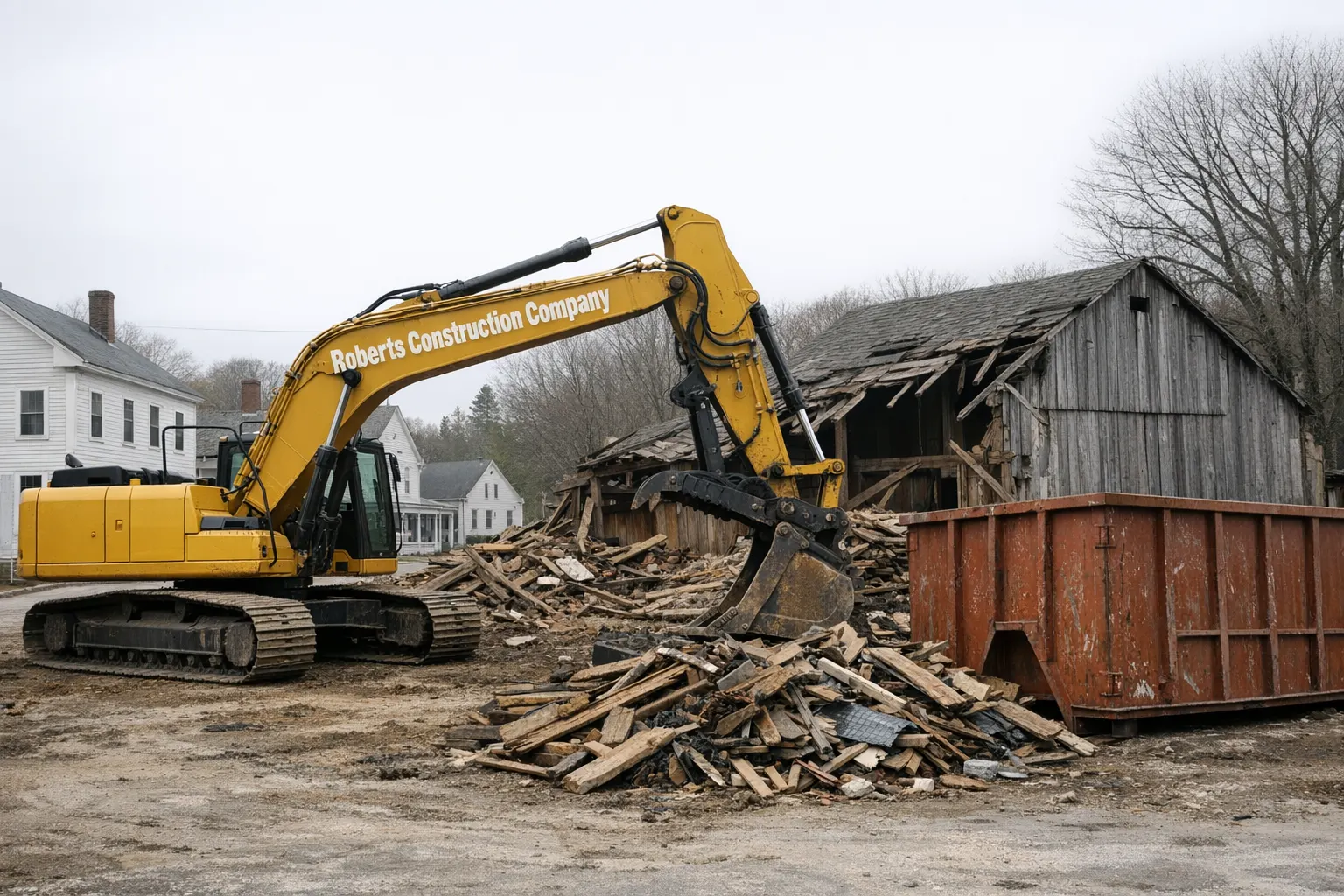
Demolition contractor in Glocester, RI — Roberts Construction Company excavator taking down a barn
Structure demolition in Glocester, RI — tested, disconnected, then taken down.

The register.

R-01

Seasonal lake camps

Echo Lake (Pascoag Reservoir) · Waterman Reservoir

Why it comes down

Built as summer shacks on piers and block, now sitting on year-round waterfront value. Undersized footprints, no real foundations, and framing that was never meant to see February. Owners buy the water, not the building.

How we take it down

Small-machine work on tight lake lots with neighbors a driveway’s width away. Erosion controls between the work and the water — these shorelines sit inside RIDEM-regulated buffers — and debris loaded straight to the truck because there’s nowhere to stage a pile.

What the lot becomes

A year-round house on a full foundation. We usually handle the site preparation and the new dig in the same mobilization as the teardown.

R-02

Dairy barns & farm outbuildings

West Glocester · Harmony farm parcels

Why it comes down

Glocester’s farm era left timber-frame barns, sheds, and coops that outlived their farms. Roof failure lets water in, sills rot on the stone, and an unmaintained barn moves from asset to insurance liability fast.

How we take it down

Selective and salvage-minded: hand-hewn beams set aside if they’re sound, metal roofing sorted for recycling, and the frame dropped away from the dry-laid stone foundation so the walls survive the building they held up.

What the lot becomes

A pad for a new pole barn, restored pasture, or a stone perimeter kept as a landscape feature. Pair it with land clearing and stump removal when the overgrowth comes down with the barn.

R-03

Failed ells & additions

Chepachet village houses

Why it comes down

The village’s 19th-century houses grew by accretion — kitchen ells, woodsheds, lean-tos on rubble footings. Those add-ons settle and rot at a different rate than the original block, and eventually the worst piece threatens the best piece.

How we take it down

Surgical partial demolition: hand separation at the connection, the machine working away from the historic main block, and the exposed wall weathered-in the same day. Inside the historic district, we coordinate the streetscape questions before permits are filed.

What the lot becomes

Either a clean restored original footprint, or a code-built addition on a proper frost wall — dug, formed, and backfilled by the same crew that took the old one off.

R-04

Mobile homes & derelict structures

Rural roads townwide

Why it comes down

End-of-life mobile homes, fire-damaged houses, and long-vacant structures the building official has flagged. They drag on the parcel’s value and, once open to weather, they only get more expensive to deal with.

How we take it down

Utility disconnects confirmed first, asbestos survey done — older units and mid-century houses hide it in flooring and pipe wrap — then a fast, clean takedown with the pad, piers, and skirting removed along with the structure.

What the lot becomes

A buildable lot with a documented clean slate, or graded and seeded green space. Rough and finish grading closes the job.

R-05

Chimneys, silos & buried remnants

Foundations · slabs · cisterns

Why it comes down

Partial structures are their own category: a leaning chimney after a house fire, an orphaned silo, an old cellar hole hiding in the brush at the edge of a field. All of them are fall hazards or machine traps.

How we take it down

Top-down masonry drops for the vertical pieces; for cellar holes and slabs, either full removal or break-and-bury below grade, with the machine probing carefully — old Glocester farmsteads hide dug wells and cisterns nobody mapped. Ledge under a slab isn’t rare here either; we handle the rock removal when it is.

What the lot becomes

Compacted structural fill placed in lifts and documented, so the next builder — maybe you — knows exactly what’s under the grass.

The Chepachet standard

Demolition inside a National Register village is a different trade.

The Chepachet Village Historic District — the 1842 Dorr Rebellion village, the old mill cluster, the houses shoulder-to-shoulder along Route 44 — is the kind of place where a careless teardown does damage that never gets undone. Contributing structures draw Glocester Historic District Commission review, and even non-contributing work happens a few feet from buildings that are irreplaceable.

So village demolition gets a stricter playbook from us: smaller machines, hand separation where an ell meets an original block, vibration awareness next to two-hundred-year-old rubble foundations, dust control on a street where the neighbors are close enough to hear the radio, and salvage of granite steps, stone walls, and old brick that belong to the streetscape even when the building behind them is done. We’d rather spend an extra day protecting the village than be the contractor Chepachet remembers for the wrong reason.

Out on the backroads the machines get bigger and the pace picks up — but the sequencing below stays exactly the same.

The order of operations, every time.

Demolition jobs go wrong in the sequencing, not the smashing. This is the Glocester version of ours.

  1. 01

    Asbestos survey and RIDOH plan

    A licensed inspector surveys the structure first. Rhode Island requires a Department of Health-approved asbestos abatement plan before the town issues a demolition permit, and abatement runs on advance notification to RIDOH — with RIDEM notified as well. Any abatement happens before we mobilize.

  2. 02

    Utility disconnects

    Electric service dropped at the pole and confirmed with Rhode Island Energy. No gas mains out here — but propane tanks get emptied and removed by the supplier, and buried fuel lines get found before the machine does.

  3. 03

    Permit from the Glocester building official

    Demolition permit through Town Hall in Chepachet, with Historic District Commission review layered in when the structure contributes to the village district.

  4. 04

    Dig Safe (811), then well and OWTS handling

    The 811 ticket precedes any grubbing of foundations. The septic tank is pumped by a licensed hauler and abandoned — crushed or filled — and the well is capped or preserved for the rebuild in coordination with a licensed well driller.

  5. 05

    Takedown and haul-off

    The structure comes down per its register entry above. Debris is sorted — metal recycled, clean wood separated — and hauled on our trucks to licensed C&D facilities. The town transfer station on Chestnut Hill Road is for residents' household loads, not contractor demo debris.

  6. 06

    Grade, compact, stabilize

    Fill placed in compacted lifts, the lot graded to drain, and disturbed ground seeded or stabilized so the parcel is an asset the day we leave — build-ready if that's the plan.

General guidance — confirm current requirements with RIDOH, RIDEM, and the Town of Glocester building official for your specific structure and parcel.

Frequently asked — Glocester demolition

Five questions before a Glocester structure comes down.

Do I need an asbestos inspection before demolishing in Glocester?
In practice, yes. Rhode Island requires an asbestos abatement plan approved by the Department of Health before the town can issue a demolition permit, and abatement work runs on advance notification to RIDOH — with RIDEM notified as well. Even a 1970s lake camp can hide asbestos in flooring, siding, or pipe wrap, so the survey happens first, every time. We sequence the licensed abatement contractor before our machine ever arrives.
Who issues the demolition permit in Glocester?
The Glocester building official, at Town Hall in Chepachet. If the structure is a contributing building inside the Chepachet Village Historic District, expect Historic District Commission involvement before anything visible from the street comes down. We flag the district question on day one because it changes the schedule more than anything else on the checklist.
What happens to the well and septic after a demolition?
Since every Glocester property runs a private well and an OWTS, both need a plan. The septic tank gets pumped by a licensed hauler and then abandoned properly — crushed or filled so it can never collapse under someone's lawn. The well is either preserved for the rebuild or capped in coordination with a licensed well driller. Skipping either step creates a hazard the next owner inherits.
Can you take a barn down without wrecking the stone foundation?
Yes — it's one of our favorite jobs. We drop the frame away from the walls, pick debris out with the machine rather than pushing through, and leave the dry-laid stone intact for reuse as a garden wall, a pole-barn perimeter, or simply a piece of the property's history. If there's salvageable hand-hewn timber, we set it aside before the frame comes down.
Where does the demolition debris go?
Off site on our trucks, sorted and hauled to licensed construction-and-demolition facilities — metal separated for recycling, clean wood and mixed C&D each to the right destination. Glocester's transfer station on Chestnut Hill Road serves residents' household loads, not contractor demolition debris, so disposal is built into our price rather than left as your problem.

Register entry pending

Got a camp, a barn, or a leaning ell that belongs on this list? Send us the address.

Demolition usually leads to digging — see our Glocester excavation page for what comes next, our Glocester underground utilities page for re-serving the rebuilt lot, or the demolition services overview for how we run this work everywhere.