
Anatomy of a job · Griswold, CT
Scope: structure demolition
Demolition in Griswold: taking down a mill-village house without touching the one next door.
Most of our Griswold demolition work happens on the tight 19th-century blocks of the Jewett City borough — houses built for mill workers, a few feet apart, on streets with nowhere to stage. Here’s that job, stage by stage, the way we actually run it.
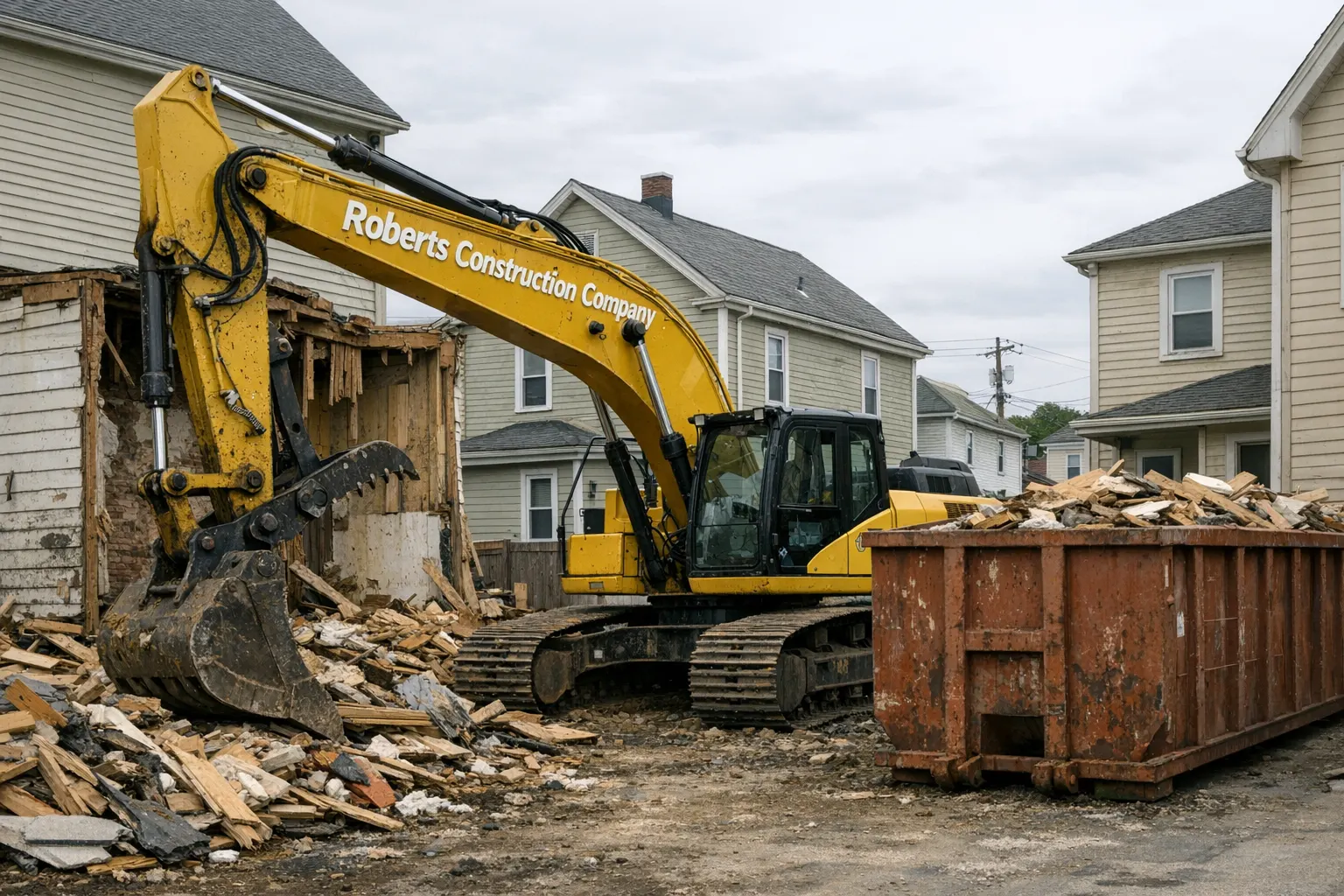
The paperwork comes down before the house does.
A Griswold demolition starts at a desk: the demolition permit through the town building official, and Connecticut’s asbestos sequence through the state Department of Public Health. Commercial buildings and residential structures of five or more units require a licensed asbestos inspection before demolition, and a notification is filed for demolitions even when no asbestos turns up. Where asbestos is found in a structurally sound building, abatement happens first — a licensed abatement contractor for anything beyond 3 linear or 3 square feet.
Mill-era buildings earn their reputation here. Pipe lagging in the cellar, 9x9 floor tile, transite siding under vinyl — houses built or re-sided across the 1900s hide all three. Budgeting the survey up front beats discovering it with the machine running.
Killing three services owned by three different outfits.
Inside the Jewett City borough line, a teardown means coordinating three separate utilities. JCDPU — the borough’s municipal utility — pulls the electric service and governs the sewer side, where the lateral gets excavated and capped at the main under their inspection. The Jewett City Water Company, the private water utility that has served the borough since 1894, kills the water service. Each cap is a small dig of its own, called into CBYD (811) like any other.
Outside the borough the checklist swaps to rural: cap the well, pump the septic tank, crush and backfill it in place per the Uncas Health District’s abandonment expectations. Either way, nothing structural moves until every disconnect is confirmed.
Protecting the neighbor standing eight feet away.
Jewett City’s housing stock went up fast in the 1800s for mill workers, on lots drawn tight to the street and to each other. The practical result: the building next door is close enough to hit with a dropped rafter. So protection is its own stage — fence line barriers, plywood over the neighbor-side glazing where the owners agree, plates over sidewalk and curb where the machine tracks, and a hose on the pile because dust doesn’t respect a property line.
We photograph the neighboring foundations and walls before we start. It protects the neighbor, and it protects us.
Hand work on the close face, small iron on the rest.
On a lot this narrow, the machine can’t swing at everything. The face closest to the neighbor comes apart by hand — porches, connective sheds, the eave line — until there’s room to work. Then a compact excavator, sized to fit the side yard it has to enter through, pulls the structure top-down and always toward the open side of the lot. Big iron is for big sites; a borough teardown is won with a machine that fits between the houses.
Debris leaves one roll-off at a time.
There’s no room on a mill-village street to stage a fleet of containers, so the debris plan is a rotation: one roll-off in the footprint or at the curb, loaded sorted — clean wood separate from scrap metal separate from mixed C&D — and swapped as it fills. Sorted loads price better at the licensed volume-reduction facilities where contractor debris legally goes. Griswold’s own transfer station on Route 138 is a resident drop-off for small sorted loads, not a demolition outlet, so the house leaves town on trucks we schedule around the street, not against it.
The rubble-stone foundation comes out, the hole gets built back.
Under most borough houses is a dry-laid or lime-mortared rubble-stone foundation. Once the superstructure is down, we pull the stone, break out later concrete patches, and inspect what the cellar was hiding — old fuel tanks and cisterns are not rare finds in houses this age. Then the hole is rebuilt as ground: structural backfill placed in compacted lifts, graded to shed water toward the street or an approved point, never toward the neighbor eight feet away.
What the lot becomes next.
Some clients want a lawn; some want a building pad with utilities stubbed for the next structure. We finish either way — final grading, topsoil and seed, or a pad compacted and certified for the rebuild. On rural Griswold parcels the same crew rolls straight into clearing the rest of the lot when the teardown is step one of a bigger site plan.
When the teardown is step one of a larger plan, the follow-on scopes are ours too: land clearing and stump removal on the wooded parcels outside the borough, rock removal where the glacial till gives way to ledge, then grading and full site preparation for whatever comes next.
Frequently asked — Griswold demolition
Six questions owners ask before a Griswold teardown.
- Do I need an asbestos inspection before demolishing a Griswold house?
- Connecticut’s asbestos rules run through the state Department of Public Health. Commercial, industrial, institutional, and residential buildings of five or more units must be inspected by a licensed asbestos consultant before demolition, and a demolition notification is required even when no asbestos is present. If asbestos is found in a structurally sound building, it gets abated first — anything over 3 linear or 3 square feet by a licensed abatement contractor. We build that sequencing into the schedule, not around it.
- Who disconnects the utilities before a Jewett City teardown?
- Three separate owners, usually. JCDPU pulls the electric service and governs the sewer lateral cap at the main — with their inspection. The Jewett City Water Company kills the water service. Outside the borough it’s simpler on paper and dirtier in practice: cap the well, pump and crush the septic tank, and backfill it per the Uncas Health District’s abandonment expectations. Nothing comes down until every disconnect is confirmed in writing.
- Can you demolish a house that’s only a few feet from the neighbor’s?
- That’s the defining Jewett City job. Mill-village side yards can be single-digit feet wide, so we protect the neighbor’s side first, hand-strip the close face instead of pulling it with the machine, and run a compact excavator sized to the lot rather than the biggest iron we own. The machine always pulls debris toward the open side of the lot, never toward the property line.
- Where does the demolition debris go?
- Out of town, by roll-off, in sorted loads — clean wood, scrap metal, and mixed C&D each priced differently at licensed volume-reduction facilities. Griswold’s transfer station on Route 138 is a resident drop-off for small sorted loads, not an outlet for contractor demolition debris, so a full house never goes there. On a narrow borough street we cycle one container at a time instead of staging several.
- Do you remove the old foundation too?
- Yes, and in the borough it’s usually a rubble-stone foundation laid dry or in lime mortar in the 1800s. We pull the stone, break out any later concrete patches, then backfill in compacted lifts and grade the lot to drain — either as a finished lawn-ready pad or as prepared bearing for the next foundation if a rebuild is coming.
- Who issues the demolition permit in Griswold?
- The Town of Griswold building official. The permit rides on top of the state-level pieces — asbestos inspection and notification where required, utility disconnect confirmations, and CBYD marks — so we assemble that package once, in order, rather than chasing pieces after the machine is mobilized.
Eight feet of side yard is enough. We’ve worked with less.
How we run demolition everywhere is on the demolition services page. For the rest of our Griswold work, start with excavation in Griswold — and if the disconnects have you wondering who owns what pipe, our Griswold underground utilities page maps the whole borough-line puzzle.
Also in GriswoldExcavation Underground utilities