Underground utilities · Killingly, CT
Underground utilities in Killingly: one town, two completely different digs.
Inside the Danielson service area
Public water under one company, public sewer under a town authority, and a century of pipe already in the ground. The work is taps, laterals, and street openings — surgical trenching between old foundations on borough streets.
The other seven villages
Cross the borough line and both utilities disappear. Dayville, Ballouville, East Killingly, South Killingly, Williamsville — and most of Attawaugan and Rogers — run on private wells, septic, and whatever lines the owner buries. The work is long private runs across till and ledge.
The dividing line
Same town hall, different underground. Here’s the split, item by item.
Danielson service area
Rural Killingly
Water
Danielson service area
Public. Connecticut Water runs the old Crystal Water Company system under the borough — taps at the main, meter pits, and full service replacements from curb stop to foundation. Much of the housing stock predates modern copper, so galvanized and undersized services still turn up.
Rural Killingly
Private wells, lot by lot. The dig is a supply-line trench from the well casing to the basement wall — below frost, bedded in sand, pitched so it drains — sized around NDDH separation distances from the septic system.
Sewer
Danielson service area
Killingly WPCA — roughly 45 miles of main, 1,300 manholes, and 12 pump stations feeding the treatment plant on Wauregan Road at the Quinebaug. Laterals in the mill-era borough are commonly vitrified clay a century old; replacing them from main to foundation is our steadiest Danielson call.
Rural Killingly
None. Everything outside the service area runs an NDDH-permitted septic system, so the below-grade work is tank lines, distribution piping, and leach-field excavation instead of laterals.
The street
Danielson service area
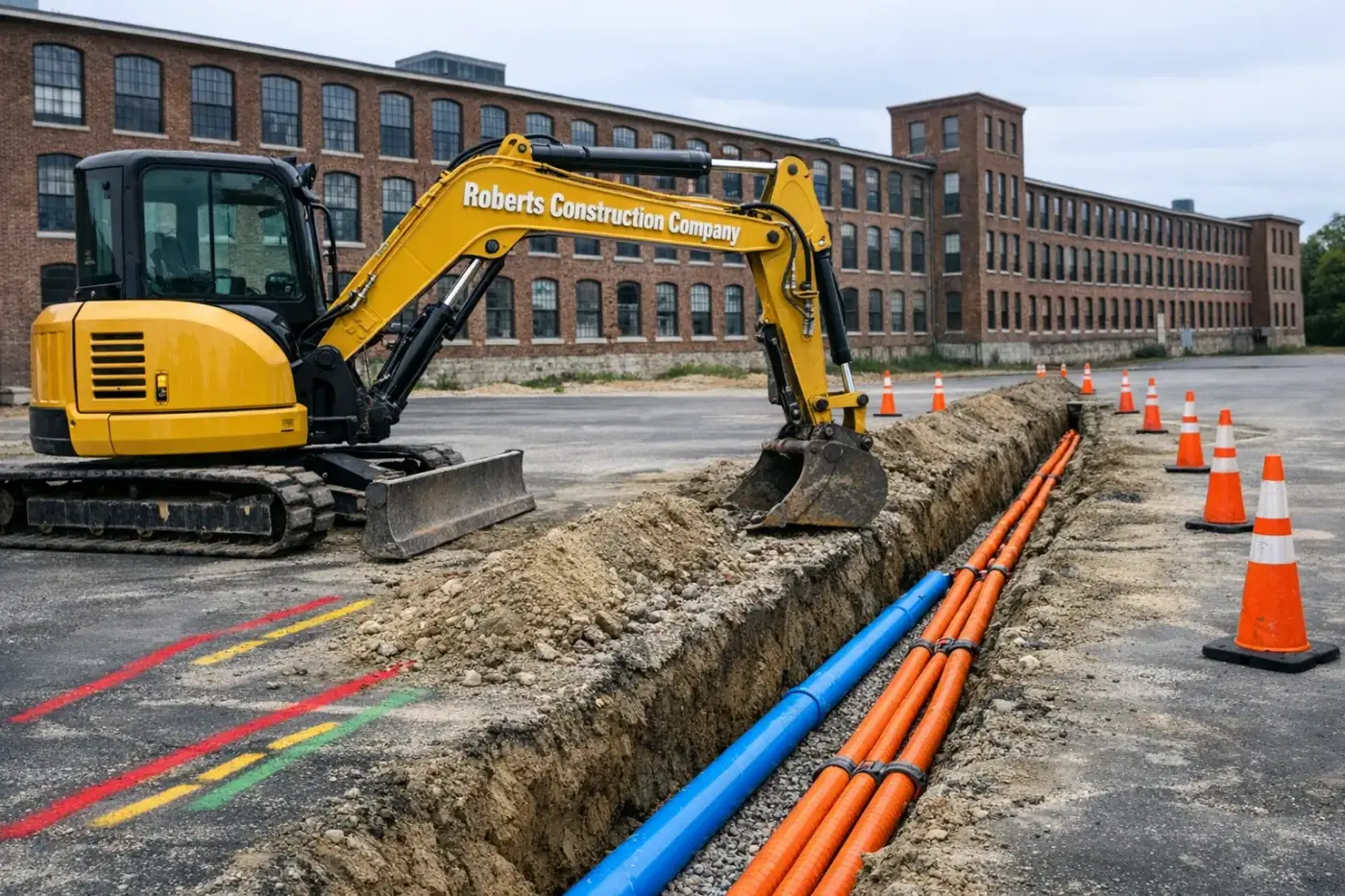
Borough streets mean street openings: town coordination, saw-cut pavement, trench boxes, plates overnight, compacted backfill, and a patch the plow won’t catch. Tight lots and close-set 19th-century foundations decide the machine size.
Rural Killingly
Mostly private ground — driveways, lawns, and field edges. No pavement politics, but ledge and glacial till show up instead, and the run lengths get long: 300-foot well lines and driveway conduit runs are ordinary.
The marks
Danielson service area
CBYD (811) locates gas, electric, water, and sewer before we open anything. In the borough the ground is crowded — four utilities can share one narrow trench line laid down over 120 years in no particular order.
Rural Killingly
CBYD is still mandatory, but it only marks public facilities. Half of what matters on a rural lot is private and unmapped, so we trace old well lines and buried conduit ourselves before the first cut.
Track one · borough work
Taps, laterals, and street openings in Danielson.
Danielson’s underground was built for a mill economy — water and sewer laid down when Powdrell & Alexander was still shipping curtains. That vintage is exactly why the work exists now. Clay sewer laterals crack and root in; galvanized water services choke down to a trickle; and every renovation that adds a bathroom asks a hundred-year-old pipe to do more. We run sewer lateral replacements from the WPCA main to the foundation and water service replacements from the Connecticut Water tap to the meter, usually in a single day of open trench per run so the street closes back up fast.
The craft in borough work is everything around the pipe: saw-cutting clean lines, shoring a trench between two rubble-stone foundations that were never engineered to be neighbors, keeping one lane moving, plating overnight, and compacting backfill in lifts so the patch doesn’t become a pothole by February. Our utility trenching crews do this weekly across eastern Connecticut’s mill boroughs — Danielson’s narrow lots are familiar ground, not a special occasion.
Track two · rural work
Wells, conduit, and long private runs everywhere else.
Outside the service area, there is no main to tap — the utilities are whatever gets buried on your own land. A typical East Killingly or South Killingly job stacks three trenches into one mobilization: the well supply line from casing to basement, an electrical conduit run out to a detached garage or barn, and a drainage line carrying roof and footing water away from the foundation. Sharing a trench where codes allow saves real money; we plan the routes together instead of digging three times.
The constraint nobody sees coming is the septic system. NDDH separation distances govern how close a water line or leach field can sit to anything else, so on a rural lot the trench map starts with the septic plan and works outward. The other constraint is under your boots — glacial till uplands with ledge close to the surface, especially toward the Rhode Island line. We test-pit questionable routes first and price rock honestly: a line item that goes to zero if the ripper never comes off the truck.
Every Killingly dig starts with the same phone call.
Call Before You Dig — CBYD, dial 811 — is Connecticut law on every excavation, and in a borough as densely piped as Danielson it’s the difference between a clean job and a very bad afternoon. We file the ticket, wait out the marks, and hand-dig within the tolerance zone of every located line. Water and sewer connection details run through Connecticut Water and the Killingly WPCA respectively; street work coordinates with Killingly Public Works.
General guidance — confirm current requirements with CBYD (811), the Killingly WPCA, Connecticut Water, and the Town of Killingly for your specific parcel and scope.
Frequently asked — Killingly utilities
What Killingly owners ask before a tap, a lateral, or a long rural run.
- Who supplies public water in Danielson?
- Connecticut Water. The borough grew up on the old Crystal Water Company system, which Connecticut Water now owns and operates as part of its eastern service area — they have since tied the Crystal system into their Plainfield system with a new transmission main for supply and reliability. New taps, meter settings, and service replacements all coordinate through Connecticut Water; we handle the excavation, bedding, and backfill side.
- Who owns the sewers in Killingly?
- The Killingly Water Pollution Control Authority (WPCA). The system runs about 45 miles of sewer main with roughly 1,300 manholes and 12 pump stations, treating on the order of three million gallons a day at the plant on Wauregan Road beside the Quinebaug. Your lateral — the pipe from the main to your foundation — is the piece we replace most often, and the connection work is coordinated with the WPCA. Sewer emergencies go to the town at (860) 779-5392.
- My street looks like it should have sewer but doesn't. Is that normal here?
- Very normal. Public water and sewer end near the Danielson borough limits, and a street can look fully built-out yet still be entirely well-and-septic. Portions of Attawaugan and Rogers have Connecticut Water service, but most of the town outside Danielson has neither utility. We confirm availability lot-by-lot with the WPCA and Connecticut Water service maps before quoting, because the answer changes the whole scope.
- What does a rural Killingly utility run usually involve?
- Some combination of a well supply line from the casing to the basement, electrical conduit to a detached garage or barn, and drainage piping — all buried below frost on a sand bed with warning tape. NDDH separation rules govern how close any of it can run to the septic system, so on a rural lot we plan the trench routes around the leach field before the first bucket goes in.
- Do you handle the CBYD call and the street opening?
- Yes. Call Before You Dig (811) goes in on every job, borough or rural, before any excavation. In Danielson streets we also carry the street-opening side — permit, traffic control, steel plates overnight, and a proper patch-back — coordinated with Killingly Public Works. On rural lots the marks only cover public utilities, so we locate private lines (old well runs, unmarked conduit, septic components) ourselves before trenching.
Which Killingly is your lot in? Tell us the street — we’ll know the answer before we quote.
Utility runs are one piece of what we do here. See our full Killingly excavation page for foundations, septic, and drainage across all eight villages, our Killingly demolition page for teardowns, or the underground utilities service overview for how we run this work everywhere we go.
Also in KillinglyExcavation Demolition