(401) 479-1472

Buried services · Scituate, Rhode Island

Underground utilities in Scituate start with the watershed.

Most of this town drains into the Scituate Reservoir — the drinking-water source for roughly 60% of Rhode Island. So before we talk about water lines, conduit, or drainage, we talk about the rule that sits over all of them: nothing we bury, trench, or dewater gets to threaten what flows toward Providence’s taps. Every service below is built under that frame.

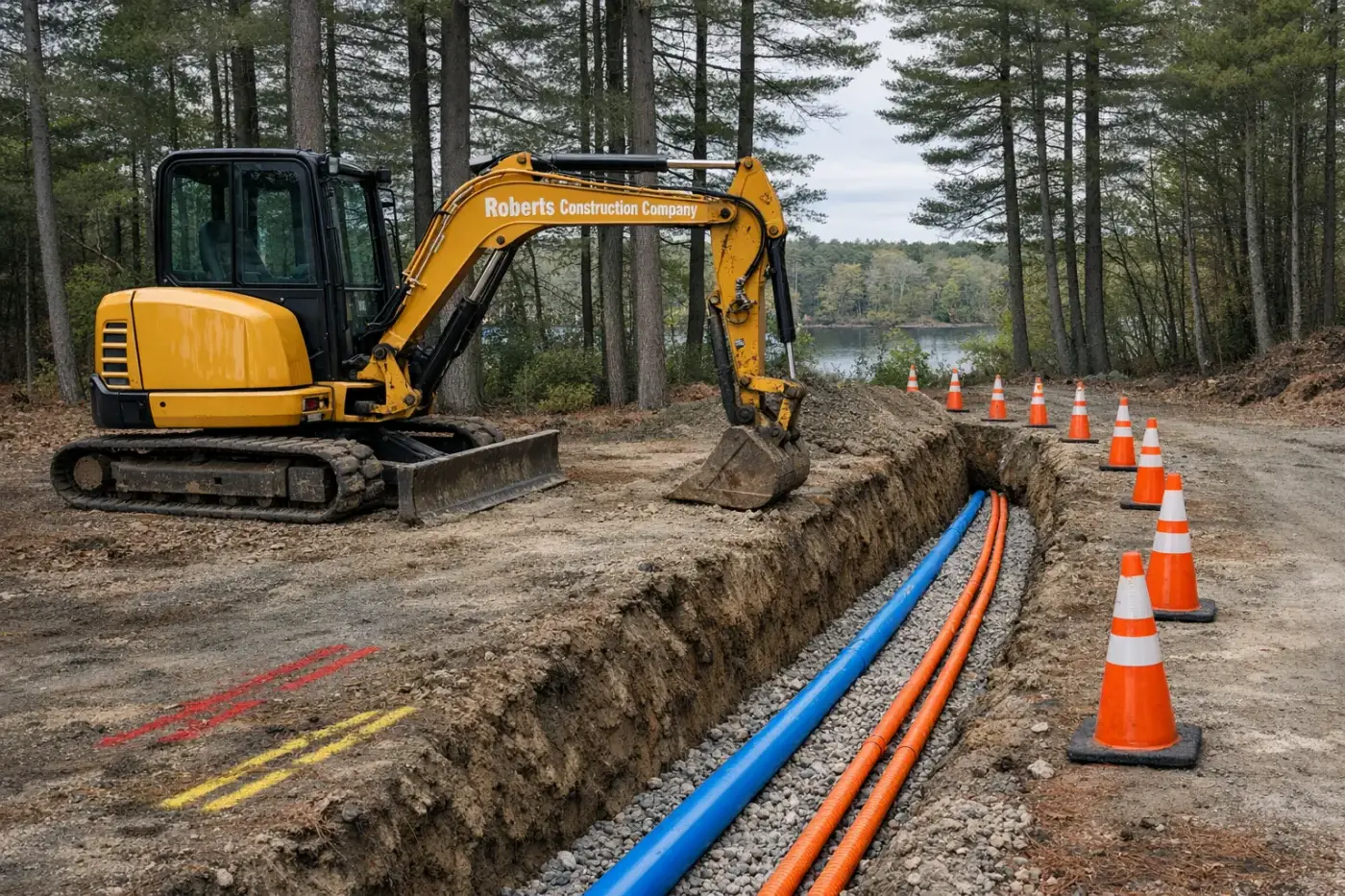
Underground utilities in Scituate, RI — Roberts Construction Company excavator over an open water line and conduit trench
Underground utility trenching in Scituate, RI — every dig starts with 811 marks.

The frame every job runs under

Two agencies read over our shoulder here. We plan for both.

The Providence Water Supply Board owns vast buffer holdings around the reservoir and reviews earth disturbance of any scale inside the watershed. RIDEM regulates the wetlands, the OWTS systems, and the stormwater side. Their reviews stack — clearing one does not clear the other. For a homeowner burying a water line, that mostly translates into site discipline rather than extra paperwork: controls installed before the bucket touches ground, spoil kept out of drainage paths, trenches closed fast.

It also shapes what utilities exist to connect to. Development in the watershed has been deliberately held back for a century, which is why Scituate has no public sewer at all and public water only in fragments. Understanding that map — what’s available at your road, and what has to be built private — is half the estimate. The other half is the same watershed-aware excavation thinking we bring to every Scituate dig.

General guidance — confirm current requirements with Providence Water, RIDEM, and the Town of Scituate for your specific parcel and scope.

The service register, watershed notes included.

Five buried services we install across North Scituate, Hope, Clayville, Rockland, and Potterville — each with the note on how the reservoir changes the work. If it changes nothing, we say that too.

SVC—01

Water lines

In most of Scituate, a water line means a supply run from a private drilled well to the house — trenched below frost, bedded, and sleeved where it crosses a driveway. In the limited pockets with public mains — parts of North Scituate on Providence Water, a slice of the Hope area on Kent County Water Authority — it means a metered service connection built to the utility’s tap and inspection standards. Two very different jobs. We confirm which one your parcel is before we price it.

Watershed noteWell-line trenches near a tributary get silt fence downgradient and same-day backfill. No open trench sits over a weekend within the watershed if we can help it.

There is no municipal sewer anywhere in Scituate, so “sewer line” work here means building laterals — the pipe from the house to the OWTS tank, and from tank to distribution box. Grade is everything: these lines run on fractions of an inch per foot, and a bellied lateral is the most common cause of a backed-up system. We laser-check pitch on every run and coordinate the RIDEM-side permitting when the lateral work is part of a larger system repair.

Watershed noteOWTS-related digs inside the watershed carry the most scrutiny of any utility work in town — conservative setbacks from wells and regulated waters, and designs that RIDEM and Providence Water review can both live with.

Buried power to detached garages, barns, and workshops; generator transfer feeds; overhead-to-underground conversions on wooded lots where storm outages are a fact of life. We trench to code depth for the conductor type, bed and cover the conduit properly, and lay marking tape so the next contractor’s Dig Safe ticket actually finds it. The electrician pulls and terminates; we make the ground part right.

Watershed noteConduit is the lightest-touch utility in the watershed — shallow, dry, quick to close. The discipline is staging: spoil and fuel stay away from anything that drains toward the reservoir.

SVC—04

Drainage

The watershed-critical service. Roof leaders, curtain drains, and yard drainage in Scituate are designed to capture and infiltrate on-site — dry wells sized to the roof area, infiltration trenches in the till, swales that spread water instead of concentrating it. What we will not build is a pipe that shortcuts stormwater toward the Ponaganset, the Moswansicut, or any named tributary. On this one service, the watershed rule and good engineering point the same direction.

Watershed noteInfiltrate, don’t discharge. Every Scituate drainage design starts from that sentence.

The umbrella service under all of the above: open-cut trenching for any buried line, with proper bedding, compacted lifts, warning tape, and a surface restored to grade. Scituate’s glacial till digs predictably; the outcrop ledge does not, so we test-pit long runs before quoting and carry a rock line item that goes to zero if the ground cooperates.

Watershed noteTrench dewatering inside the watershed filters through a sediment bag or basin before release — never straight onto ground that runs to a stream.

The full scope of what we bury and how we trench it lives on our underground utilities service page. This page is about how those services land in one particular town.

Before any Scituate trench opens

  1. 1Dig Safe ticket811 notification placed and locates confirmed on the ground.
  2. 2Watershed checkDoes the parcel drain to the reservoir? If yes, controls scale up.
  3. 3Wetlands screenStreams and wet edges flagged; RIDEM buffers mapped before layout.
  4. 4Controls in firstSilt fence and staging set before the first bucket of the trench.

Frequently asked — Scituate utilities

Buried-line questions from the watershed town.

Is there public water or sewer to connect to in Scituate?
Mostly no. Scituate has no public sewer anywhere in town — every building runs on a RIDEM-permitted OWTS. Public water exists only in limited pockets: Providence Water mains reach parts of North Scituate, and Kent County Water Authority serves a portion of the Hope area near the Coventry line. Everywhere else, your water line runs from a private drilled well. We confirm which situation your parcel is in before quoting, because the trench design is different for each.
Does the reservoir watershed change how a buried line gets installed?
Yes, in practical ways. The pipe itself is standard, but the site discipline around the trench is not: sediment controls before we open ground, spoil staged away from anything that drains toward a tributary, dewatering that filters before it releases, and same-day backfill wherever possible. On larger projects, Providence Water review can stack on top of RIDEM and town permits. The line costs about the same — the site management is where the watershed shows up.
Do I really need Dig Safe on a rural Scituate lot?
Yes. Rhode Island law requires a Dig Safe (811) notification before any mechanized digging, and it applies even where marked utilities are sparse. Rural Scituate has more buried infrastructure than people expect — well supply lines, propane runs, buried power to outbuildings, and old farm-era piping that predates records. We place the Dig Safe ticket and hand-verify near anything the locate can’t see.
Can you run underground power to a detached garage or barn?
Yes — buried conduit to outbuildings, generator transfer feeds, and overhead-to-underground conversions are regular Scituate work. We trench to the depth the electrical code requires for the conductor type, bed the conduit in screened material, lay warning tape, and backfill in lifts. A licensed electrician handles the wire pull and terminations; we coordinate so the trench is open exactly as long as it needs to be — a point the watershed rules care about too.
Where can roof and yard drainage discharge in the watershed?
Onto your own ground, properly. The working rule inside the watershed is capture and infiltrate on-site — dry wells, infiltration trenches, and graded swales that slow water down rather than piping it toward a stream. A drainage line aimed at a reservoir tributary is exactly what Providence Water oversight exists to prevent. We design Scituate drainage to soak, not to ship.

Tell us what needs to be buried and where the lot sits. We’ll tell you what the watershed adds — usually less than people fear, never nothing.

Related in Scituate: excavation · demolition. Statewide service detail: water lines, sewer & septic laterals, electrical conduit, drainage, and utility trenching.

Also in ScituateExcavation Demolition