
A worked example · West Greenwich, RI
The 600-foot driveway problem: underground utilities for the West Greenwich house you can’t see from the road.
West Greenwich zoning favors big lots, and the town is the most forested in Rhode Island. Put those together and you get its signature building condition: a house set a long way back in the trees, with every utility it needs arriving through one narrow corridor of dirt. Here’s how we think that corridor through — with numbers.
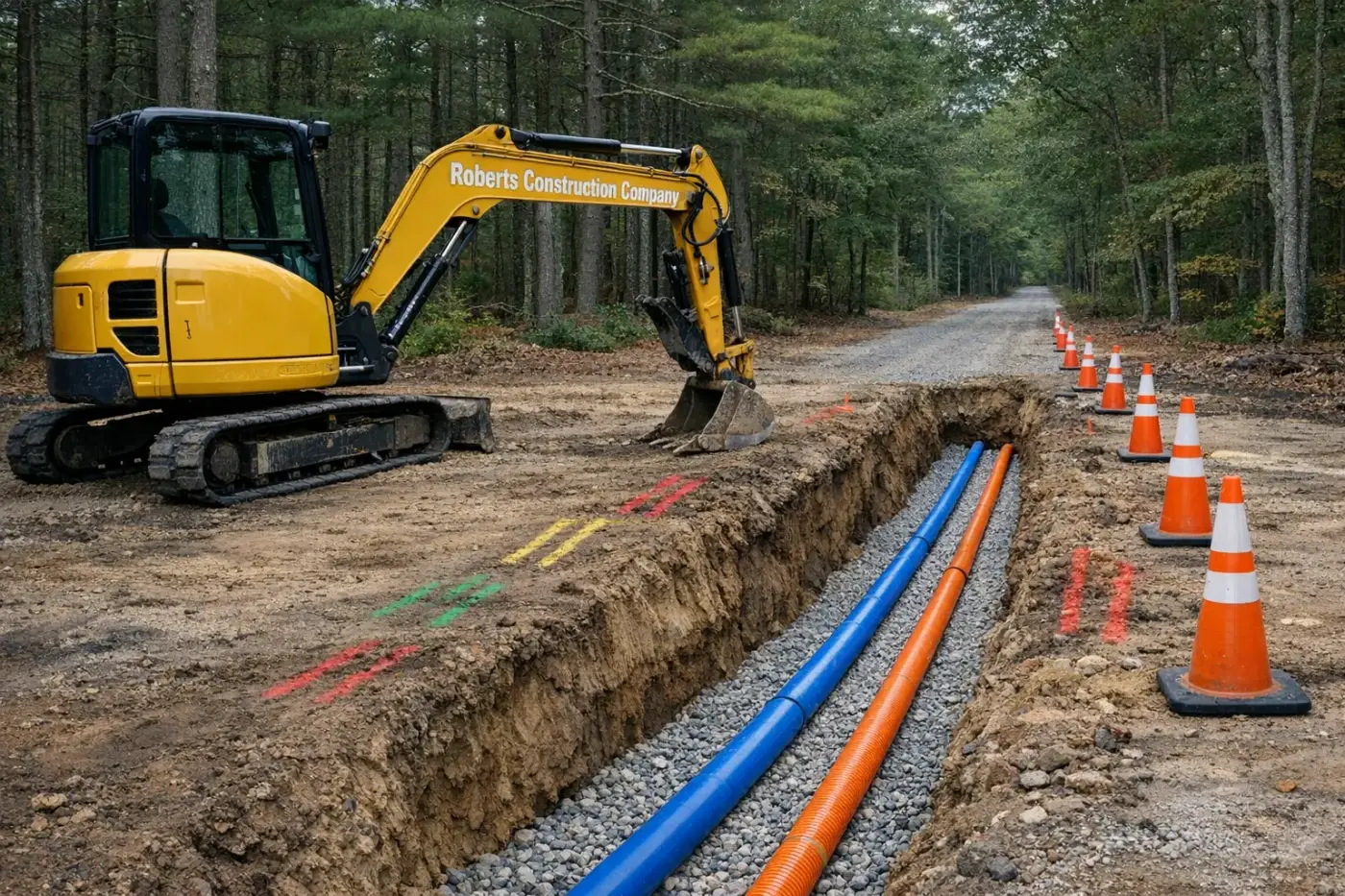
The problem, stated plainly.
A 600-foot drive isn’t unusual here — off Hopkins Hollow, around Mishnock, along the edges of the Big River Management Area, plenty run longer. Every foot of it has to carry electric service, communications, and sometimes water, and each of those has its own rules about depth, separation, and who inspects it before we’re allowed to cover it up. The trench is the cheap part. The expensive mistakes are sequencing mistakes: burying the driveway before the conduit, setting the culvert before the sleeves, or letting the electric design assume a distance the wire can’t actually tolerate.
So we plan long-drive utility work the way an engineer would — as one corridor with stations, not as three separate favors to three separate trades. The utility trenching itself follows the plan; it never leads it. What follows is the worked example we walk owners through, using a composite of real West Greenwich jobs: six wooded acres, a 600-foot drive, one seasonal stream at about station 1+80.
Power
Voltage drop is the design driver, and it’s not close.
Run the numbers on 600 feet of secondary at 240 volts and the corridor designs itself. A 3% drop budget gives you about 7 volts to spend. Spend it over 600 feet at any serious load and you’re into 350-kcmil aluminum per leg — heavier still, or paralleled runs, if the panel schedule includes a heat pump, a shop, or an EV charger. Cable that size costs real money, bends grudgingly, and still wastes energy every hour the house runs.
The usual answer on a drive this long is a primary extension: the utility carries medium-voltage cable down the corridor and sets a pad-mount transformer near the house, so the lossy secondary run shrinks to 40 feet instead of 600. That decision belongs to your electrician’s load calculation and Rhode Island Energy’s engineering — but it changes our work completely. Primary wants more cover, utility-spec bedding, marker tape, and an inspection before backfill; the conduit runs need long-sweep bends with the total bend between pull points held inside the budget the cable crew can actually pull through. We build to the spec sheet, and we get the utility’s sign-off before a bucket of backfill goes in.
Water
The trench that usually isn’t there.
Most of West Greenwich has no public water — the well gets drilled near the house, and the water line is a short run from wellhead to basement, set around four feet down, below frost. So on the classic long drive, water usually stays out of the driveway corridor entirely.
The exceptions matter, though. Ledge or a RIDEM wetland buffer can push the well toward the road; shared drives sometimes carry a common supply. And near the I-95 interchanges at Nooseneck Hill Road and Victory Highway there’s a limited commercial pocket where Kent County Water Authority infrastructure reaches — KCWA is headquartered on Technology Way in town. Whether a given parcel can tie in is a per-parcel check we make before we quote, not after.
Communications
Conduit is cheap once, expensive twice.
Whether a comms provider will build 600 feet of drop down a private drive — and what they’ll charge for it — varies by provider and year. What doesn’t vary: if the trench is open anyway, empty comms conduit with a pull string costs almost nothing. If the trench is closed, the same pipe means mobilizing an excavator through a finished driveway and a landscaped yard.
So we put it in on every long-drive job: sweeps, not elbows, and the bend count kept low enough that fiber pulls through years later without drama. While the corridor is open we also look at drainage — a 600-foot drive sheds a lot of water, and the culverts and swales go in far cheaper while the machine is already there.
The crossing
Station 1+80: the stream decides your schedule.
RIDEM regulates freshwater wetlands statewide, and on a wooded West Greenwich parcel the odds that a 600-foot corridor crosses something regulated are high — seasonal streams, beaver flowages, and pond buffers thread through nearly every quad, and parcels in or beside the Big River Management Area draw watershed scrutiny on top. A driveway crossing takes state review, and that review takes time. It is the long pole on most of these jobs.
The rule we build by: open a permitted crossing once. The day the culvert goes in, every utility that will ever cross that stream gets a rigid sleeve under it — power, comms, and a spare. Coming back to trench through a permitted crossing later means a second RIDEM round and disturbed mitigation work. We’ve never met an owner who regretted the spare sleeve.
The worked example, as a trench schedule.
Six acres, 600-foot drive, stream at 1+80, transformer at the house end. Stations in feet from the road. Every job differs; the discipline doesn’t.
| Station | In the trench | Cover | Field note |
|---|---|---|---|
| 0+00 – 0+40 | Utility riser pole to first sweep | Per utility spec | Rhode Island Energy dictates the riser detail and the first 40 feet. Their inspector signs off before backfill. |
| 0+40 – 1+80 | Primary conduit + comms conduit on shelf | ±36″ primary / 24″ comms | Joint-trench section. Comms rides a bedded shelf above the primary with the separation the utility sheet calls for. |
| 1+80 – 2+10 | Stream crossing — sleeved | Below culvert bedding | The RIDEM-permitted crossing. Both conduits sleeved in rigid casing under the culvert, installed the same day the culvert is set. |
| 2+10 – 5+60 | Primary + comms, straight run | ±36″ / 24″ | Long clean run through upland till. Pull points held under the 360-degree bend budget so cable actually pulls. |
| 5+60 – 6+00 | Transformer pad, secondary, well line joins | 24″ secondary / 48″ water | Transformer set near the house; short secondary to the meter. Water line from the wellhead enters the corridor here, below frost. |
Depths shown are typical, not quoted — the utility’s current specification and the electrician’s design govern. Dig Safe (811) is mandatory before any excavation in Rhode Island, long drives included. General guidance — confirm current requirements with Rhode Island Energy, RIDEM, and the West Greenwich building official for your parcel and scope.
Frequently asked — West Greenwich utilities
Five questions owners ask about long-drive utility runs.
- Can you really not just run bigger wire 600 feet from the road?
- You can, but the math punishes you. Holding a 3% voltage drop at 240 volts over 600 feet pushes you into 350-kcmil aluminum or larger — and into paralleled runs if the house has any real load. On most long West Greenwich drives the cheaper, better answer is a primary extension: the utility brings medium-voltage cable down the drive and sets the transformer near the house, so the fat, lossy secondary run stays short. We trench and pipe it either way; the utility's spec sheet and your electrician's load calculation decide which way.
- Does the water line run down the driveway too?
- Usually not in West Greenwich. There's no public water across most of town — the well gets drilled near the house, so the water line is a short run from wellhead to basement, set below frost. The exceptions are lots where ledge or a RIDEM wetland buffer forces the well toward the road, or shared drives with a common well. Then the supply line rides the driveway corridor and we treat it like any other utility in the trench plan.
- Is there any public water near the I-95 exits?
- A limited amount. Kent County Water Authority is actually headquartered on Technology Way in West Greenwich, and its mains reach some commercial parcels in the northeast corner of town near I-95. Whether a specific parcel can connect is a per-parcel question we put to KCWA before quoting. Everywhere else in town — including nearly all residential land — plan on a drilled well and an OWTS.
- What happens where the driveway crosses a stream or wetland?
- RIDEM regulates freshwater wetlands statewide, and West Greenwich is wet country — seasonal streams and beaver flowages thread through most large parcels. A driveway crossing needs RIDEM review, and the smart move is to sleeve every future utility under the crossing while the culvert is being built. Opening a permitted crossing twice means a second round of state review. We put the conduits in the first time, every time.
- Do you coordinate with the electrician and the utility, or do we?
- We do. The trench, conduit, and backfill are ours; the cable and terminations belong to your electrician and to Rhode Island Energy. What makes a long-drive job go smoothly is one party owning the sequence — trench inspection before backfill, utility spec compliance on depth and bedding, and the electrician's conduit schedule matching what's actually in the ground. That coordination is part of our scope, not an extra.
If your West Greenwich lot has a long drive on the survey, get the utility corridor designed before the driveway is built. We’ll walk it with you and put numbers on it.
Related reading: our underground utilities service overview, our West Greenwich excavation page for the watershed and permitting picture, and — if the parcel comes with an old camp or barn on it — demolition in West Greenwich.
Also in West GreenwichExcavation Demolition