(401) 479-1472

West Greenwich, RI · Parcel cleanup

What demolition means on a big West Greenwich parcel: an inventory, item by item.

Large-lot zoning and deep woods mean West Greenwich parcels hold decades of accumulation — a camp past saving, a barn off its sills, a dump behind the treeline. Clearing one isn’t a single act of demolition. It’s a list, and every item on it has its own rules and its own disposal route. Here’s ours.

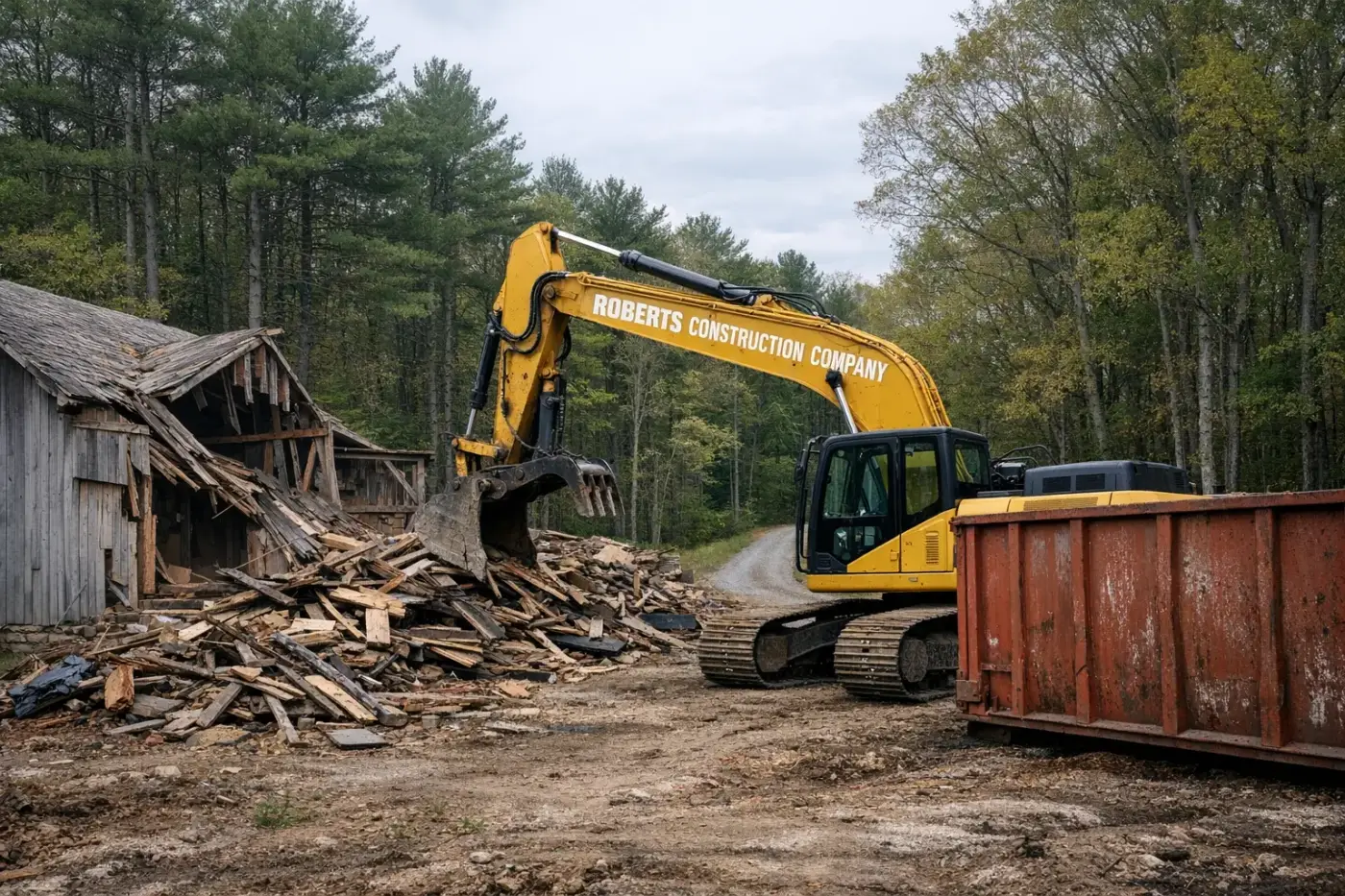
Demolition contractor in West Greenwich, RI — Roberts Construction Company excavator taking down a barn
Structure demolition in West Greenwich, RI — tested, disconnected, then taken down.

The inventory, in the order we take it.

Composite of the neglected-parcel cleanups we run in this town. Your parcel won’t have all eight items. It will have more of them than you think.

01

The main structure

The camp, farmhouse, or fire-damaged house itself. Asbestos survey and any RIDOH-required abatement come first, utilities are confirmed dead, then the machine takes it down in a controlled sequence — roof, frame, deck — and the material is loaded out. Debris from this corner of the state generally runs to the Central Landfill in Johnston or a licensed C&D processor; nothing gets pushed into the cellar hole and buried.

Disposal routeLicensed C&D disposal

02

Barns, sheds & outbuildings

Big parcels accumulate outbuildings, and they rarely die all at once. Sound timber and hand-hewn beams have salvage value worth separating; metal roofing and siding go to scrap rather than the landfill scale. What's left — rot, shingles, mixed debris — is loaded out as C&D. Sorting on site is cheaper than paying mixed-load tonnage.

Disposal routeSalvage + scrap + C&D

03

Slabs, foundations & chimneys

The concrete and stone that stays behind after a structure is gone. Clean concrete and fieldstone can often be processed and reused on the parcel as fill or driveway base — a real saving when the alternative is trucking it 25 miles. Painted block, tile-faced chimney, and anything suspect goes out with the C&D stream instead.

Disposal routeCrush / reuse on site where clean

04

Buried fuel-oil tanks

The item that decides whether a cleanup is routine. We probe likely locations — off the old kitchen wall, near the fill pipe stub — before quoting. A tight tank is pumped, cleaned, pulled, and hauled for proper disposal with the excavation inspected as it opens. Staining or odor means a stop and a call: release response in Rhode Island is RIDEM's jurisdiction, and on parcels near the Big River Management Area the scrutiny is appropriately higher.

Disposal routePump, pull & dispose — RIDEM if released

05

Wells & cesspools

A neglected parcel usually hides at least one of each. An old dug well or drilled well left open under brush is a hazard and a liability; it gets properly abandoned and sealed, with the location recorded. Cesspools and failed septic tanks are pumped by a licensed hauler, then crushed and filled so nothing collapses under a future lawn. If the parcel is being rebuilt, new OWTS work runs through RIDEM as a separate, coordinated scope.

Disposal routeProper abandonment, documented

06

Debris piles & old farm dumps

Almost every long-neglected West Greenwich parcel has a dump — a hollow behind the barn with fifty years of cans, appliances, fence wire, and tires in it. We excavate it, sort it, and route each stream where it belongs: metal to scrap, tires to a permitted outlet at their own fee, the rest out as debris. Wetland buffers cross many of these parcels, so we confirm the pile isn't sitting in one before the excavator reaches in.

Disposal routeSorted: scrap / tires / C&D

07

Derelict vehicles & equipment

Trucks on blocks, a dead tractor, the trailer that stopped being weather-tight in the nineties. Fluids are drained and captured, anything titled is handled with the paperwork it needs, and the steel goes to scrap. On a big cleanup the scrap value offsets a real piece of the hauling cost, and we credit it accordingly.

Disposal routeScrap outlets

08

The final regrade

The last item is the one you keep. Cellar holes filled and compacted in lifts, stumps pulled along the work area, surface boulders relocated or removed, and the ground rough-graded to drain. The goal is a parcel that reads as land again — ready for sale, for a new build, or just for a mower.

Disposal routeStays on site

Items 08 and beyond are where cleanup turns back into construction: stump removal, land clearing, rock removal, grading, and full site preparation if a new build follows the teardown.

Before the machine starts

The paperwork runs in one order. We run it for you.

  1. 1.

    Asbestos survey and RIDOH plan. A licensed inspector surveys the structures; where asbestos is found, an abatement plan goes to the RIDOH Asbestos Control Program for approval, with the start-work notification filed at least ten business days before abatement begins. The town won’t issue a demolition permit without the asbestos question answered. Pre-1978 buildings also get handled with lead-safe work practices.

  2. 2.

    Utility disconnects, in writing. Electric service cut and confirmed by Rhode Island Energy, propane tanks picked up by the supplier, and any well pump circuit verified dead. On rural parcels the temptation is to assume a long-abandoned building is cold. We don’t assume; we confirm.

  3. 3.

    Demolition permit from the town. The West Greenwich building official issues the demolition permit and inspects per the town’s schedule. Parcels touching RIDEM wetland buffers or the Big River Management Area boundary get their constraints mapped before we stage equipment, not after.

  4. 4.

    Dig Safe (811). Mandatory before excavation anywhere in Rhode Island — tank pulls, foundation grubbing, and dump excavation included. Rural West Greenwich has fewer marked utilities than a village street, which makes the unmarked private lines — well feeds, old camp wiring — the ones that matter.

General guidance — confirm current requirements with RIDOH, RIDEM, and the Town of West Greenwich building official for your specific parcel and scope.

Frequently asked — West Greenwich demolition

Five questions about clearing a neglected parcel.

Do I need an asbestos survey before demolishing an old West Greenwich camp?
In Rhode Island, plan on it. RIDOH's Asbestos Control Program requires an approved asbestos abatement plan before a demolition permit is issued, and the only way to know what the plan must cover is a survey by a licensed inspector. Old camps and farmhouses are exactly the building stock where asbestos shows up — pipe wrap, siding shingles, floor tile, roofing. Abatement, where needed, happens before our machine touches the structure, with a start-work notification filed with RIDOH at least ten business days ahead.
Can demolition debris go to the West Greenwich transfer station?
No. The Bates Trail transfer station is for permitted residents — household trash, recycling, and modest bulky-waste drop-offs for a fee. Contractor-scale demolition debris doesn't qualify. Our loads leave town to licensed facilities; in Rhode Island that generally means the Central Landfill in Johnston or a licensed construction-and-demolition processor. Disposal is line-itemed in our quote so you can see what the tonnage actually costs.
What happens if you find a buried oil tank?
We stop, assess, and handle it as its own scope. Old camps and farm properties here often heated with oil, and tanks got buried and forgotten. A sound tank gets pumped, cleaned, and pulled with soil observed as it comes out. Any evidence of a release brings RIDEM into the picture, and remediation requirements are theirs to set — we don't bury the problem and we don't guess at the rules. Budget-wise, an uneventful tank pull is modest; a release is not, which is why we probe likely tank locations before quoting a fixed number.
Does the Big River Management Area affect demolition work?
It can. Parcels inside or adjacent to the roughly 8,300-acre Big River Management Area sit over a future drinking-water supply held by the RI Water Resources Board, and anything with contamination potential — tank pulls, old dumps, washdown — draws extra scrutiny there. RIDEM freshwater wetland buffers also cross many large parcels, which constrains where we stage debris and run equipment. We pull the boundaries before we plan the job.
Can you take the parcel all the way to buildable after demolition?
Yes — that's usually the point. After structures and debris are gone we handle stump removal, land clearing along the building envelope, rock removal where ledge or boulders interfere, and rough grading so the parcel drains and reads as land instead of a scar. If you're heading toward new construction, the same mobilization can roll straight into site preparation and the excavation scopes on our West Greenwich excavation page.

Walk us through the parcel once. We’ll hand you the inventory, the disposal routes, and one number.

Demolition is one chapter of the broader story on our demolition services page. For the town’s watershed and permitting picture, see excavation in West Greenwich; if the cleared parcel needs power and comms brought down a long drive next, that’s our West Greenwich underground utilities page.

Also in West GreenwichExcavation Underground utilities