Permits & Process · November 1, 2026
Dig Safe in Rhode Island vs. Call Before You Dig in Connecticut
Two states, two call centers, two clocks. What changes when the job is on the Foster side of the line instead of the Sterling side.
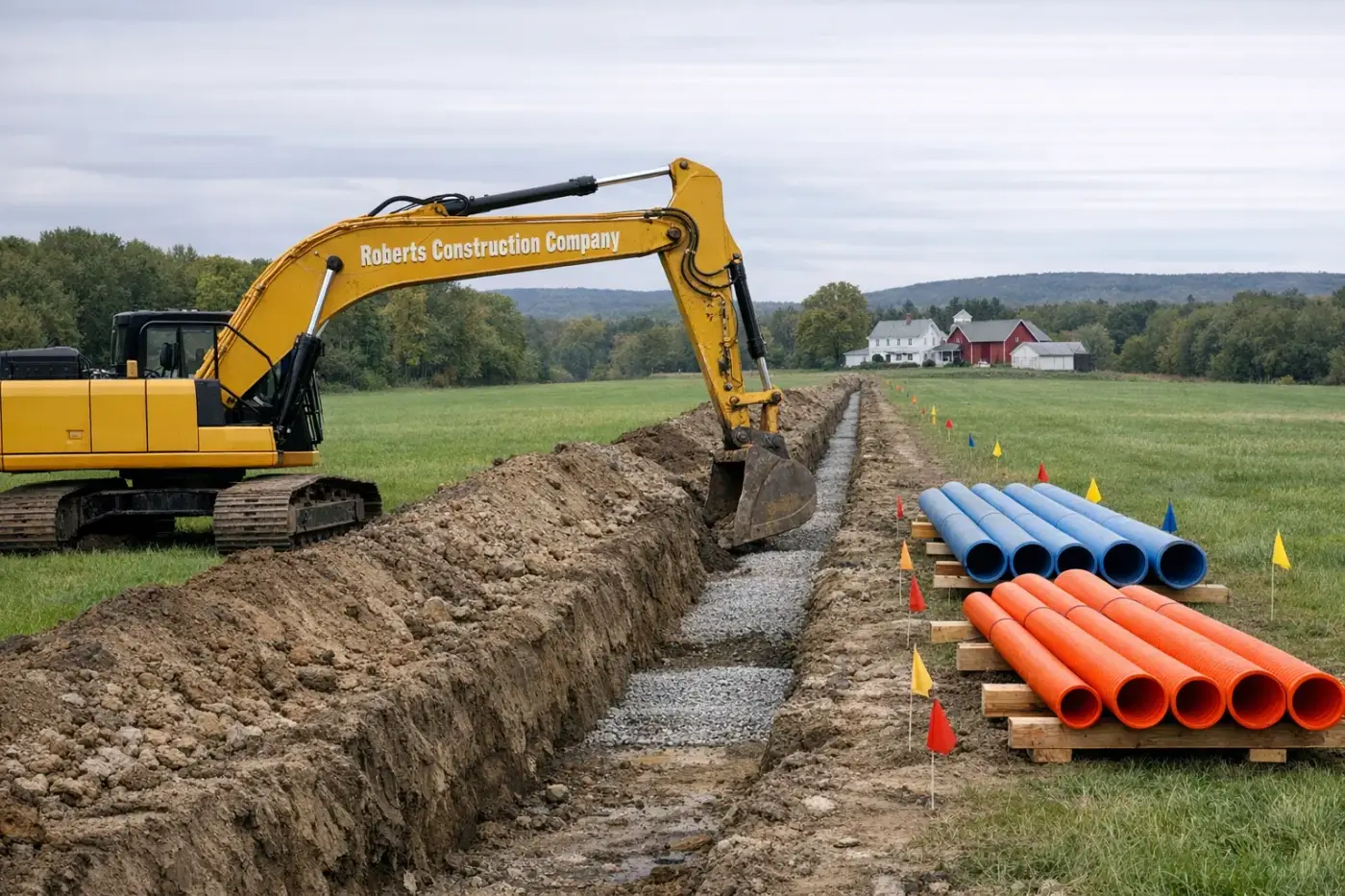
We work both sides of the Connecticut–Rhode Island line, and the locate request is the first thing that changes when the truck crosses it. Both states route 811 to a one-call center, both require notice before a machine touches the ground, and both put the liability on whoever digs without marks. The details differ enough that we keep them on a card in every cab.
Connecticut: Call Before You Dig
Connecticut's one-call center is Call Before You Dig, Inc. (CBYD), reached at 811 or 1-800-922-4455, with online tickets at cbyd.com. The law is CGS 16-345 and the PURA regulations under it. Anyone excavating with power equipment must notify CBYD at least two full working days before digging, not counting weekends and holidays, and not more than 30 days before the work starts. Homeowners hand-digging are encouraged but not required to call.
Before you call, the excavation area has to be premarked in white: paint, flags, or white-tipped stakes outlining where the digging will happen. Once the utilities respond, you have a tolerance zone of 18 inches on either side of a marked line where only hand digging or vacuum excavation is allowed. CBYD covers its member utilities: Eversource, the gas companies, the telecoms, the municipal utilities like Norwich Public Utilities and Jewett City Water. PURA's Gas Pipeline Safety Unit enforces the statute and can fine excavators who dig without a ticket.
Rhode Island: Dig Safe
Rhode Island's one-call center is Dig Safe System, Inc., the same regional center that covers Massachusetts, Maine, New Hampshire, and Vermont, reached at 811 or 1-888-344-7233 (1-888-DIG-SAFE). The law is Rhode Island General Laws Chapter 39-1.2, enforced by the Division of Public Utilities and Carriers. Notice has to go in at least 72 hours before excavation, excluding Saturdays, Sundays, and holidays, and not more than 30 days before. In practice that's three business days, so a Monday ticket is good for Thursday digging.
The rest looks like Connecticut: white premarks before the request, utilities required to mark within the 72-hour window, an 18-inch tolerance zone with hand or soft digging only, and the excavator responsible for maintaining the marks through the job. The statute was amended in 2024; the changes tightened the definition of damage and the marking and re-marking timeframes, so if you've got an old Dig Safe card in the truck, replace it. Rhode Island Energy is the big gas and electric member on our side of the state, with Kent County Water and the towns covering water and sewer.
What both systems miss
Neither center marks private utilities. The run from the meter to a detached garage, the propane line to the tank, a well line, the septic laterals, invisible-fence wire, irrigation, landscape lighting: none of it is a member facility, and none of it gets painted. In rural Sterling, Foster, and Glocester, the private side is often longer than the public side. We walk the lot with the owner before every trench, hand-probe anywhere a private line should be, and treat a buried pipe we can't explain as live until we prove it isn't.
How we schedule around the two clocks
- Connecticut jobs: ticket filed the day the contract is signed, machine on site no sooner than the third business day.
- Rhode Island jobs: same, but we hold the start until the fourth business day so the 72-hour window has cleared and we've seen the marks.
- Jobs that straddle the line (it happens on Ekonk Hill and along Route 14): one ticket in each state, both numbers in the folder.
- Marks older than 30 days, or washed out by rain or regrading: new ticket, no exceptions. Remarks are free; a hit gas line is not.
- Call Before You Dig, Connecticut — File and check Connecticut locate tickets.
- Dig Safe System, Rhode Island — File and check Rhode Island locate tickets.
- Rhode Island Dig Safe law (RIPUC) — Current statute text and the 2024 amendments.
- Connecticut PURA: CBYD and homeowners — The two-working-day rule and homeowner guidance.
Related services
Where we run this work
Have a job like this?