
Field feature · Putnam, Connecticut
Roberts Construction Company
Taking a tired building out of downtown Putnam.
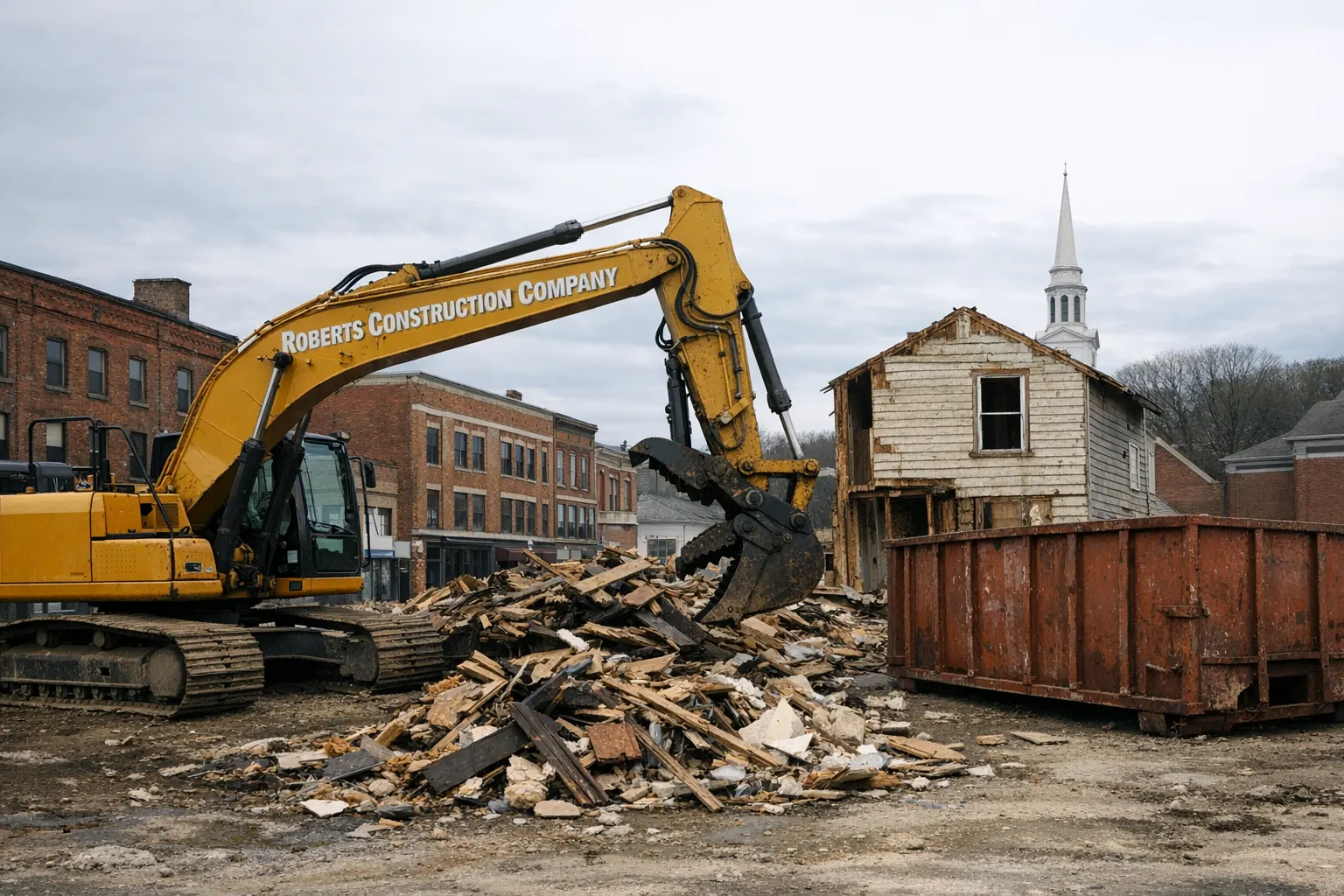
Demolition in a walkable downtown is a different discipline from knocking a barn flat in a field. Here is how an infill teardown actually goes on the brick blocks by the Quinebaug — the protection, the paperwork, and the slab question the flood map forces.
I.
The building nobody will miss — and everybody will watch come down.
Every downtown has one: the structure that outlived its last good use. In Putnam it is usually mill-era — a sagging commercial block off Main Street, a garage addition that never should have been framed, a house cut into apartments one time too many. The town around it has moved on. Putnam’s downtown filled back up with restaurants, the antiques trade, and the Riverwalk; Cargill Falls Mill went from vacant floors to eighty-two apartments. A tired building on an infill lot is not character here — it is the gap in the streetscape.
And because the streetscape is the point, the demolition has to be surgical. People walk past downtown Putnam jobs at lunchtime. Shop owners two doors down have opinions and a right to them. The job is to remove one building without the block ever feeling unsafe, unpassable, or coated in dust.
“The machine work is the fast part. The week of planning around a tight street is why the machine work goes fast.”
II.
Protection and staging on streets that were laid out for wagons.
Putnam’s downtown blocks are compact — that is their charm and our constraint. There is rarely room to swing a big machine, park a fleet of trucks, and fence a generous exclusion zone. So the plan shrinks to fit: an excavator sized to the lot, top-down deconstruction instead of the dramatic pull, and a loading sequence where each truck is staged in and out rather than queued along someone’s storefront.
Abutters get the most attention. A shared or near-shared wall means survey and photo documentation before we start, vibration awareness during, and weather protection for any exposed face after. Sidewalk stays protected or safely detoured, dust stays down with water, and the noisy hours land early — the same early-start habit we use on our underground utility work in Putnam, and for the same reason: the antiques district fills with people by mid-morning.
III.
The paperwork that happens before the first bite.
Mill-era buildings carry mill-era materials. Connecticut requires an asbestos inspection by a licensed consultant before demolishing commercial, industrial, institutional, or public buildings — and residential buildings of five units or more. If the survey finds asbestos and the structure is sound, abatement comes first: licensed contractors for anything beyond trivial amounts, notification to the state Department of Public Health when the quantity thresholds are crossed, and disposal only at authorized facilities. Lead paint gets the same respect on anything old enough to have it, which downtown is.
Then the disconnect sequence. Putnam makes this cleaner than most towns because the WPCA runs both water and sewer — one authority confirms the water kill and the sewer cut-and-cap. Electric and gas are released by their utilities on their own paper. Only when every service is verified dead does the demolition permit through the town’s building office turn into a machine on site — with CBYD 811 marks on the ground first, because the neighbors’ services run right past the lot.
General guidance — confirm current requirements with the Putnam building office, CT DPH, CT DEEP, and the Putnam WPCA for your specific structure and scope.
1955
Putnam already knows what a downtown teardown means.
When hurricanes Connie and Diane hit eight days apart, the Quinebaug destroyed or badly damaged 477 dwelling units, 26 stores and offices, and every industry along the river — over thirteen million dollars of damage in 1955 money. What followed was an urban-renewal rebuild that produced, among other things, the Riverfront Commons shopping center. Putnam’s downtown is not a museum piece; it is a place that has already torn down, rebuilt, and reinvented itself once.
That history is why we treat an infill demolition here as a redevelopment move, not an ending. The lot that opens up is the next chapter of a story the town has been writing since the water went down.
IV.
The slab decision the flood map forces.
On upland lots, whether to pull a slab is a cost question. In the FEMA-mapped Quinebaug flood plain it is a design question: any rebuild has to meet base flood elevation, so an old slab sitting low is usually dead weight against the next project. Most flood-plain slabs come out with the foundation, and the hole is backfilled with compacted structural fill, graded to drain away from the neighbors. If the parcel will sit green for a while, we finish with topsoil and seed so it reads as a lawn, not a scar.
Where rebuilding is the plan, demolition blends straight into site preparation — the same mobilization can handle rock removal if the footprint grows, and on the leafier edges of town a teardown often pairs with land clearing and stump removal to open the whole lot at once. The full excavation picture for the town is on our Putnam excavation page.
V.
Where the building goes.
Off the lot in roll-offs, sorted as it is loaded: steel to the scrap market, clean concrete and masonry toward recycling, the mixed balance to licensed construction-and-demolition facilities. One local note worth knowing — the Pomfret/Putnam transfer station on Nora Lane runs residents’ bulky-waste days, hand-unloaded, and is not an outlet for contractor demolition debris. Ours never goes there. Weight tickets and disposal records stay in the job file, because on a downtown teardown the town, the bank, or the next buyer eventually asks.
Frequently asked — Putnam demolition
Six questions owners ask before a Putnam teardown.
- What permits does a Putnam teardown need?
- A demolition permit through the town’s building office, sitting on top of Connecticut’s state demolition code. Before the permit moves, the pre-demo items have to be in order: the asbestos question answered, utilities disconnected and confirmed, and abutters protected in the plan if the building shares a lot line. We run that sequence as part of the job rather than handing you a checklist.
- Is an asbestos inspection required before demolition?
- For commercial, industrial, institutional, and public buildings — and residential buildings of five or more units — Connecticut requires an inspection by a licensed asbestos consultant before demolition. If asbestos is found and the structure is sound, it gets abated first, by a licensed abatement contractor for anything beyond trivial quantities, with notice to the state Department of Public Health when thresholds are crossed. Single-family teardowns are lighter on paper but the material reality is the same age.
- Who disconnects water and sewer before a downtown Putnam demo?
- The Putnam WPCA operates both systems, so the water kill and the sewer cut-and-cap run through one authority — we coordinate the disconnects, the WPCA confirms them, and electric and gas are released by their own utilities before the machine arrives. No demolition starts until every service to the building is verified dead.
- Can you take a building down tight to its neighbors?
- That is most of what downtown demolition is. On Putnam’s brick blocks we work top-down with an excavator sized to the street, protect the sidewalk and the abutting walls, keep dust suppressed with water, and stage trucks so a narrow street stays passable. The machine work is often the fast part; the protection and staging plan is where the job is won.
- What happens to the slab and foundation on a flood-plain lot?
- It depends on what comes next. In the FEMA-mapped Quinebaug flood plain, a rebuild triggers base-flood-elevation compliance, so an old low slab is usually a liability, not an asset — most come out, and the hole gets compacted structural fill graded to drain. If the lot is going to sit as green space, full removal and clean topsoil is the honest finish. We price both ways so the choice is visible.
- Where does the debris go?
- Off-site in roll-offs to licensed construction-and-demolition facilities, sorted so metal and clean concrete get recycled instead of buried. The Pomfret/Putnam transfer station on Nora Lane is a residents’ bulky-waste operation, not a contractor outlet — demolition debris from our jobs never touches it. Disposal records stay with the job file.
If a tired building is standing between your Putnam lot and its next use, walk it with us before you price anything else.
Full service detail: demolition services. Also in Putnam: excavation · underground utilities.
Also in PutnamExcavation Underground utilities