
Professional Boulder Installation
Expert placement and installation of natural stone boulders for landscaping, retaining walls, and decorative features.
Natural Stone Solutions for Your Property
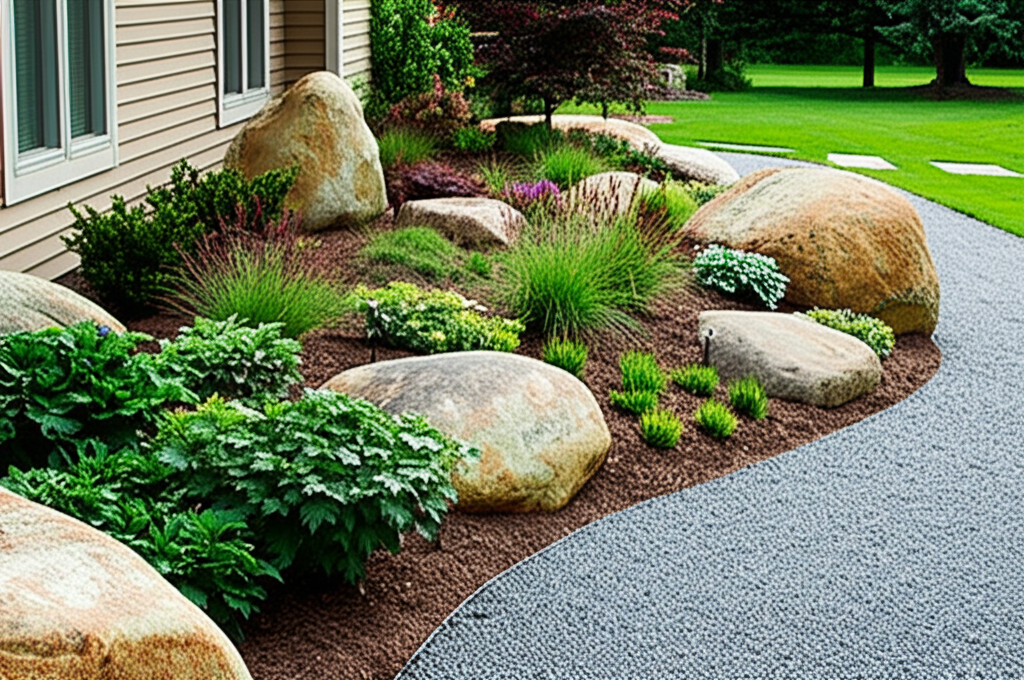
At Roberts Construction Company, we specialize in the expert selection, placement, and installation of boulders and natural stone for both functional and aesthetic purposes.
Boulder work combines the raw beauty of natural stone with practical applications to solve landscape challenges, create visual interest, and enhance your property's value. Our skilled team uses specialized equipment and techniques to safely and precisely place boulders of all sizes.
From creating dramatic focal points in your landscape to building natural-looking retaining walls, our boulder work services transform ordinary spaces into extraordinary outdoor environments.
Benefits of Professional Boulder Work
Incorporating boulders into your landscape offers numerous advantages beyond their visual appeal.
Boulders add organic beauty and timeless appeal to your landscape, creating a connection with the natural environment.
Unlike manufactured materials, boulders withstand decades of exposure to the elements without deteriorating or losing their appeal.
Boulder installations require virtually no maintenance, saving you time and money over the lifetime of your landscape.
Boulder Work Applications
Discover the many ways we can incorporate boulders into your landscape to solve challenges and create stunning features.
Natural stone retaining walls that blend with the landscape while providing structural support for sloped areas.
Strategic placement of decorative boulders to create visual interest and natural focal points in your landscape.
Boulder installations that prevent soil erosion on slopes, shorelines, and other vulnerable areas.
Custom boulder arrangements for waterfalls, ponds, and streams that create stunning natural water features.
Natural stone steps and pathways that provide safe, attractive access through your landscape.
Custom boulder arrangements that create natural seating and gathering spaces for outdoor enjoyment.
How a Boulder Job Actually Runs
Most clients picture boulder work as "drop the rock and walk away." It isn't. A boulder placed wrong looks wrong forever, and a boulder retaining wall built without geogrid and a base drain will fail in five winters. Here is what the work actually looks like.
1. Site walk and sizing
We walk the property, look at the slope, the soil, and the visual lines you want the stone to follow. Eastern Connecticut lots usually come with their own vocabulary of glacial erratics already on site — sometimes the right move is to use what's there. We also pull wetlands maps before quoting; anything inside a regulated buffer changes the permit and the placement options.
2. Stone selection
We pull from local glacial erratics, salvage from job sites, and Sterling-area granite quarries depending on what the design needs. For retaining walls we specify roughly cubic boulders in the 1-to-3-ton range with at least one flat face. For landscape accents we pick for character — moss, lichen, weathered faces. Picking on the ground beats picking off a phone photo.
3. Base prep
Boulder retaining walls get a 12-inch crushed stone base trenched below frost depth, with a perforated 4-inch base drain running to daylight. Landscape boulders get less prep — usually a stone-cradle bed dug a foot below the finished grade so the boulder seats and doesn't look perched. Either way, the base does more work than people realize.
4. Placement and rotation
Excavator with thumb sets the boulder rough. Final positioning runs by hand-signal — rotate the stone until the face presents the way it should, the flat side beds in, and the visual line matches the others in the run. A retaining-wall run gets backfilled in 6-inch lifts with crushed stone, geogrid every other course on anything over four feet tall.
5. Finish grading and stabilization
Final grade flows up to the boulder so it looks like it grew there, not like it was set there last Tuesday. Slopes above and below get stabilized — seed and straw at minimum, erosion blanket on anything steeper than 2:1. We come back after the first rain to check that the base drain is daylighting and that the finish grade is shedding water away from the wall.
Boulder Work — Common Questions
- Where do the boulders come from?
- Most of our boulder work in eastern Connecticut uses local glacial erratics — the granite boulders that the last ice sheet dropped across the region — sourced from active or salvage job sites. For specific shapes and colors, we also pull from Sterling-area granite quarries and from regional stone yards. Local stone is cheaper to deliver and looks right in a New England landscape; we generally don't truck stone in from out of state unless the design calls for something specific.
- What size boulders can you place?
- Anything from a 200-pound landscape accent up to multi-ton armor stone. Single boulders in the 1-to-4-ton range cover most retaining-wall and feature work. Larger pieces (6 tons and up) are used for armor stone, bank stabilization, and structural retaining. The limit is access and equipment rating, not weight itself — we'll spec the right machine for the boulder size and the site conditions.
- Do I need a permit for boulder work on my property?
- Most decorative boulder placement on private property doesn't need a permit. Boulder retaining walls over four feet tall, anything within a regulated wetlands buffer, and shoreline armoring typically do — town inland wetlands review for in-buffer work, sometimes a building permit for structural walls. We handle the permit pull when one is required.
- How do you actually place a multi-ton boulder?
- Excavator with thumb attachment for picks under 10 tons. Bigger pieces get a crane. Final positioning is done with the boulder set on a small pile of crushed stone, then rotated by hand-signal pressure from the machine until the face presents the way it should. The right-looking placement is rarely the first try.
- Will the boulders shift or settle over time?
- Properly set, no. The key is undermining the boulder into a compacted base course, not just dropping it on topsoil. Once it's seated, the weight does the rest — a properly-placed 4-ton boulder isn't going anywhere short of frost-heave in a soft underlying bed. Boulder retaining walls get geogrid reinforcement and a base drain so they hold their batter through the freeze-thaw cycle.
Ready to Get Started? Get Your Free Estimate Today
Contact us now for professional boulder work services in Sterling CT. Free estimates available.
Related excavation services
Most sites need more than one scope. These services are commonly scheduled together with the work on this page.
- Sitework & land clearingRough clearing, access, and prep before foundations or utilities.
- Driveway excavationSubgrade, stone base, and drainage before paving or gravel.
- Patio excavationPads and tiers for hardscape and outdoor living.
- Pool excavationDig, benching, and spoils for inground pool shells.
- Deck foundation excavationPiers, sonotubes, and grade beams for elevated decks.
- Retaining wallsExcavation and backfill for segmental, stone, and concrete walls.
Where we run this work
We run this scope across 15 eastern Connecticut and western Rhode Island towns.
- Sterling, CTHome town · granite ledge, wells & septic
- Plainfield, CTFour villages · river-valley site work
- Norwich, CTNPU water & sewer · six neighborhoods
- Willimantic, CTThread City mill-era foundations
- Killingly, CTDanielson borough · eight villages
- Putnam, CTQuinebaug-side downtown · antiques district
- Brooklyn, CTRural agricultural lots · farm work
- Canterbury, CTRoute 14 + 169 · wetland-heavy
- Griswold, CTJewett City borough · Pachaug
- Lisbon, CTThree highways · three job profiles
- Coventry, RISuburban east · rural west of 102
- Foster, RIRural acreage · RIDEM-permitted
- Glocester, RIChepachet · Harmony · West Glocester
- Scituate, RIProvidence Water watershed
- West Greenwich, RII-95 corridor · large-acreage
Ready to Start Your Project?
Contact us today for a free consultation and estimate. Our team is ready to help with your construction needs.